Worked examples
Two examples
Example 1
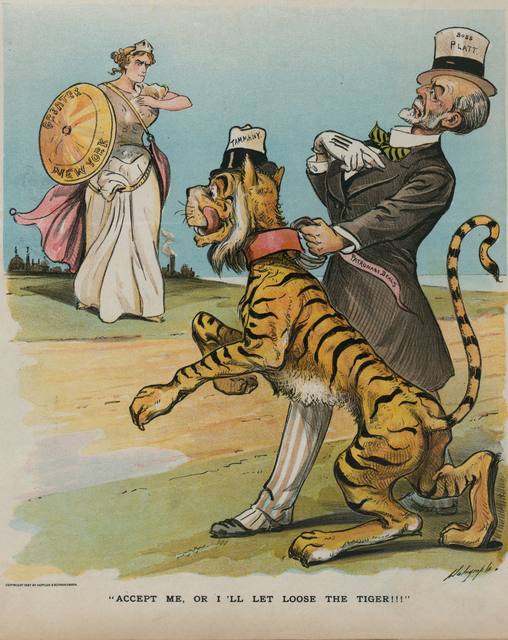
The cover of Puck, June 2, 1897, by Louis Dalrymple. An old man in a top hat marked “BOSS PLATT” holds a hungry tiger by its collar. The tiger wears a small hat marked “TAMMANY.” A pink ribbon hanging from the man’s coat is marked “PATRONAGE DEALS.” Facing them stands a woman in a long gown, holding a shield marked “GREATER NEW YORK.” The caption: “ACCEPT ME, OR I’LL LET LOOSE THE TIGER!!!” Background: Thomas C. Platt was the boss of New York’s Republican Party. (In politics, a boss was the leader of a party organization. He handed out city jobs and favors, and in return people voted the way he wanted.) In 1898 the five boroughs were to be joined into one city, Greater New York.
B. Tammany Hall, the Democratic Party organization of New York City
C. the new city of Greater New York
D. Boss Platt
- Skills Quiz 6 gives four things to read, and the first is the words. So before looking at the animal, read every label.
- The tiger wears a hat marked “TAMMANY.” Tammany Hall was the Democratic Party organization that ran much of New York City politics. Cartoonists drew it as a tiger so often that the tiger became its symbol, the way the eagle stands for the country.
- Now test each choice against the picture.
- A takes the symbol literally. There is no zoo, and a real tiger would not wear a hat with a party’s name on it. This is the classic trap: reading the symbol as the thing itself.
- C, Greater New York, is a different figure: the woman holding the shield with that name. D, Boss Platt, is the man holding the collar. Each figure in a cartoon is labeled for a reason; match the label to the figure.
- So the answer is B. Notice what the artist chose: a hungry, snarling animal held back only by Platt’s hand. A tiger stands for danger. The artist is saying that Tammany is dangerous, and that Platt is using that danger as a threat.
Answer: B
Example 2
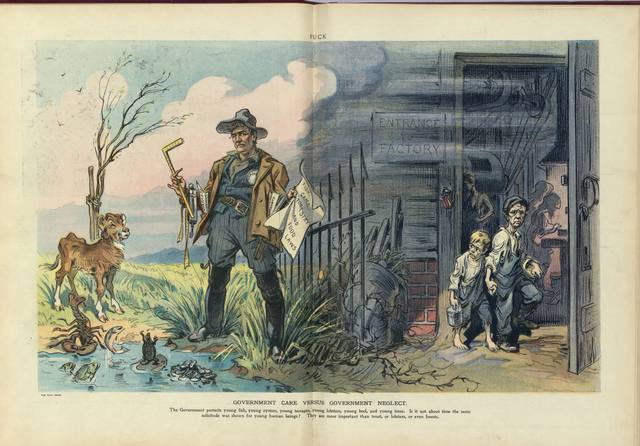
A two-page cartoon from Puck, February 5, 1913, by Udo J. Keppler. On the left, in sunshine, a strong man with a badge marked “WARDEN” carries measuring tools and a paper marked “FISH, GAME, FORESTRY AND FOOD LAWS.” Around him are a young tree tied to a stake, a calf, and a pond with young fish, a lobster, a turtle, and oysters. On the right, in dark smoke, two thin, ragged boys come out of a door marked “ENTRANCE TO FACTORY.” The caption: “GOVERNMENT CARE VERSUS GOVERNMENT NEGLECT.”
B. the factory owner
C. the government’s care for young animals and trees
D. the father of the two boys
- Start with the labels on and around the man. His badge says “WARDEN.” A warden is an officer who enforces rules, as a game warden enforces the laws about hunting and fishing. His paper says “FISH, GAME, FORESTRY AND FOOD LAWS.”
- Then look at what surrounds him: a young tree tied to a stake so it grows straight, a healthy calf, and a pond of young fish and shellfish. Everything near him is young, and everything is looked after.
- Now read the caption: “GOVERNMENT CARE VERSUS GOVERNMENT NEGLECT.” The left side is the care. The man stands for the government, caring for young animals and trees through its laws.
- A takes the figure literally. He carries no rod, and his paper is a list of laws, not a fishing license.
- B and D place him on the wrong side of the picture. The factory and the boys are on the right, in the smoke, with no one caring for them. Nothing connects the warden to the factory or to the boys’ family.
- So the answer is C. Notice the exaggeration too: the warden is big, strong, and standing in sunshine; the boys are thin and walking out of darkness. The artist uses light, dark, and size to make the comparison you are meant to see.
Answer: C
Where this is taught: Skills Quiz 6, Cartoons and pictures: First, the idea · Skills Quiz 6: the worked example · Skills Diagnostic, Part 6
In your Kaplan book: Unit 3, Chapter 1, Lesson 3: Analyze Author's Purpose and Point of View · Map of the Terrain, topic 6: Cartoons and pictures
The drill
Ten questions
How many:
Read what is in the box first. Then tap your answer; a few questions ask you to choose words from a drop-down instead, the way the GED test does. Press Check my answers at the bottom.Read what is in the box first. Circle your answer; where there are brackets, circle the choice that fits. The answer key, with the reasoning, is on the last page.