Worked examples
Two examples
Example 1
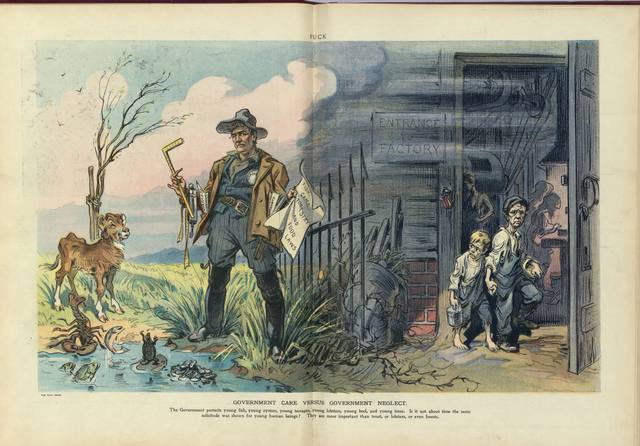
A two-page cartoon from Puck, February 5, 1913, by Udo J. Keppler. On the left, in sunshine, a strong man with a badge marked “WARDEN” carries measuring tools and a paper marked “FISH, GAME, FORESTRY AND FOOD LAWS.” Around him are a young tree tied to a stake, a calf, and a pond with young fish, a lobster, a turtle, and oysters. On the right, in dark smoke, two thin, ragged boys come out of a door marked “ENTRANCE TO FACTORY.” The caption: “GOVERNMENT CARE VERSUS GOVERNMENT NEGLECT.”
The words printed under the caption
Which statement would the artist most likely agree with?A. The government had laws to protect fish and game.The Government protects young fish, young oysters, young terrapin, young lobsters, young beef, and young trees. Is it not about time the same solicitude was shown for young human beings? They are more important than trout, or lobsters, or even forests.
B. The government should protect children at least as well as it protects young animals.
C. Children are safer in factories than outdoors.
D. Lobsters are more important than forests.
- The question is not “what is true?” and not “what do I think?” It is “what is this picture arguing for?”
- Find the argument in the words first. The caption sets two things against each other: government care and government neglect. The lines below it ask, “Is it not about time the same solicitude was shown for young human beings?” Solicitude means careful concern.
- Then the picture: care and sunshine for a calf and young fish on the left; smoke, a factory door, and two thin boys on the right.
- A is true, and the picture even shows the paper of laws. But it is a fact the artist uses, not the point he makes. True, but not the argument.
- C is the opposite of the argument. The boys come out of the factory thin and ragged, in the dark.
- D twists the words. The printed lines say young human beings “are more important than trout, or lobsters, or even forests.” They do not compare lobsters with forests.
- So the answer is B. Everything in the cartoon points the same way: the government already knows how to protect the young; it should protect children too. In 1913, many states still allowed children to work in factories.
Answer: B
Example 2
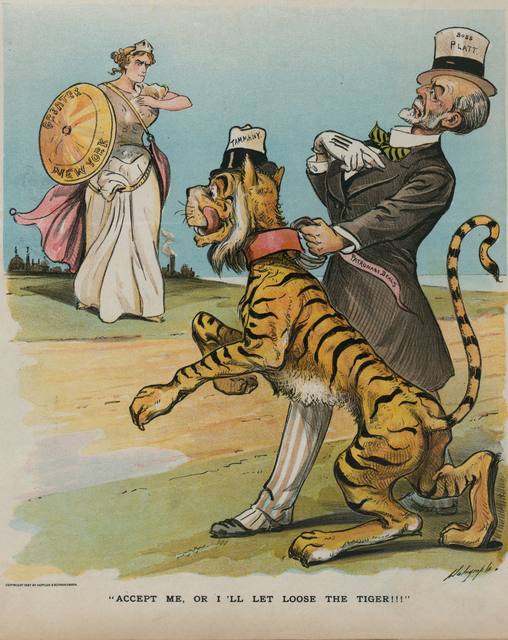
The cover of Puck, June 2, 1897, by Louis Dalrymple. An old man in a top hat marked “BOSS PLATT” holds a hungry tiger by its collar. The tiger wears a small hat marked “TAMMANY.” A pink ribbon hanging from the man’s coat is marked “PATRONAGE DEALS.” Facing them stands a woman in a long gown, holding a shield marked “GREATER NEW YORK.” The caption: “ACCEPT ME, OR I’LL LET LOOSE THE TIGER!!!” Background: Thomas C. Platt was the boss of New York’s Republican Party. (In politics, a boss was the leader of a party organization. He handed out city jobs and favors, and in return people voted the way he wanted.) In 1898 the five boroughs were to be joined into one city, Greater New York.
B. who won the 1897 election for mayor
C. what Puck argued about Boss Platt in 1897
D. how many people lived in Greater New York
- First name the cartoon’s point. Platt holds back the Tammany tiger and tells the city, “ACCEPT ME, OR I’LL LET LOOSE THE TIGER!!!” The ribbon hanging from his coat says “PATRONAGE DEALS.” Patronage is the giving of government jobs to political friends.
- So the argument is that Platt is using a threat: let him and his deals run the new city, or Tammany will. The artist presents both men as bad choices held over the city’s head.
- Now Quiz 2’s question: primary for what? A cartoon is a primary source for the argument, made at the time by one artist and one magazine, not for the facts the argument is about.
- A takes the symbol literally. There was no tiger.
- B asks for a fact the cartoon cannot give. It was printed in June, before the November election. In fact Tammany’s candidate, Robert Van Wyck, won and became the first mayor of Greater New York, but you would learn that from election records, not from this cover.
- D asks for a number. The cartoon gives none; a census would.
- So the answer is C. The cover is excellent evidence of what Puck wanted New Yorkers to think about Platt in 1897.
Answer: C
Where this is taught: Skills Quiz 6, Cartoons and pictures: First, the idea · Skills Quiz 6: the worked example · Skills Diagnostic, Part 6
In your Kaplan book: Unit 3, Chapter 1, Lesson 3: Analyze Author's Purpose and Point of View · Map of the Terrain, topic 6: Cartoons and pictures
The drill
Ten questions
How many:
Read what is in the box first. Then tap your answer; a few questions ask you to choose words from a drop-down instead, the way the GED test does. Press Check my answers at the bottom.Read what is in the box first. Circle your answer; where there are brackets, circle the choice that fits. The answer key, with the reasoning, is on the last page.