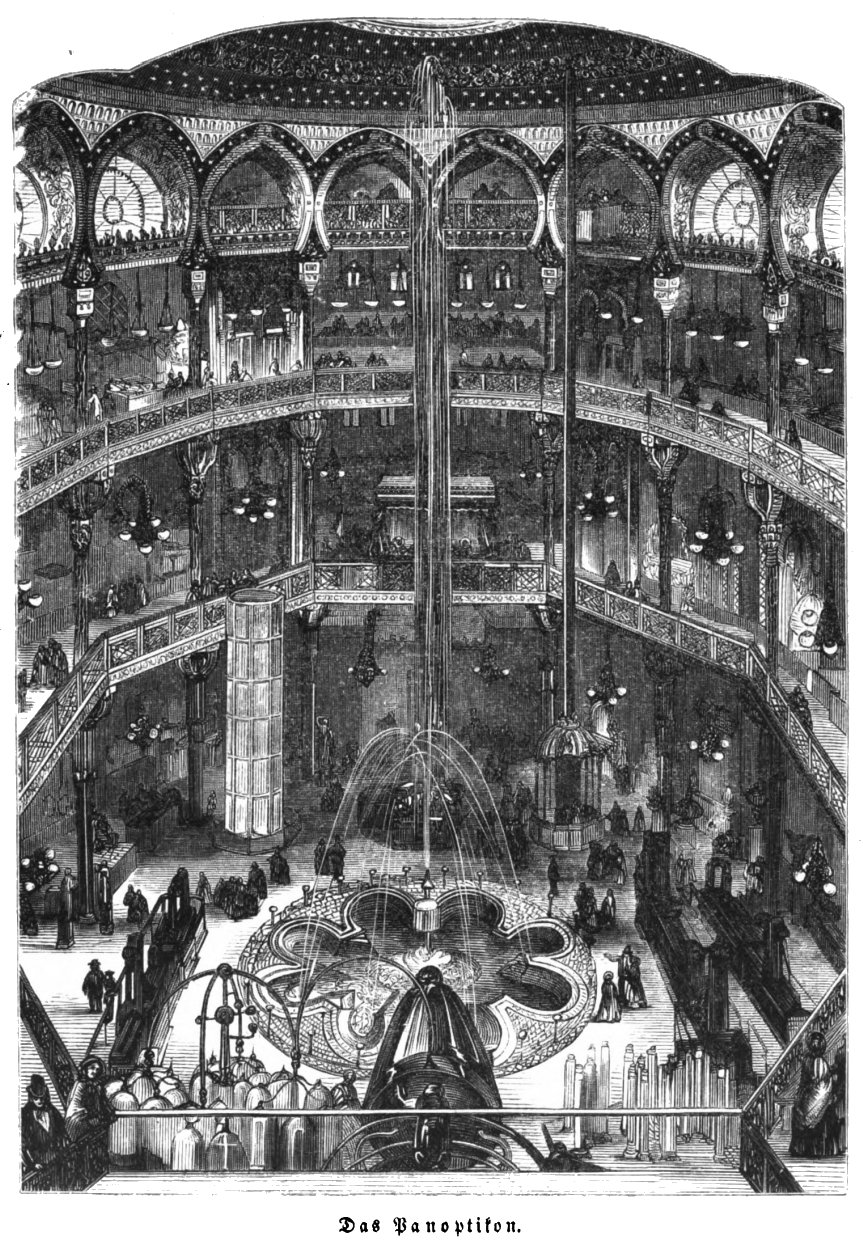
Panopticon means all-seeing — after Argus Panoptes, the hundred-eyed giant of the myth. Jeremy Bentham gave the name to a prison: a tower from which every cell could be watched at once, the design that gave surveillance its shape and its word.
But in 1854, London gave the same name to a palace of delight. The Royal Panopticon of Science and Art rose on Leicester Square, and for a shilling the public came in to watch electricity spark and a fountain leap a hundred feet to the dome — the Victorians called it recreational learning. The venture failed in two years and became a music hall; the ground it stood on is a cinema still, the Odeon on Leicester Square.
Forty years later, in New York, Woodville Latham and his sons gave the name a third time — to the first moving pictures ever thrown on an American screen — before rechristening the machine the Eidoloscope, from eidolon: the image, the visible form.
The all-seeing eye, turned inside out — from the watching of the watched, to the people gathered to watch, to the flickering picture itself. Find a seat. Call it three pennies.
This is the room where The People’s Share keeps its moving pictures and the writing that walks beside them. The Call to the Commons maps the argument; here you meet the living players, and now and then simply marvel at the machines.
The register is deliberately lighter — the history of invention, the wonder of the switched-on device — carried alongside the harder questions rather than in place of them. A movement that only warns will tire the people it needs; one that also delights, that remembers technology was once a marvel the whole street lined up to see, keeps them. Every exhibit pairs something to watch with something to read: word and world, motion and ink.
The Builders, and the Broker
Altman, Amodei, Hassabis, Schmidt — four figures shaping what AI becomes, each with an accessible video to meet them by, and a note on where they stand in the argument over who owns the abundance. Take a seat →
The Watchers, and the Godfather
Hinton, Gebru, Buolamwini, Raji, Li — the builder who crossed over to warn, the three who caught the machines misreading faces, and the teacher of both the machines and their watchers. Take a seat →
The AI Doc: Or How I Became an Apocaloptimist
Daniel Roher and Charlie Tyrell’s documentary — Focus Features, March 2026; Altman, both Amodeis, Hassabis, Bender, Gebru, Bengio, and Diamandis across one screen — built to create what Tristan Harris calls common knowledge: everyone knowing that everyone else knows there’s a problem. It ends with a shrug and a hope, which is honest; the question is what fills the space the shrug leaves open. The film is the first circle, the regulators’ roadmap the second; the ownership argument next door is the third.