What this guide is for
This guide is about cells, the tiny living units that every living thing is made of. It starts with what a cell is and how small it is. Then it explains the two basic kinds of cells, the parts inside a cell and the job of each part, how plant cells differ from animal cells, and how materials move into and out of a cell.
It is a longer version of Part 4 of the Life Science Start Here page. If the class has already read Part 4, you will recognize the ideas here; this guide goes slower and gives more examples.
Part 3, on the two kinds of cells, is where the class left off reading. If you are short on time, read Parts 1 and 2 quickly and give Part 3 your full attention.
At the end there are questions that check themselves, and a list of the terms used in the guide.
Goes with: Two Kinds of Cells · Made to Order · Look Again Quiz 9: The Cell · Quiz 10: The Membrane
In this guide:
What a cell is, and how small
A cell is the smallest unit that is alive on its own. A cell takes in food or energy, uses it, gets rid of waste, responds to what is around it, and can make more cells. Nothing smaller than a cell can do all of these things by itself.
Some living things are just one cell. A single bacterium is a whole living thing, and so is a single yeast cell (yeast is the tiny living thing that makes bread dough rise). These are called single-celled organisms. An organism is simply one complete living thing.
Other living things are made of a great many cells working together. These are called multicellular organisms ("multi" means many). A tree, a pigeon, and you are all multicellular. Scientists estimate that a human body has about 30 trillion cells. In a multicellular organism, cells take on different jobs: a muscle cell can shorten to pull on a bone, a nerve cell carries signals, and a red blood cell carries oxygen.
How small is a cell?
Most cells are far too small to see without a microscope, a tool that uses lenses to make small things look much larger.
To measure cells, scientists use a very small unit called the micrometer. A micrometer is one thousandth of a millimeter. A millimeter is the smallest space marked on a metric ruler, a little more than the thickness of a credit card. So if you took one of those tiny millimeter spaces and cut it into a thousand equal slices, each slice would be one micrometer wide.
Here are some sizes, step by step:
- Most of the cells in your body are somewhere between about 10 and 30 micrometers across.
- A red blood cell is about 7 or 8 micrometers across.
- A typical bacterium is only 1 to 5 micrometers long. Bacteria are much smaller than your own cells.
- One of the largest human cells is the egg cell, about a tenth of a millimeter (100 micrometers) across. It is just barely large enough to see as a tiny speck without a microscope.
How many cells would fit across the period at the end of this sentence?
Start with a millimeter. If a typical body cell is about 10 micrometers wide, then 100 of them in a row make 1,000 micrometers, which is 1 millimeter. So a row of about 100 of your cells, side by side, would just stretch across the smallest space on a ruler.
Now the period. A period printed in an ordinary book is much smaller than a millimeter; it is roughly a third of a millimeter across, depending on the size of the type. A third of 100 is about 33. So a row of roughly 30 of your cells could sit side by side across one printed period.
Bacteria are smaller still. A row of a hundred or more bacteria could fit across the same period.
A cell is the smallest unit that is alive on its own. Some living things are a single cell; others, like you, are made of trillions of cells. Most cells can be seen only with a microscope.
Think it through. A student says, "A cell is too small to matter. What matters is the whole body." Using what you just read, how would you answer?
Show a model answer
Every part of the body is made of cells, and every job the body does is done by cells. Muscles move because muscle cells shorten; oxygen reaches the body because red blood cells carry it. The cell is the smallest unit that is alive, so the life of the whole body is the work of its cells added together.
The cell theory
By the middle of the 1800s, after about two hundred years of looking at living things through microscopes, scientists had put what they learned about cells into three statements. Together these statements are called the cell theory.
The cell theory: (1) All living things are made of one or more cells. (2) The cell is the basic unit of life. (3) All cells come from cells that already existed.
Here is what each statement means in plain words.
1. All living things are made of cells. A mushroom, a blade of grass, a mosquito, and a person are all made of cells. If something is not made of cells, it is not a living thing. (This is why most scientists say a virus is not alive: a virus is not a cell.)
2. The cell is the basic unit of life. "Basic unit" means the smallest piece that still counts as the real thing. You can break a cell into its parts, but none of the parts can live on its own. Life starts at the level of the cell.
3. All cells come from cells that already existed. A new cell is made only when an existing cell divides in two. Cells do not form out of nonliving material. Every one of your 30 trillion cells came, by division after division, from one fertilized egg cell.
The word "theory" in science does not mean a guess. A scientific theory is a broad explanation that has been tested many times and is supported by a large amount of evidence. The cell theory is one of the best-supported ideas in biology.
The cell theory was built up over about two hundred years, by people with microscopes who looked carefully and argued about what they saw. That story, from the first person to name the cell to the experiments that settled the third statement, is told in the study guide The History of the Cell Theory.
Practice
Choose an answer, then press Check. The explanation opens either way.
Which statement is part of the cell theory?
All cells come from cells that already existed: this is the third statement of the cell theory. The first choice says the opposite, and it is the old idea that the cell theory replaced.
A scientist finds a new kind of particle in pond water. It is not made of cells. What does the cell theory say about it?
It is not a living thing, because all living things are made of cells. "A single-celled organism" is tempting because it is tiny and lives in water, but a single-celled organism is still a cell, and this particle is not.
Two kinds of cells: prokaryotic and eukaryotic
This part is the most important one in the guide. Take it slowly.
All cells share four things. Every cell has:
- a cell membrane: a thin, flexible outer layer that surrounds the cell and controls what goes in and out;
- cytoplasm: the jelly-like material that fills the cell;
- DNA: the chemical that carries the cell’s instructions;
- ribosomes: tiny structures that build proteins, following the instructions in the DNA.
Beyond these four shared things, cells come in two basic kinds. The difference between them is where the cell keeps its DNA.
Prokaryotic cells: no nucleus
A prokaryotic cell (say pro-KAIR-ee-OT-ik) has no nucleus. A nucleus is a compartment inside a cell, with its own membrane around it, that holds the DNA. A prokaryotic cell has no such compartment. Its DNA, usually one long loop, sits in the cytoplasm with nothing wrapped around it.
A prokaryotic cell also has no other compartments with membranes around them. Inside, it is one open space. It does have a membrane, cytoplasm, ribosomes, and DNA, like every cell. Most prokaryotes also have a stiff cell wall outside the membrane, which holds the cell’s shape.
A living thing made of a prokaryotic cell is called a prokaryote. Prokaryotes are always single-celled, and they are small: usually 1 to 5 micrometers long. There are two groups of prokaryotes: bacteria and archaea (say ar-KEE-uh). Part 4 explains the difference between them.
Eukaryotic cells: DNA inside a nucleus
A eukaryotic cell (say you-KAIR-ee-OT-ik) keeps its DNA inside a nucleus. It also has many other small compartments, each with a membrane around it and each doing a particular job. These small parts are called organelles, which means "little organs." Just as your stomach and heart are organs that do jobs for your body, organelles do jobs for the cell. Part 5 goes through them one by one.
Eukaryotic cells are usually much larger than prokaryotic cells: often 10 to 100 micrometers across, which can be ten or more times as wide as a bacterium.
A living thing made of eukaryotic cells is called a eukaryote. There are four groups of eukaryotes:
- animals, including people, pigeons, and cockroaches;
- plants, from street trees to the basil on a windowsill;
- fungi, such as mushrooms, mold, and yeast;
- protists, a mixed group that is mostly single-celled, such as the amoeba, a tiny living thing found in pond water.
Notice that being single-celled does not make something a prokaryote. Yeast and amoebas are single cells, but each of those cells has a nucleus, so they are eukaryotes. The question to ask is always: does the cell have a nucleus?
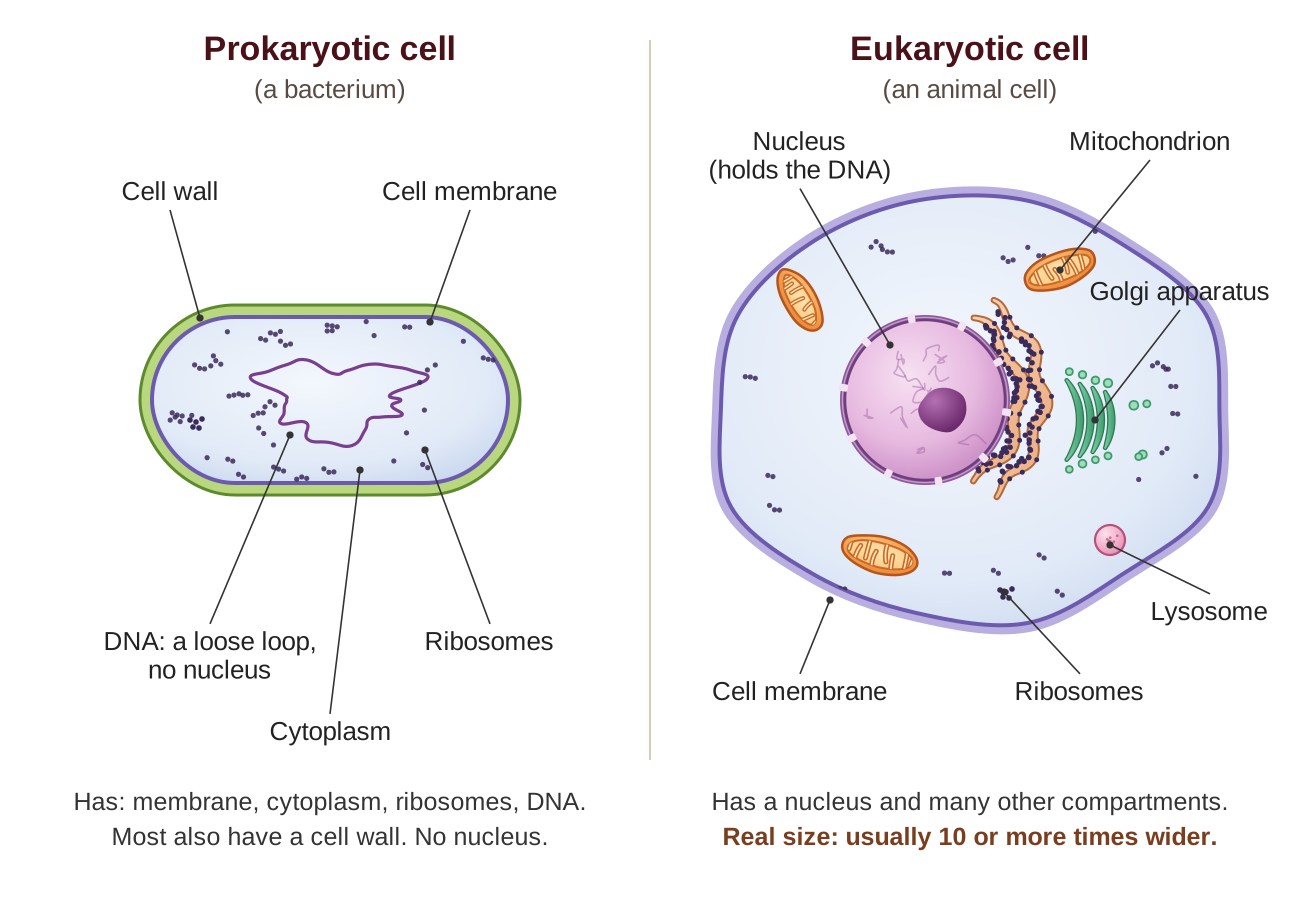
The names come from Greek. Karyon means kernel or nut, and here it stands for the nucleus. Pro means before, and eu means true or good. So a prokaryote is "before a nucleus": it has none. A eukaryote has a "true nucleus." Another way: pro sounds like "no," and eu sounds like "do": prokaryotes have no nucleus, eukaryotes do.
| Prokaryotic cell | Eukaryotic cell | |
|---|---|---|
| Nucleus | No | Yes |
| Where the DNA is | Loose in the cytoplasm | Inside the nucleus |
| Cell membrane | Yes | Yes |
| Cytoplasm | Yes | Yes |
| Ribosomes | Yes | Yes |
| Organelles with membranes (such as mitochondria) | No | Yes |
| Usual size | 1 to 5 micrometers | 10 to 100 micrometers |
| Single-celled or many cells? | Always single-celled | Either |
| Examples | Bacteria and archaea | Animals, plants, fungi, protists |
A cell has a membrane, cytoplasm, ribosomes, and DNA. The DNA is not inside a nucleus. What kind of cell is it?
Go through the list one item at a time. A membrane, cytoplasm, ribosomes, and DNA are found in every cell, so those four do not tell you which kind this is.
The only useful clue is the last one: the DNA is not inside a nucleus. A cell with no nucleus is a prokaryotic cell. It could be a bacterium or an archaeon (one of the archaea).
The habit to build: most of what a question tells you about a cell is shared by all cells. Look for the one feature that only some cells have.
A yeast cell is one single cell. Is it a prokaryote?
It is tempting to say yes, because it is a single cell. But the question to ask is whether it has a nucleus. A yeast cell does have a nucleus, because yeast is a fungus. So it is a eukaryote, even though it is a single cell.
Prokaryotes do have DNA. "No nucleus" does not mean "no DNA." It means the DNA has no compartment around it.
A prokaryotic cell has no nucleus; its DNA is loose in the cytoplasm. Bacteria and archaea are prokaryotes. A eukaryotic cell keeps its DNA inside a nucleus and has many organelles. Animals, plants, fungi, and protists are eukaryotes.
Practice
Choose an answer, then press Check. The explanation opens either way.
Which of these is found in BOTH prokaryotic and eukaryotic cells?
Ribosomes. Every cell needs to build proteins, so every cell has ribosomes. A nucleus is the tempting wrong answer for people who remember that prokaryotes have DNA, but they keep that DNA loose, with no nucleus around it.
A mushroom cell has a nucleus. What kind of cell is it?
Eukaryotic. A cell with a nucleus is eukaryotic, and fungi such as mushrooms are eukaryotes. "Prokaryotic" would be right only if the cell had no nucleus.
What is the main difference between a prokaryotic cell and a eukaryotic cell?
Only eukaryotic cells keep their DNA in a nucleus. "Only eukaryotic cells have DNA" is the most common mistake: both kinds have DNA; the difference is where it is kept.
The three domains of life
Scientists sort all living things into groups. The largest groups of all are called domains. There are three domains of life: Bacteria, Archaea, and Eukarya.
Bacteria
Bacteria are single-celled prokaryotes. They live almost everywhere: in soil, in water, on your skin, and inside your gut, where many kinds help you digest food. A few kinds cause disease, such as the bacteria that cause strep throat. Most bacteria have a cell wall made with a material called peptidoglycan (say pep-tid-oh-GLY-kan).
Archaea
Archaea are also single-celled prokaryotes. Under a microscope they look a lot like bacteria: small, with no nucleus. For a long time they were counted as bacteria.
In the 1970s, the American scientist Carl Woese compared the genes of many prokaryotes and found that they fell into two very different groups. One group was the bacteria. The other group, the archaea, differs from bacteria in its chemistry and its genes. For example, archaea have no peptidoglycan in their cell walls; their walls are made of other materials. Their cell membranes are built from different fat-like molecules too.
Many archaea live in places where almost nothing else can, such as boiling hot springs and very salty lakes. But archaea also live in ordinary places, such as soil, the ocean, and the human gut.
Eukarya
Eukarya are all the living things made of eukaryotic cells: animals, plants, fungi, and protists. Every living thing you can see without a microscope belongs to this domain, and so do many single-celled things you cannot see, such as yeast and amoebas.
| Domain | Kind of cell | Single-celled or many cells? | Examples |
|---|---|---|---|
| Bacteria | Prokaryotic (no nucleus) | Single-celled | The bacteria in yogurt; the bacteria that cause strep throat |
| Archaea | Prokaryotic (no nucleus) | Single-celled | Archaea in hot springs, salt lakes, soil, and the gut |
| Eukarya | Eukaryotic (has a nucleus) | Either | Animals, plants, fungi, protists |
Older books sort living things into five or six kingdoms instead, such as the animal kingdom and the plant kingdom. The domains are a larger and newer grouping. The kingdoms fit inside the domains: animals, plants, and fungi, for example, are all inside the domain Eukarya.
The three domains of life are Bacteria, Archaea, and Eukarya. Bacteria and Archaea are both prokaryotes, but they differ in their chemistry and genes. Eukarya includes every living thing whose cells have a nucleus.
Think it through. A student says, "Archaea are just bacteria that live in hot water." What is wrong with this statement?
Show a model answer
Two things. First, archaea are not bacteria. They look similar, but their genes and chemistry are different; for example, their cell walls have no peptidoglycan. That is why they have a domain of their own. Second, not all archaea live in hot water. Many live in ordinary places such as soil, the ocean, and the human gut.
The parts of a eukaryotic cell and their jobs
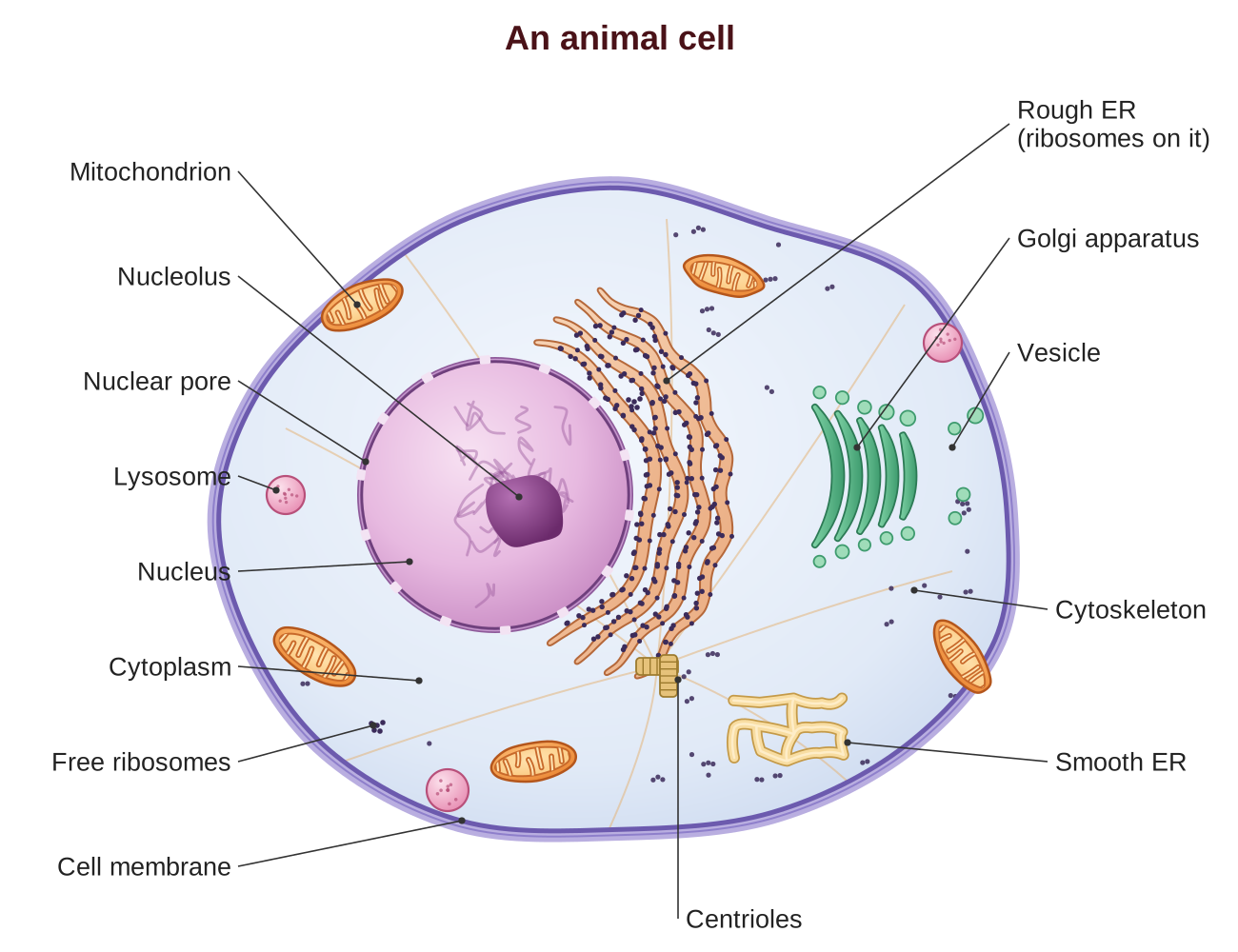
This part goes through the main parts of a eukaryotic cell, one at a time. For each part, it says what the part is and what job it does. The drawing below shows an animal cell with each part labeled. Look back at it as you read.
A real cell is not flat like a drawing. It is a three-dimensional shape, like a tiny water balloon filled with jelly, with the organelles floating in the jelly. And a real cell contains many copies of most parts: hundreds of mitochondria, for example, and millions of ribosomes, where the drawing shows only a few.
Cell membrane
The cell membrane is the thin, flexible layer around the outside of the cell. It is made mostly of a double layer of fat-like molecules, with proteins set into it. The membrane holds the cell together and separates the inside of the cell from the outside.
Its most important job is to control what goes in and what comes out. It lets some things through easily, lets others through only with help, and keeps others out. Part 7 explains how. Every cell, prokaryotic or eukaryotic, has a membrane.
Cytoplasm
The cytoplasm is everything inside the membrane except the nucleus. It is mostly a jelly-like fluid, made mostly of water, with the organelles sitting in it. Many of the cell’s chemical reactions happen in the cytoplasm.
Nucleus
The nucleus is a large, rounded compartment, usually the biggest thing inside an animal cell. It is surrounded by its own membrane, called the nuclear envelope, which has small openings, called pores, that let materials pass in and out.
The nucleus holds the cell’s DNA. Because the DNA carries the instructions for the cell’s work, the nucleus is often described as the part that directs the cell. More exactly, it stores the instructions and sends out copies of them when they are needed.
DNA
DNA is the chemical that carries the instructions for building and running a living thing. It is a very long, thin molecule. A section of DNA that holds the instructions for one particular product, usually a protein, is called a gene.
In a eukaryotic cell, the DNA is kept in the nucleus, divided into several pieces called chromosomes. A human body cell has 46 chromosomes. The study guide Cell Division explains how a cell copies its chromosomes and passes them on when it divides.
Ribosomes
Ribosomes are tiny structures that build proteins. A protein is a large molecule made of a chain of smaller pieces linked together in a particular order. Proteins do most of the work in a cell: some speed up chemical reactions, some carry materials, and some form the cell’s framework.
A ribosome reads a copy of a gene’s instructions and links the pieces of the protein together in the order the instructions give. Ribosomes are so small that they look like dots, even in drawings made from powerful microscopes. Some float free in the cytoplasm. Others are attached to the endoplasmic reticulum, described next. Ribosomes are found in every cell, including bacteria and archaea.
Endoplasmic reticulum (ER)
The endoplasmic reticulum (say en-doh-PLAZ-mik reh-TIK-yoo-lum), or ER for short, is a network of folded membranes that spreads out from the nucleus through the cytoplasm. "Endoplasmic" means inside the cytoplasm, and "reticulum" means little net.
There are two kinds of ER. Rough ER has ribosomes attached to its outside, which makes it look bumpy, or rough, under a microscope. Proteins built by those ribosomes go into the rough ER, where they are folded into their proper shape. Many of these proteins will later be sent out of the cell or placed in the membrane. Smooth ER has no ribosomes. It makes fats and oils for the cell, and in liver cells it helps break down some drugs and poisons.
Golgi apparatus
The Golgi apparatus (say GOAL-jee) is a stack of flattened sacs, like a short stack of pancakes. It is named after Camillo Golgi, an Italian scientist who first described it more than a hundred years ago.
The Golgi apparatus receives proteins from the ER. It finishes them, sorts them, and packs them into tiny bubbles of membrane called vesicles. The vesicles carry the proteins to where they are needed: to other parts of the cell, or to the cell membrane to be released outside. One way to remember it: the Golgi works like the packing and shipping room of a warehouse. What matches is this: items arrive, are finished and labeled, are boxed, and are sent out to the right address.
Mitochondria
Mitochondria (say my-toh-KON-dree-uh; just one is a mitochondrion) are bean-shaped organelles with a smooth outer membrane and a folded inner membrane.
Their job is to release the energy stored in food so that the cell can use it. Inside the mitochondria, sugar from food is broken down using oxygen. This gives off carbon dioxide and water, and the energy that is released is stored in small molecules called ATP. The cell then uses ATP wherever it needs energy, the way you might carry cash to spend wherever you go. This whole process is called cellular respiration.
You may hear mitochondria called "the powerhouse of the cell." That phrase means only that mitochondria are where most of the cell’s usable energy is released. They do not make energy out of nothing: the energy was already stored in the food.
Cells that use a lot of energy, such as muscle cells, have many mitochondria. Plant cells have mitochondria too, because plants also have to release the energy in the sugar they make. The study guide Photosynthesis and Cellular Respiration explains this process in detail.
Lysosomes
Lysosomes (say LY-soh-sohmz) are small sacs filled with chemicals that break things down. These chemicals are enzymes: proteins that speed up a particular chemical reaction, here the reaction that takes a large molecule apart.
Lysosomes break down worn-out parts of the cell, food particles the cell has taken in, and bacteria that some white blood cells swallow. The broken-down pieces can then be reused. Lysosomes are found mainly in animal cells; in plant cells, the large vacuole does much of this work.
Vacuoles
A vacuole (say VAK-yoo-ohl) is a sac, surrounded by a membrane, that stores materials: water, food, or wastes. Animal cells have only small vacuoles, if they have any. Plant cells have one very large vacuole, described in Part 6.
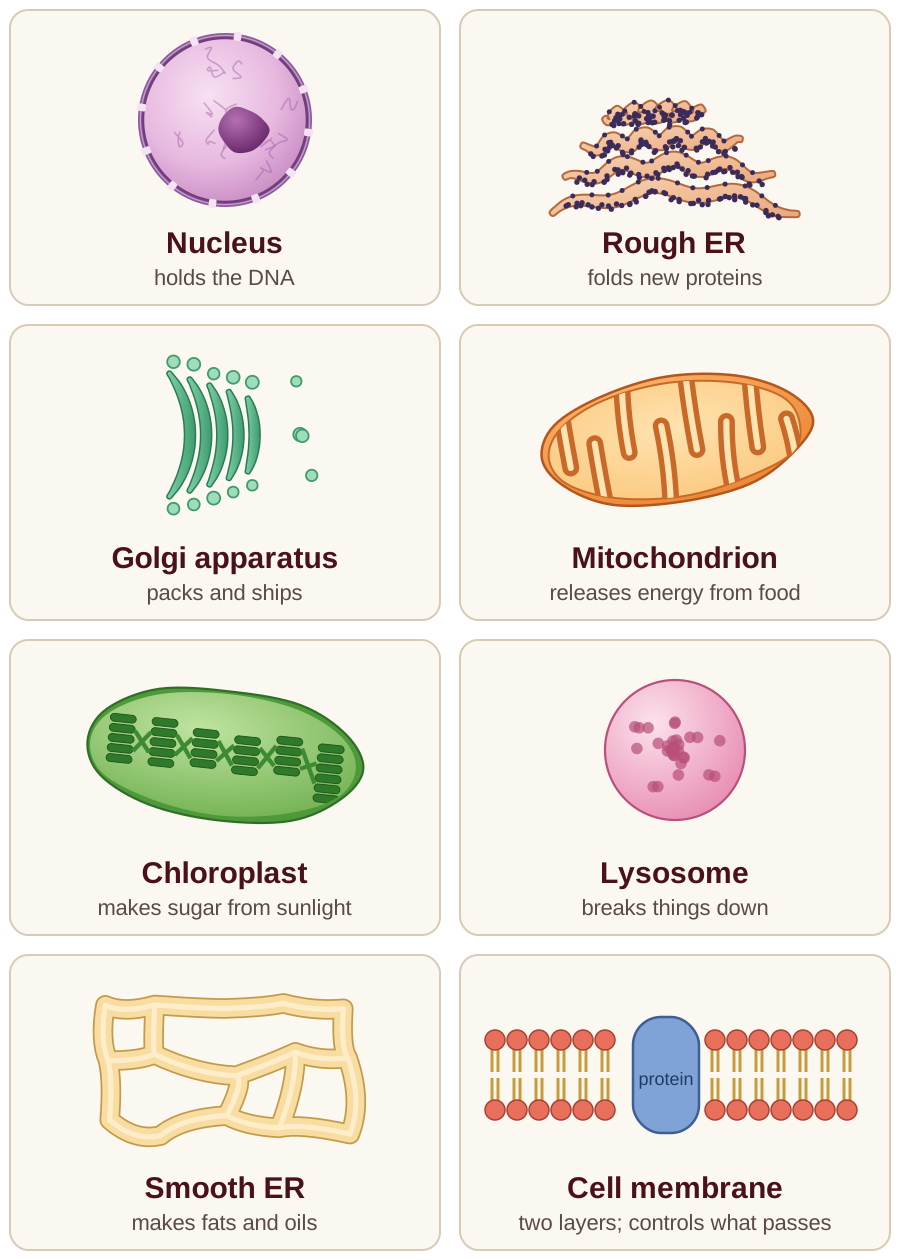
Each part of a cell has a job. The membrane controls what enters and leaves. The nucleus holds the DNA. Ribosomes build proteins. The ER folds proteins and makes fats. The Golgi apparatus finishes, sorts, and ships proteins. Mitochondria release energy from food. Lysosomes break things down. Vacuoles store materials.
| Part | Its job | In prokaryotes too? |
|---|---|---|
| Cell membrane | Controls what enters and leaves | Yes |
| Cytoplasm | Jelly that fills the cell; many reactions happen here | Yes |
| DNA | Carries the instructions | Yes (loose, not in a nucleus) |
| Ribosomes | Build proteins | Yes |
| Nucleus | Holds the DNA | No |
| Endoplasmic reticulum | Folds proteins; makes fats | No |
| Golgi apparatus | Finishes, sorts, and ships proteins | No |
| Mitochondria | Release energy from food (cellular respiration) | No |
| Lysosomes | Break down worn-out parts and food | No |
| Vacuoles | Store water, food, or wastes | No |
Practice
Choose an answer, then press Check. The explanation opens either way.
Which part of the cell releases energy from food so the cell can use it?
The mitochondrion, through cellular respiration. The nucleus is a common wrong answer, because it "directs" the cell; but directing the work is not the same as supplying the energy for it.
A cell in the pancreas makes a protein and sends it out of the cell. Which part packs the protein into vesicles for shipping?
The Golgi apparatus finishes, sorts, and packs proteins into vesicles. The vacuole is tempting because it holds materials, but it stores them; it does not pack them for shipping.
A cell is treated with a chemical that stops its ribosomes from working. What can the cell no longer do?
Build proteins: that is the ribosomes’ job. "Break down worn-out parts" is the job of lysosomes. (The lysosomes’ enzymes are proteins, so in time they would suffer too, but the direct loss is protein building.)
Plant cells and animal cells
Plant cells and animal cells are both eukaryotic. They share almost all the parts in Part 5: a membrane, cytoplasm, a nucleus with DNA, ribosomes, ER, a Golgi apparatus, and mitochondria. But plant cells have three things that animal cells do not.
1. A cell wall
A plant cell has a stiff cell wall outside its cell membrane. The wall is made mostly of cellulose, a tough material built from sugar. (Cellulose is the "fiber" in vegetables that your body cannot digest.) The wall gives the cell a firm, boxy shape and helps hold the whole plant up.
The wall does not replace the membrane. A plant cell has both: the wall on the outside and the membrane just inside it. The membrane is thin, flexible, and controls what enters and leaves. The wall is stiff, gives support, and lets water and small particles pass through it easily. An animal cell has only the membrane.
Plants are not the only living things with cell walls. Most bacteria and archaea have them, and so do fungi. But the walls of each group are made of different materials. So a cell wall alone does not prove that a cell is a plant cell.
2. Chloroplasts
Chloroplasts (say KLOR-oh-plasts) are green organelles that capture the energy of sunlight and use it to make sugar from carbon dioxide and water. This process is called photosynthesis. Chloroplasts are green because they contain a green substance called chlorophyll, which absorbs light. They are the reason leaves are green.
Not every plant cell has chloroplasts. The cells of a leaf have many, but the cells of a root, which grows underground in the dark, usually have none. Animal cells never have chloroplasts, which is why animals must eat to get their food.
3. A large central vacuole
A grown plant cell has one large central vacuole, which can take up most of the space inside the cell. It stores water, along with some food and wastes.
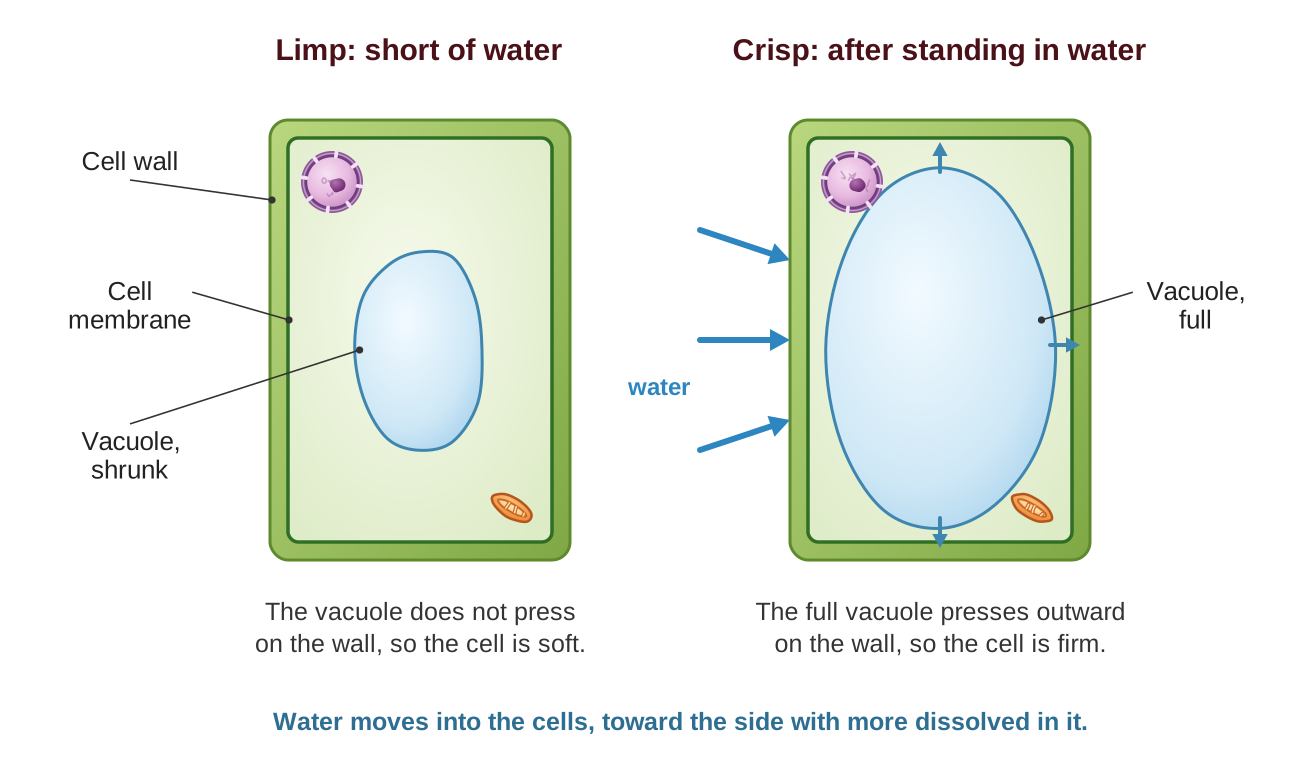
When the vacuole is full, it presses outward against the cell wall. This pressure is what makes a plant firm and upright. When a plant does not get enough water, the vacuoles shrink, the pressure drops, and the plant droops. This drooping is called wilting. Part 7 comes back to this.
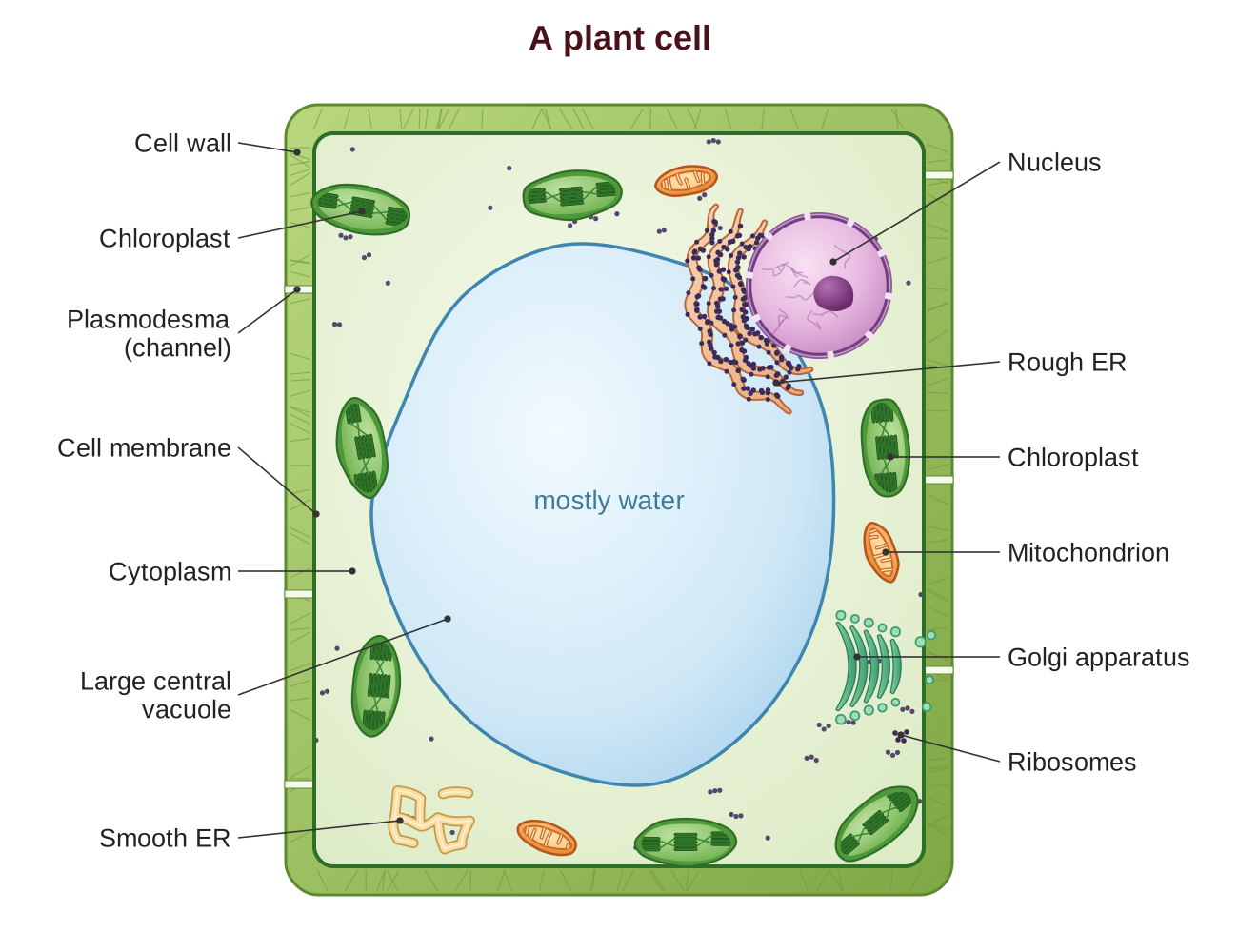
Compare this drawing with the animal cell in Part 5. The plant cell is boxy, because of its wall. The animal cell is rounded, with no wall. The plant cell’s nucleus is pushed to the side by the big vacuole. And only the plant cell has green chloroplasts.
| Part | Plant cell | Animal cell |
|---|---|---|
| Cell membrane | Yes | Yes |
| Nucleus | Yes | Yes |
| Ribosomes, ER, Golgi apparatus | Yes | Yes |
| Mitochondria | Yes | Yes |
| Cell wall | Yes, made mostly of cellulose | No |
| Chloroplasts | Yes, in green parts of the plant | No |
| Vacuole | One large central vacuole | Small ones, if any |
| Lysosomes | Few or none; the vacuole does much of this work | Yes |
| Usual shape | Boxy, with straight sides | Rounded or irregular |
A cell has a nucleus, mitochondria, and a cell wall, but no chloroplasts. Is it a plant cell?
Go one clue at a time. The nucleus shows that it is a eukaryotic cell, so it is not a bacterium or an archaeon. The mitochondria do not help: plant, animal, and fungus cells all have them.
The cell wall is the tempting clue, because plant cells have walls. But fungi have walls too. So the wall alone does not decide it.
The missing chloroplasts point away from a leaf cell, but some plant cells, such as root cells, have no chloroplasts either. So from these clues alone we cannot be sure. It could be a fungus cell, such as yeast, or a plant root cell. To decide, we would need more information, such as what the wall is made of or whether there is a large central vacuole.
The habit to build: one feature that several groups share is weak evidence. Look for a feature that only one group has, or for several features that point the same way.
Plant cells have three things animal cells do not: a cell wall, chloroplasts, and a large central vacuole. Both kinds of cell have a membrane, a nucleus, and mitochondria.
Think it through. Your arm cells and the cells of a lettuce leaf both have mitochondria. Why does a lettuce leaf need mitochondria if it already has chloroplasts?
Show a model answer
Chloroplasts and mitochondria do different jobs. Chloroplasts use sunlight to make sugar, which stores energy. Mitochondria release the energy stored in that sugar so the cell can use it. A plant needs both: one to make its food, and the other to get the energy back out of its food. Having chloroplasts does not mean a cell can skip cellular respiration.
How things move into and out of a cell
The membrane chooses
The cell membrane lets some things pass through it easily, lets others through only with help, and keeps others out. A membrane that works this way is called selectively permeable. "Permeable" means able to be passed through, and "selectively" means by choosing.
Small particles, such as oxygen, carbon dioxide, and water, cross the membrane fairly easily. Larger particles, such as sugar, and particles with an electric charge, such as salt particles in water, cross only through special proteins in the membrane, or not at all.
To understand how things cross, you need one more word. The concentration of something is how crowded it is: how much of it there is in a certain amount of space. A spoonful of sugar in a small cup of coffee makes a high concentration of sugar; the same spoonful in a large pot makes a low concentration.
Diffusion
The tiny particles in a liquid or a gas are always moving and bumping into one another at random. Because of all this random motion, particles spread out on their own, from where they are crowded to where they are less crowded, until they are evenly spread. This spreading is called diffusion. Put in terms of concentration: in diffusion, particles move from a high concentration to a low concentration.
Here is an example you can try at home. Put one drop of food coloring into a glass of still water and do not stir. At first the color is a dark cloud in one spot. Over the next hour it spreads, and at last the whole glass is evenly colored. Nobody stirred it. The particles of dye spread out on their own.
Diffusion costs the cell no energy, because nothing has to push the particles. They spread out by themselves.
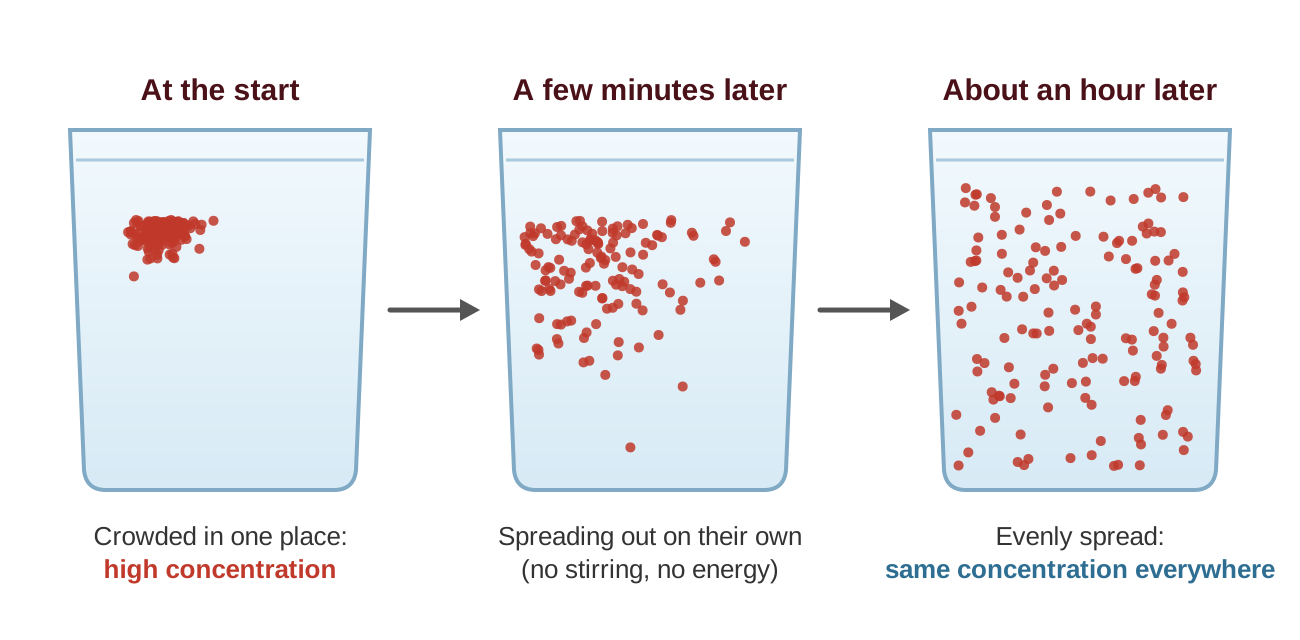
Your body depends on diffusion every second. In your lungs, the air you breathe in has a high concentration of oxygen, and the blood arriving at your lungs has a low concentration. So oxygen diffuses from the air into the blood. Carbon dioxide goes the other way: there is more of it in the blood than in the air in your lungs, so it diffuses out of the blood and you breathe it out.
Osmosis
Osmosis (say oz-MOH-sis) is the diffusion of water across a selectively permeable membrane.
Osmosis has one feature that catches nearly everyone. When you look at salty water, you notice the salt. But in osmosis, the salt or sugar is usually the thing that cannot cross the membrane. The water is what crosses. So you have to watch the water.
Here is a way to work out which way the water will move, in three steps:
- Look at both sides of the membrane and ask: which side has more dissolved in it? (More salt, more sugar, more of anything.)
- Water moves toward that side, the side with more dissolved in it. This is the step people get backward. It can help to think of it this way: the side with more dissolved in it has less water in each drop, so the water is less crowded there, and water, like anything that diffuses, moves toward where it is less crowded.
- The side the water moves toward gains water and swells. The other side loses water and shrinks.
A stalk of celery has been sitting out on the counter and has gone limp and bendy. You stand it in a glass of plain cold water. A few hours later it is firm and crisp again. What happened?
Step 1. Which side has more dissolved in it? The inside of the celery cells has sugars, salts, and other materials dissolved in its water. The plain water in the glass has almost nothing dissolved in it. So the inside of the cells has more dissolved in it.
Step 2. Which way does the water move? Toward the side with more dissolved in it. So water moves from the glass into the celery cells.
Step 3. What happens? The cells gain water. Each cell’s large central vacuole fills up and presses outward against the cell wall. With every cell pressing on its wall, the whole stalk becomes firm. The limp celery is crisp again.
Why was it limp in the first place? Sitting out in dry air, it lost water. Its vacuoles shrank, the pressure against the walls dropped, and the stalk went soft, just as a plant wilts when it is not watered.
A cook sprinkles salt over sliced cucumbers. Twenty minutes later there is a pool of liquid in the bowl and the slices are limp. Where did the liquid come from?
Step 1. The salt dissolves in the thin film of water on the slices, so the outside of the cells now has more dissolved in it than the inside.
Step 2. Water moves toward the side with more dissolved in it: out of the cucumber cells.
Step 3. The cells lose water and go limp. The water that left them collects in the bowl. The salt did not turn into liquid; the liquid came out of the cucumber.
The same rule explains why a hospital drip, or IV, is made of a salt solution mixed to match the blood, called saline, and not plain water. Red blood cells placed in plain water take in water until they swell and can burst. Red blood cells placed in very salty water lose water and shrivel. In a liquid with the same amount dissolved as the inside of the cell, water moves in and out at the same rate, and the cell keeps its normal size.
Active transport
Sometimes a cell needs to bring in something that it already has more of than its surroundings. That means moving it from a low concentration to a high concentration: the opposite of the direction it would spread on its own. Moving something against the direction of diffusion is like pushing a cart uphill: it does not happen by itself, and it takes energy.
This is called active transport. The cell uses special proteins in its membrane, often called pumps, and it pays for the work with energy from ATP, which comes from the mitochondria.
Here is an example. The soil around a plant’s roots has only a small concentration of some minerals the plant needs. The root cells already hold more of those minerals than the soil does. Even so, the root cells keep pulling the minerals in, using active transport and spending energy to do it.
Ask which way the substance is moving. If it moves from where there is more of it to where there is less, it moves on its own and costs nothing: that is diffusion (or osmosis, if it is water crossing a membrane). If it moves into the side that already has more of it, it is going uphill, and that costs energy: that is active transport.
| Process | What moves | Which direction | Energy needed? |
|---|---|---|---|
| Diffusion | Any particles that can pass | From more crowded to less crowded | No |
| Osmosis | Water, across a membrane | Toward the side with more dissolved in it | No |
| Active transport | Particles the cell pumps | From less crowded to more crowded | Yes |
The cell membrane is selectively permeable. Diffusion moves particles from high concentration to low and costs no energy. Osmosis is the diffusion of water across a membrane. Active transport moves particles from low concentration to high, and it costs energy.
Practice
Choose an answer, then press Check. The explanation opens either way.
A raisin is left overnight in a cup of plain water. In the morning it is plump. What happened?
The raisin has a lot of sugar dissolved inside it, and the plain water has almost nothing. Water moves toward the side with more dissolved in it, so it moves into the raisin. "Sugar moved out" is the tempting wrong answer, because people watch the sugar; but the sugar stays put, and the water moves.
A cell pulls in potassium even though it already has much more potassium inside than outside. What is this, and does it cost energy?
Moving something into the side where there is already more of it is uphill. That is active transport, and it costs energy. Diffusion is tempting because potassium is crossing the membrane, but diffusion only goes from more crowded to less crowded.
A gardener in a community garden waters a tomato plant with very salty water. Soon the plant wilts. Why?
The salty water outside has more dissolved in it than the root cells, so water moves out of the cells, toward the salt. The vacuoles shrink and the plant wilts. "The root cells pulled in too much water" points the rule the wrong way.
Following a protein through the cell
Parts 5 and 7 described the parts of a cell one by one. In a living cell, the parts work together. Following one protein from start to finish shows how.
Suppose a cell needs to make a protein and send it out of the cell. Cells in the pancreas, for example, make insulin, a protein that helps control the amount of sugar in the blood, and release it into the blood. Here is the path such a protein takes:
- Nucleus. The gene for the protein is in the DNA, inside the nucleus. The DNA stays there. A working copy of the gene’s instructions is made and sent out through a pore in the nuclear envelope.
- Ribosome. In the cytoplasm, a ribosome attached to the rough ER reads the copy and builds the protein, linking its pieces together in the order the instructions give.
- Endoplasmic reticulum. As the protein is built, it passes into the rough ER, where it is folded into its proper shape.
- Golgi apparatus. A small bubble of membrane, a vesicle, carries the protein from the ER to the Golgi apparatus. There it is finished, sorted, and packed into a new vesicle.
- Cell membrane. The vesicle travels to the cell membrane and joins with it, the way two soap bubbles that touch can merge. The protein is released outside the cell.
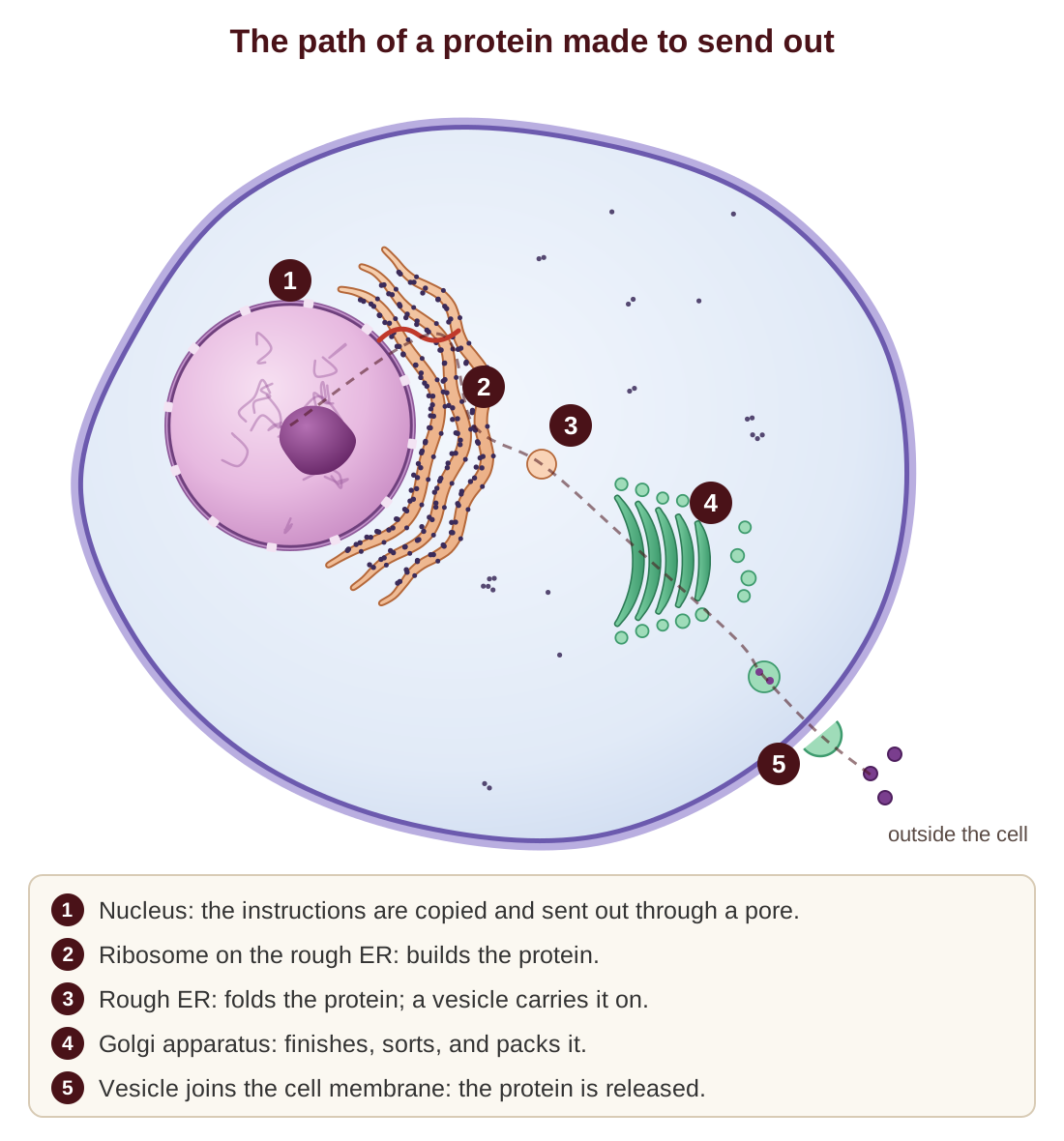
The room Made to Order follows exactly this path. It takes you inside one cell, has you learn each part by name and by job, and then has you build a protein and ship it out: from the nucleus, to a ribosome, to the ER, to the Golgi apparatus, and out through the membrane.
A protein for export follows this path: instructions copied in the nucleus, protein built by a ribosome, folded in the ER, finished and packed in the Golgi apparatus, carried in a vesicle to the membrane, and released.
Think it through. A cell’s Golgi apparatus stops working. Its ribosomes and ER still work. What happens to the proteins the cell is trying to send out?
Show a model answer
The proteins can still be built by the ribosomes and folded in the ER. But without the Golgi apparatus, they are not finished, sorted, and packed into vesicles for shipping. So they pile up inside the cell and do not reach the membrane to be released. Each step depends on the one before it.
The terms in this guide
Cell the smallest unit that is alive on its own.
Organism one complete living thing.
Single-celled made of just one cell.
Multicellular made of many cells.
Microscope a tool that uses lenses to make small things look much larger.
Micrometer one thousandth of a millimeter; the unit used to measure cells.
Cell theory all living things are made of cells; the cell is the basic unit of life; all cells come from cells that already existed.
Prokaryotic cell a cell with no nucleus; its DNA is loose in the cytoplasm. Bacteria and archaea are prokaryotes.
Eukaryotic cell a cell that keeps its DNA inside a nucleus and has organelles. Animals, plants, fungi, and protists are eukaryotes.
Protist a member of a mixed group of eukaryotes, mostly single-celled, such as the amoeba.
Domain the largest group into which living things are sorted. There are three: Bacteria, Archaea, and Eukarya.
Archaea single-celled prokaryotes that look like bacteria but differ in their chemistry and genes; their walls have no peptidoglycan.
Peptidoglycan a material found in the cell walls of bacteria, but not of archaea.
Organelle a small part inside a cell that does a particular job.
Cell membrane the thin, flexible layer around every cell that controls what goes in and out.
Cytoplasm the jelly-like material that fills the cell, in which the organelles sit.
Nucleus the compartment, with its own membrane, that holds the DNA in a eukaryotic cell.
DNA the chemical that carries the instructions for building and running a living thing.
Gene a section of DNA with the instructions for one product, usually a protein.
Chromosome one of the pieces into which a eukaryotic cell’s DNA is divided; a human body cell has 46.
Protein a large molecule made of a chain of smaller pieces; proteins do most of the work in a cell.
Ribosome a tiny structure that builds proteins; found in every cell.
Endoplasmic reticulum (ER) a network of folded membranes; rough ER folds proteins, smooth ER makes fats.
Golgi apparatus a stack of flattened sacs that finishes, sorts, and packs proteins for shipping.
Vesicle a tiny bubble of membrane that carries materials inside a cell.
Mitochondria organelles that release the energy stored in food, through cellular respiration (one is a mitochondrion).
Cellular respiration the process that breaks down sugar using oxygen and releases its energy for the cell to use.
ATP a small molecule that stores energy in a form the cell can spend.
Enzyme a protein that speeds up a particular chemical reaction.
Lysosome a small sac of enzymes that breaks down worn-out parts and food particles.
Vacuole a sac, surrounded by a membrane, that stores water, food, or wastes.
Cell wall a stiff layer outside the cell membrane in plants, fungi, and most prokaryotes.
Cellulose the tough material, built from sugar, that plant cell walls are mostly made of.
Chloroplast a green organelle in plant cells that uses sunlight to make sugar (photosynthesis).
Selectively permeable letting some things pass through and keeping others out.
Concentration how much of something there is in a certain amount of space; how crowded it is.
Diffusion the spreading of particles from high concentration to low; it needs no energy.
Osmosis the diffusion of water across a selectively permeable membrane.
Active transport moving particles from low concentration to high, using energy.
14 questions on this guide
Check yourself
Choose an answer, then press Check. The explanation opens either way.
Which statement best describes a cell?
The smallest unit that is alive on its own. "A compartment that holds the DNA" is tempting, but that describes the nucleus, which is one part of a cell. "A molecule that carries the instructions" describes DNA.
A typical human body cell is about 10 micrometers across. A millimeter is 1,000 micrometers. About how many such cells, lined up side by side, would stretch across 1 millimeter?
100, because 1,000 divided by 10 is 100. The tempting mistake is 1,000, from reading the number of micrometers in a millimeter as the number of cells; but each cell is 10 micrometers wide, not 1.
Read the passage. In the 1660s Francesco Redi put meat in several jars. He covered some jars with fine cloth that let air in but kept flies out, and left others open. Maggots appeared only in the open jars. Which statement of the cell theory does this experiment support?
All cells come from cells that already existed. The maggots came from flies laying eggs, not from the meat itself. "All living things are made of cells" is also a true statement of the cell theory, which makes it tempting, but the experiment did not test what living things are made of.
Use the table. Which cell is a prokaryotic cell?
Cell Nucleus? Cell wall? Chloroplasts? Cell A No Yes No Cell B Yes No No Cell C Yes Yes Yes Cell A, because it has no nucleus. The cell wall may tempt you toward a plant, but bacteria and archaea have cell walls too. The nucleus is the deciding feature.
Use the same table. Cell B has a nucleus, no cell wall, and no chloroplasts. Which kind of cell is it most likely to be?
Cell Nucleus? Cell wall? Chloroplasts? Cell A No Yes No Cell B Yes No No Cell C Yes Yes Yes An animal cell: it has a nucleus, so it is eukaryotic, and it has no cell wall. A plant leaf cell would have both a wall and chloroplasts. A bacterium is tempting because it lacks chloroplasts, but a bacterium has no nucleus.
Which of the following do bacteria and archaea have in common?
Both are single-celled prokaryotes with no nucleus. The peptidoglycan choice is the tempting one, but only bacteria have peptidoglycan in their walls; archaea do not. That chemical difference is one reason they are separate domains.
A student says, "Prokaryotic cells have no DNA, because they have no nucleus." Is the student right?
No. Every cell has DNA. In a prokaryote it sits loose in the cytoplasm instead of inside a nucleus. The mitochondria choice is wrong because prokaryotes have no mitochondria at all.
Look at the animal cell drawing in Part 5. Which part is labeled as the folded membranes beside the nucleus, covered with ribosomes?
The endoplasmic reticulum, here the rough ER, which has ribosomes on it. The Golgi apparatus is tempting because it is also made of membranes, but it is a separate stack of flattened sacs and has no ribosomes on it.
A muscle cell in a runner’s leg uses a great deal of energy. Which organelle would you expect to find in large numbers in this cell?
Mitochondria, because they release energy from food through cellular respiration. Chloroplasts are tempting because they are linked with energy too, but they capture sunlight to make sugar, and animal cells do not have them.
Which part do plant cells have that animal cells do NOT have?
Chloroplasts. The other three are in both plant and animal cells. Mitochondria are the most common wrong answer, from the idea that plants make their energy only with chloroplasts; plant cells need mitochondria to release the energy in the sugar they make.
Read the passage. A slice of potato is placed in a cup of very salty water. After an hour, the slice is soft and bendy, and it weighs less than before. What best explains the result?
The salty water had more dissolved in it than the cells, so water moved out of the cells, toward the salt. The cells lost water, the vacuoles shrank, and the slice went soft and lighter. "Salt moved in" is the tempting answer, from watching the salt; but the slice got lighter, which shows something left it, and that something was water.
Oxygen moves from the lungs, where there is a lot of it, into the blood, where there is less. What is this process called?
Diffusion: particles moving from where there are more to where there are fewer, with no energy needed. Osmosis is tempting because it is also a kind of diffusion, but osmosis is the word for water only, and here the particle is oxygen.
Which statement about active transport is true?
Active transport moves particles toward where there are already more of them, against the direction of diffusion, and that costs energy. "From a high concentration to a low one" describes diffusion; it is the most common mix-up.
A cell in the pancreas makes insulin, a protein, and releases it into the blood. In which order does the protein pass through these parts?
Ribosome, ER, Golgi apparatus, cell membrane: built, then folded, then finished and packed, then released. The first choice is tempting because the Golgi apparatus is the shipping step, but a protein must be built before it can be packed.