What this guide is for
This guide tells the story of cell theory: the idea that all living things are made of cells, and that every cell comes from another cell. Nobody thought of this idea all at once. It was put together over about 250 years, by many people in several countries, each of whom added one piece of evidence.
The story is told in order, from the first microscopes in the late 1500s to the experiments of Louis Pasteur around 1860. For each person, the guide says who they were, where and when they worked, what tool they used, and what their work added.
You do not need to memorize every date for the GED. What matters more is the order of the steps, what each step showed, and the lesson the whole story teaches about how science works. The timeline in Part 1 gives you the whole story on one page, and you can come back to it as you read.
At the end there are questions that check themselves, and a list of the terms used in the guide.
Goes with: Look Again Quiz 9: The Cell · Cells: The Building Blocks of Life
In this guide:
- What cell theory says, and the timeline
- Lenses and the first microscopes
- Robert Hooke and the cork, 1665
- Antonie van Leeuwenhoek and living cells, 1670s
- Better microscopes: Brown, Schleiden, and Schwann
- Where new cells come from: Remak and Virchow
- Spontaneous generation: Redi and Pasteur
- The modern cell theory, and why its history matters
- Check yourself
What cell theory says, and the timeline
A cell is the smallest living part of a living thing. Some living things, such as bacteria, are a single cell. Others, such as a tree or a person, are made of a very large number of cells working together.
Today, scientists sum up what they know about cells in three statements. Together, the three statements are called cell theory:
- All living things are made of one or more cells.
- The cell is the basic unit of life: the smallest thing that can carry out all the jobs of being alive.
- All cells come from cells that already existed.
In science, a theory is not a guess. It is an explanation that ties together a large number of observations and has been tested many times. Cell theory is a theory in this sense. It is accepted because a great deal of evidence supports it.
Cells are far too small to see with the eye alone. A typical human cell is about one tenth the width of a human hair, or smaller. So the story of cell theory begins with the tools that made small things look bigger.
Cell theory has three parts: all living things are made of cells; the cell is the basic unit of life; and all cells come from cells that already existed. Many people, over about 250 years, supplied the evidence for it.
Lenses and the first microscopes
A lens is a curved piece of clear glass. Light bends as it passes through the curved glass, and this bending can make an object look bigger than it is. Making something look bigger is called magnifying it.
Lenses had been in use in Europe for a long time before anyone saw a cell. Eyeglasses, which are lenses set in a frame to help people see, were being made in Europe by the late 1200s. A single lens held in the hand is a magnifying glass. A magnifying glass makes things look a few times bigger, which is not nearly enough to see a cell.
The first compound microscopes
A microscope is a tool for looking at things too small to see with the eye alone. ("Micro" means small, and "scope" means a tool for looking.)
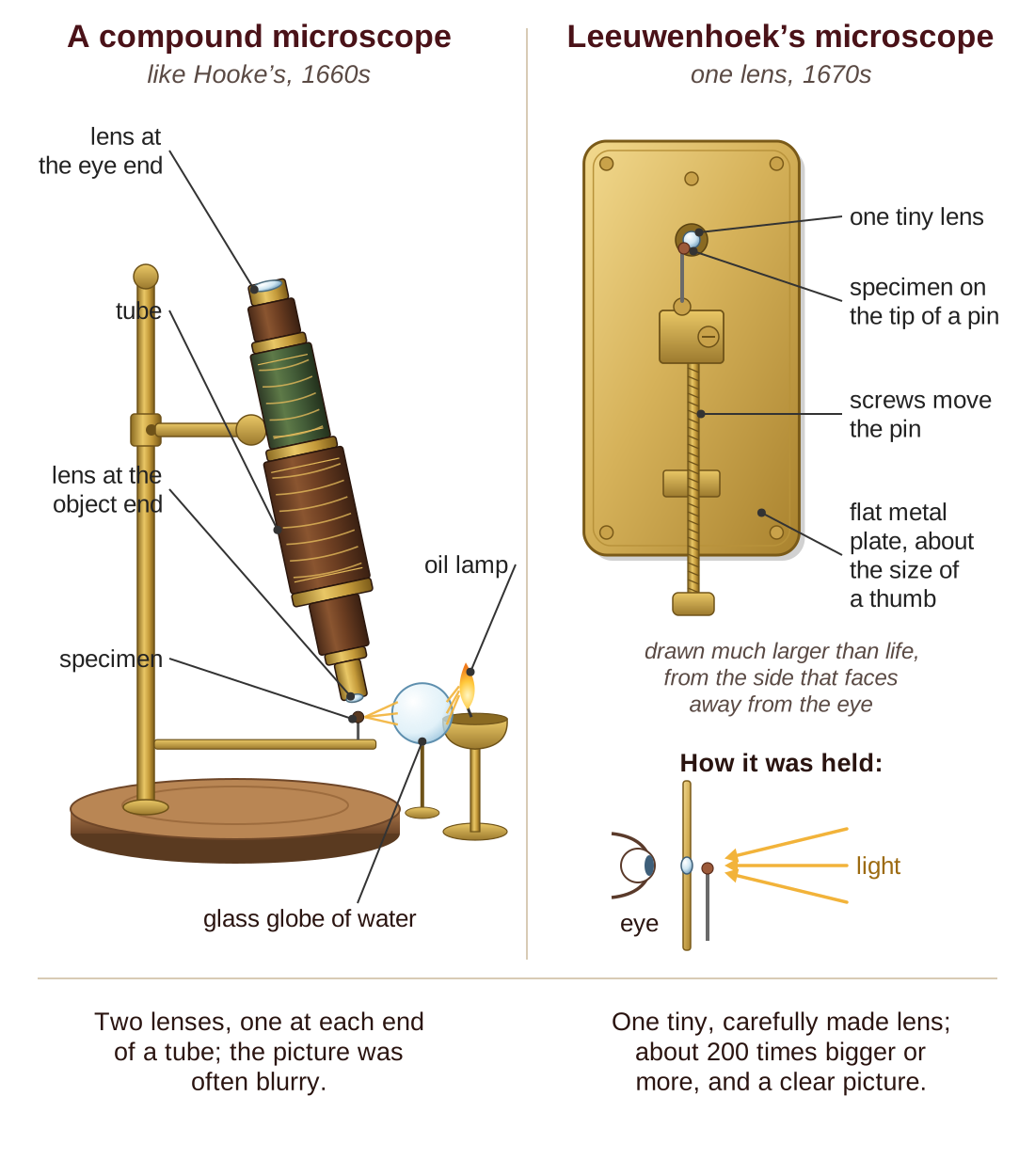
Around the 1590s and early 1600s, people found that two lenses, one at each end of a tube, could magnify much more than one lens alone. The first lens makes a bigger picture of the object, and the second lens makes that picture bigger again. A microscope built this way, with two or more lenses, is called a compound microscope. ("Compound" here means made of more than one part.)
The first compound microscopes were probably made by spectacle makers in the Netherlands. A spectacle maker is a person who makes eyeglasses. Several people have been given the credit, but the records from that time are not clear enough to say for certain who was first.
These early microscopes were not very strong by today’s standards, and the picture was often blurry. Still, they opened a new world. Over the next few decades, scientists began to use them to look closely at insects, plants, and everyday materials.
Cell theory depended on a tool. Without lenses strong enough to magnify very small things, nobody could have seen a cell.
Think it through. Why does the story of cell theory start with spectacle makers and not with a biologist?
Show a model answer
Because no one could study cells until there was a tool that made them visible. The people who knew how to shape glass into lenses were the ones who made the first microscopes. The biology came after the tool.
Robert Hooke and the cork, 1665
Robert Hooke was an English scientist who lived from 1635 to 1703. He worked in London for the Royal Society, a group of scientists who met to show each other experiments and discuss new discoveries. His job there was to prepare experiments to show at the meetings. He studied many subjects, including light, air, springs, and the stars.
Hooke used a compound microscope, lit by the flame of an oil lamp, to look at many small things: the eye of a fly, the point of a needle, the edge of a razor, a flea, a louse. He made careful drawings of what he saw.
Micrographia, 1665
In 1665 Hooke published his drawings and descriptions in a book called Micrographia. The name means "small drawings," or drawings of small things. The book was a great success, because it showed readers a world that almost no one had seen before.
One of the things Hooke looked at was cork. Cork is the light, spongy bark of the cork oak tree; it is the material that wine-bottle stoppers and bulletin boards are made of. Hooke cut a very thin slice of cork with a sharp knife, so thin that light could pass through it, and put it under his microscope.
He saw that the cork was made of a great many tiny, empty boxes, packed together in rows, with thin walls between them. He compared them to the cells of a honeycomb, the small six-sided rooms bees build out of wax. He called the boxes cells.
The word "cell" comes from a Latin word, cella, which means a small room. A small, bare room, such as a room in a monastery where a monk lived, was called a cell. The name Hooke chose is still used today for the basic unit of every living thing.
What Hooke actually saw
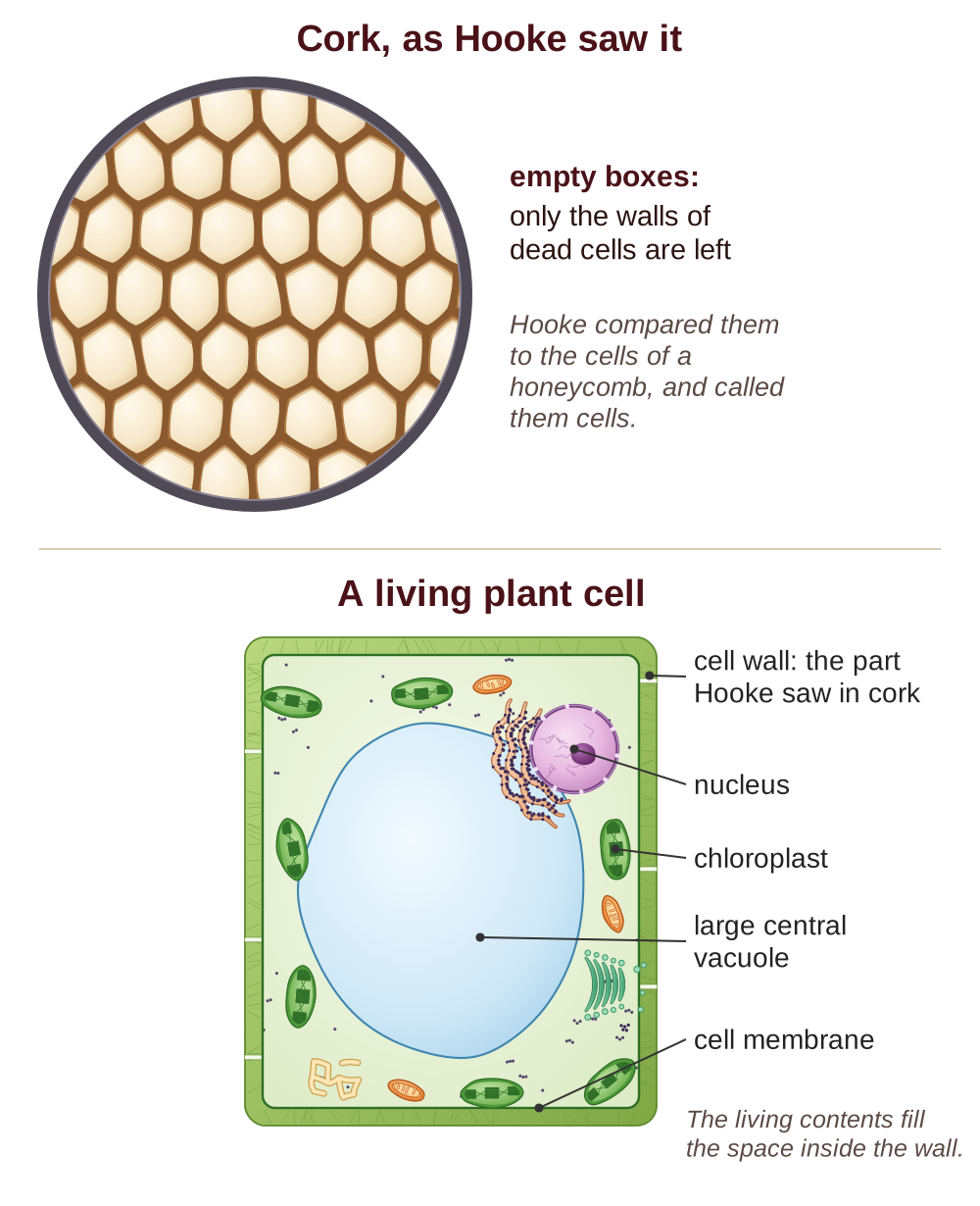
Cork comes from the outer bark of a tree, and the cells in it are dead. When a cork cell dies, its living contents are gone, and only its stiff outer layer is left. That outer layer is the cell wall, which plant cells have outside their thin cell membrane.
So what Hooke saw were the empty walls of dead plant cells. He did not see the living material that had been inside them, and he did not know that cells were the basic unit of life. He gave the name; the meaning came later, from other people’s work.
In 1665 Robert Hooke looked at a thin slice of cork under a compound microscope and named the tiny boxes he saw "cells." He was seeing the empty walls of dead plant cells.
Think it through. Hooke is famous for discovering cells. In what way is that true, and in what way does it go too far?
Show a model answer
It is true that he was the first to describe and name cells, in 1665. It goes too far if it suggests he understood what cells are. He saw only the empty walls of dead cork cells. He did not see living cells, and he did not claim that all living things are made of cells. Those ideas came from later scientists.
Antonie van Leeuwenhoek and living cells, 1670s
Antonie van Leeuwenhoek (say LAY-ven-hook) lived from 1632 to 1723 in the city of Delft, in the Netherlands. He was not a university scientist. He was a cloth merchant: he bought and sold fabric. Cloth merchants used magnifying glasses to count the threads in a piece of cloth, and this may be how he became interested in lenses.
Leeuwenhoek did not use a compound microscope. He made his own single-lens microscopes. Each one was a small metal plate, about the size of a thumb, with one tiny, very carefully made lens set into it. The object was held on a pin just behind the lens, and he held the whole thing close to his eye.
One small lens may sound weaker than two, but his lenses were so well made that his best microscopes made things look about 200 times bigger or more, and the picture was clear. That was much stronger and sharper than the compound microscopes of his time. He made hundreds of these microscopes, and he kept his methods secret.
Living things too small to see
Beginning in the 1670s, Leeuwenhoek looked at drops of water from lakes, ponds, and rain barrels. In them he saw tiny living things swimming and moving about. Nobody had ever seen them before. He called them animalcules, which means "little animals."
Many of the animalcules he described were living things made of a single cell. Today we would call many of them microorganisms: living things too small to see without a microscope.
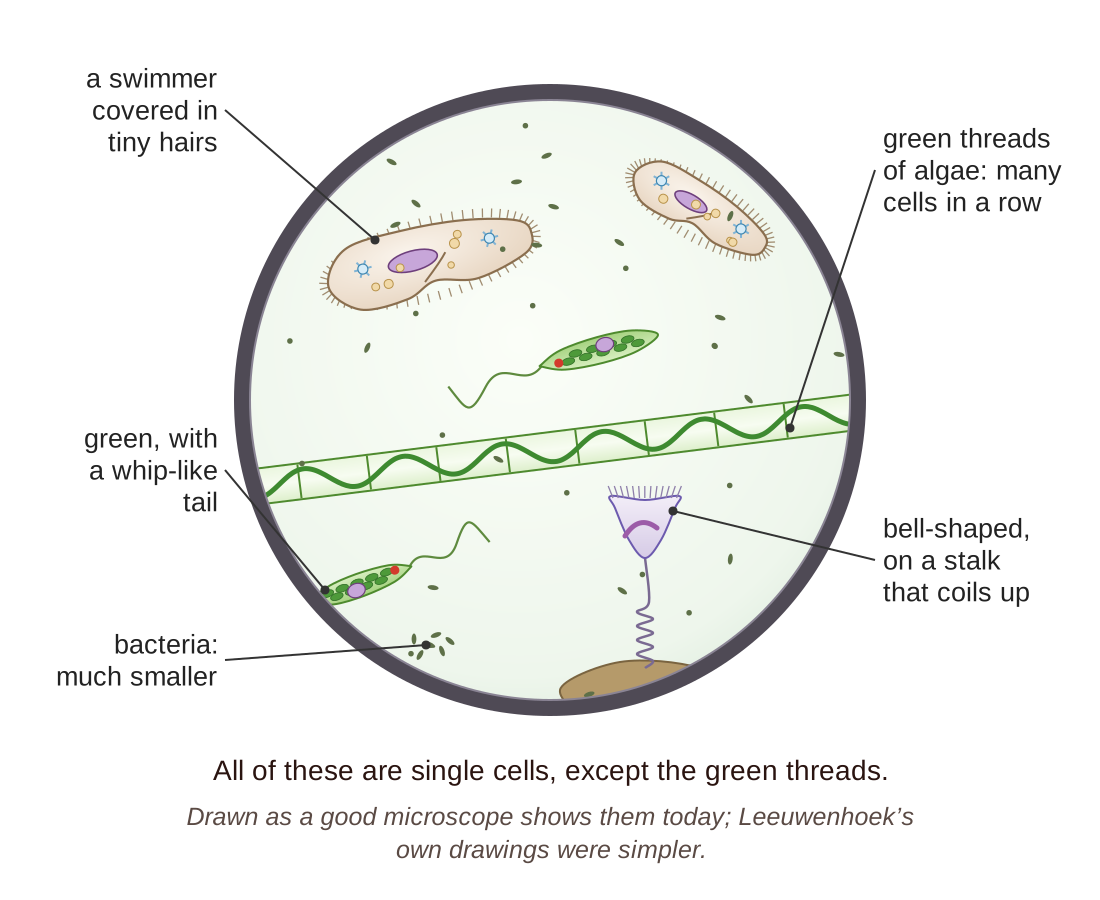
He also scraped the white material from between his teeth, mixed it with water, and looked at it. In it he saw even smaller living things, which he drew in a letter in 1683. Scientists today recognize these as bacteria, single-celled living things with no nucleus.
Leeuwenhoek wrote to the Royal Society in London, the same group Hooke worked for, describing what he saw. At first some members doubted him, because no one else could see such things. Hooke himself was asked to check, and in the late 1670s he was able to see the tiny living things too.
| Robert Hooke | Antonie van Leeuwenhoek | |
|---|---|---|
| Where | London, England | Delft, the Netherlands |
| When | 1665 (Micrographia) | the 1670s and after |
| Work | scientist for the Royal Society | cloth merchant |
| Tool | compound microscope (two or more lenses) | single-lens microscopes he made himself |
| What he saw | empty walls of dead cork cells | living single-celled things, including bacteria |
| What it added | the name "cell" | the first look at living cells, and at life too small to see |
In the 1670s Antonie van Leeuwenhoek, a cloth merchant in Delft, used single-lens microscopes he made himself to see living single-celled things in water and bacteria from his teeth. He called them "animalcules."
Think it through. Hooke saw cells first, but Leeuwenhoek is often called the first person to see living cells. Why is that a fair statement?
Show a model answer
Hooke’s cork cells were dead and empty: he saw only their walls. Leeuwenhoek saw single-celled things that were alive and moving in a drop of water. So Hooke was first to see and name cell walls, and Leeuwenhoek was first to see living cells.
Better microscopes: Brown, Schleiden, and Schwann
A long gap
After Hooke and Leeuwenhoek, about 150 years passed with few new discoveries about cells. There were several reasons.
Leeuwenhoek’s tiny lenses were very hard to make and hard to use, and he did not tell anyone exactly how he made them. The compound microscopes that other scientists used gave blurry pictures. The glass lenses of the time bent different colors of light by different amounts, so the edges of everything looked fuzzy and fringed with color. It was hard to see fine details inside a cell.
In the early 1800s, lens makers learned to combine two different kinds of glass in one lens, which removed most of the blur and the colored edges. With these better microscopes, scientists could finally see clearly inside cells. Discoveries came quickly after that.
Robert Brown names the nucleus, 1831
Robert Brown was a Scottish botanist, a scientist who studies plants. In 1831, while looking at cells from orchid plants under a microscope, he noticed a small, dark, round body inside each cell. He called it the nucleus, from a Latin word meaning kernel or nut. Others had seen this body before, but Brown named it and pointed out that it was found in cell after cell.
Today we know that the nucleus holds the cell’s DNA, its instructions. Brown did not know this. What he added was the name, and the observation that this part was a regular feature of plant cells.
Matthias Schleiden: plants are made of cells, 1838
Matthias Schleiden (say SHLY-den) was a German botanist. He studied many kinds of plant material under the microscope. In 1838 he concluded that every part of a plant is made of cells, or of material made by cells. Plants, he said, are built of cells.
Theodor Schwann: animals are made of cells, 1839
Theodor Schwann (say SHVAHN) was a German scientist who studied how animal bodies are built and how they work. He knew Schleiden and had talked with him about plant cells. Schwann then looked closely at many animal tissues. (A tissue is a group of similar cells that work together, such as muscle or skin.)
In 1839 Schwann published a book showing that animal tissues, too, are made of cells. Put together with Schleiden’s work, this meant that both plants and animals are made of cells. Schwann also argued that the cell is the basic unit of living things: the building block from which everything larger is made.
With the work of Schleiden (1838, plants) and Schwann (1839, animals), the first two parts of cell theory were in place: all living things are made of cells, and the cell is the basic unit of life.
Think it through. Why did the discoveries of the 1830s happen about 150 years after Hooke and Leeuwenhoek, and not sooner?
Show a model answer
Because the microscopes most scientists could use were not good enough. Their lenses gave blurry pictures with colored edges, and Leeuwenhoek’s better lenses were hard to make and his methods were secret. When lens makers learned to fix the blur in the early 1800s, scientists could see clearly inside cells, and new discoveries followed.
Where new cells come from: Remak and Virchow
By 1839, scientists agreed that living things are made of cells. But there was still an open question: where do new cells come from?
Schleiden and Schwann did not have the right answer. They thought new cells could form out of non-living material. Schwann suggested that cells might build up out of a fluid between other cells, somewhat the way crystals of salt form in salty water as it dries. In that comparison, the fluid matches the salty water, and the new cell matches the crystal. If that were true, a cell could appear where no cell had been before.
Robert Remak: watching cells divide
Robert Remak was a doctor and scientist, born in Posen (today Poznań, in Poland) and working in Berlin, Germany. He studied embryos: animals at the earliest stage of their development, such as a chick growing inside an egg or a young frog growing inside its egg.
In the 1840s and early 1850s, Remak watched cells in frog and chick embryos carefully under the microscope. He saw new cells forming by cell division, one cell splitting into two. He found no sign of cells forming out of fluid. His best-known paper on this appeared in 1852. His conclusion: new cells come from the division of cells that already exist.
Rudolf Virchow: "All cells come from cells," 1855
Rudolf Virchow (say FEER-koh) was a German doctor, also in Berlin, who studied disease in the body’s cells. In 1855 he wrote that every cell comes from another cell. He put it in a short Latin phrase: omnis cellula e cellula, which means "every cell from a cell," or "all cells come from cells." Virchow was a well-known and forceful writer, and the phrase spread widely.
Virchow is often given the credit for the third part of cell theory, and many textbooks name only him. But Remak’s observations of cells dividing came first, and Virchow’s statement drew on that kind of evidence. Virchow did not give Remak credit, and Remak’s part was overlooked for a long time. On the GED, Virchow’s name is the one you are most likely to see, but it is fair to know that the evidence came from Remak.
The third part of cell theory, that all cells come from cells that already existed, rests on Robert Remak’s observations of cells dividing (1840s and early 1850s) and was made famous by Rudolf Virchow in 1855.
Think it through. Schwann thought new cells might form out of a fluid, the way crystals form. What kind of evidence showed that this was wrong?
Show a model answer
Careful observation of cells as they multiplied. Remak watched cells in embryos and saw new cells appear by division of old ones, and he found no cells forming out of fluid. When better observation shows something different from what a scientist expected, the idea has to change.
Spontaneous generation: Redi and Pasteur
The question of where new cells come from was part of a larger, older question: can living things form from non-living material? The idea that they can is called spontaneous generation. ("Spontaneous" means happening on its own; "generation" means coming into being.)
For a very long time, many people believed in spontaneous generation. It seemed to fit what they saw. Maggots appeared on meat that had been left out. Mold appeared on old bread. One old recipe even claimed that mice would appear from dirty cloth and wheat left in a jar.
Two famous experiments, about 200 years apart, tested this idea. Both were fair tests: experiments that change only one thing and keep everything else the same, so that any difference in the results can be traced to that one change.
The one thing you change on purpose is the independent variable. The thing you measure or observe is the dependent variable. Everything you keep the same is called the constants. A control group is a group that is left alone, so there is something to compare against.
Francesco Redi and the jars of meat, 1668
Francesco Redi (say RAY-dee) was an Italian doctor and scientist who worked in Florence. In his time, most people believed that maggots (the small, worm-like young of flies) formed on their own from rotting meat. Redi suspected instead that maggots came from eggs laid by flies.
He put pieces of meat into several jars. He left some jars open. He covered others with fine cloth, a light fabric with holes so small that air could pass through but flies could not. The meat in all the jars was the same, and all the jars were kept in the same place.
Flies landed on the meat in the open jars, and maggots appeared there. Flies were drawn to the covered jars too, but they could only land on the cloth, and no maggots appeared on the meat, even though it rotted just the same. In 1668 Redi published his results.
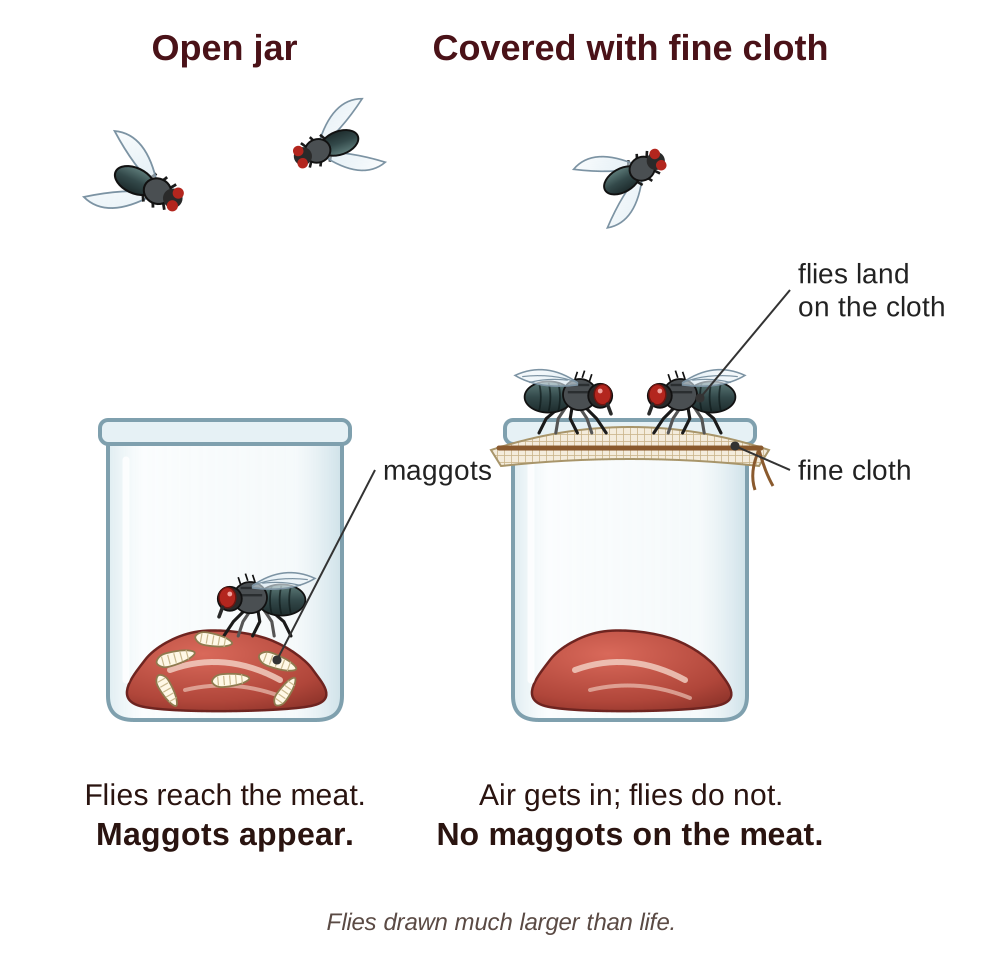
Name the parts of Redi’s experiment.
Independent variable (what he changed): whether flies could reach the meat. Open jars let them in; covered jars kept them out.
Dependent variable (what he observed): whether maggots appeared on the meat.
Constants (what he kept the same): the kind of meat, the place the jars were kept, the time they were left. The cloth let air in, so air was the same for both kinds of jar too. This mattered, because some people said life needed air to form.
Control group: the open jars, which were left in the ordinary way, with nothing added.
Result and conclusion: maggots appeared only where flies could reach the meat. So maggots come from flies, not from the meat itself.
Why the question was not settled
Redi’s experiment convinced many people that larger animals such as flies do not form from non-living material. But a few years later, Leeuwenhoek showed that there were living things far too small to see. Many people then argued that these tiny living things, at least, must form on their own. If you leave a bowl of broth out for a few days, it turns cloudy, because it fills with microorganisms. (Broth is a soup made by boiling meat or other food in water.) Where did they come from?
In the 1700s, some scientists boiled broth to kill anything living in it and then sealed the containers. Nothing grew. But believers in spontaneous generation said that sealing the containers had shut out the air, and that air was needed for life to form. The argument went on for nearly 100 years more.
Louis Pasteur and the swan-neck flasks, about 1859 to 1862
Louis Pasteur (say pas-TUR) was a French chemist who studied microorganisms. He is also known for pasteurization, heating a drink such as milk to kill harmful microorganisms, which is named after him.
Around 1859 to 1862 Pasteur designed an experiment that answered the objection about air. He put broth into glass flasks. A flask is a glass container with a round body and a narrow neck. He heated the neck of each flask and bent it into a long S-shaped curve, like the neck of a swan. Then he boiled the broth, which killed any microorganisms already in it.
The curved neck was open at the end, so air could flow in and out. But dust from the air, which carries microorganisms, settled in the low bend of the neck and could not travel up and over to reach the broth.
The broth in these flasks stayed clear for weeks, months, and even longer. Nothing grew in it.
Then Pasteur broke the neck off some of the flasks, or tipped a flask so that the broth ran into the bend and touched the trapped dust. Within a few days, that broth turned cloudy with microorganisms.
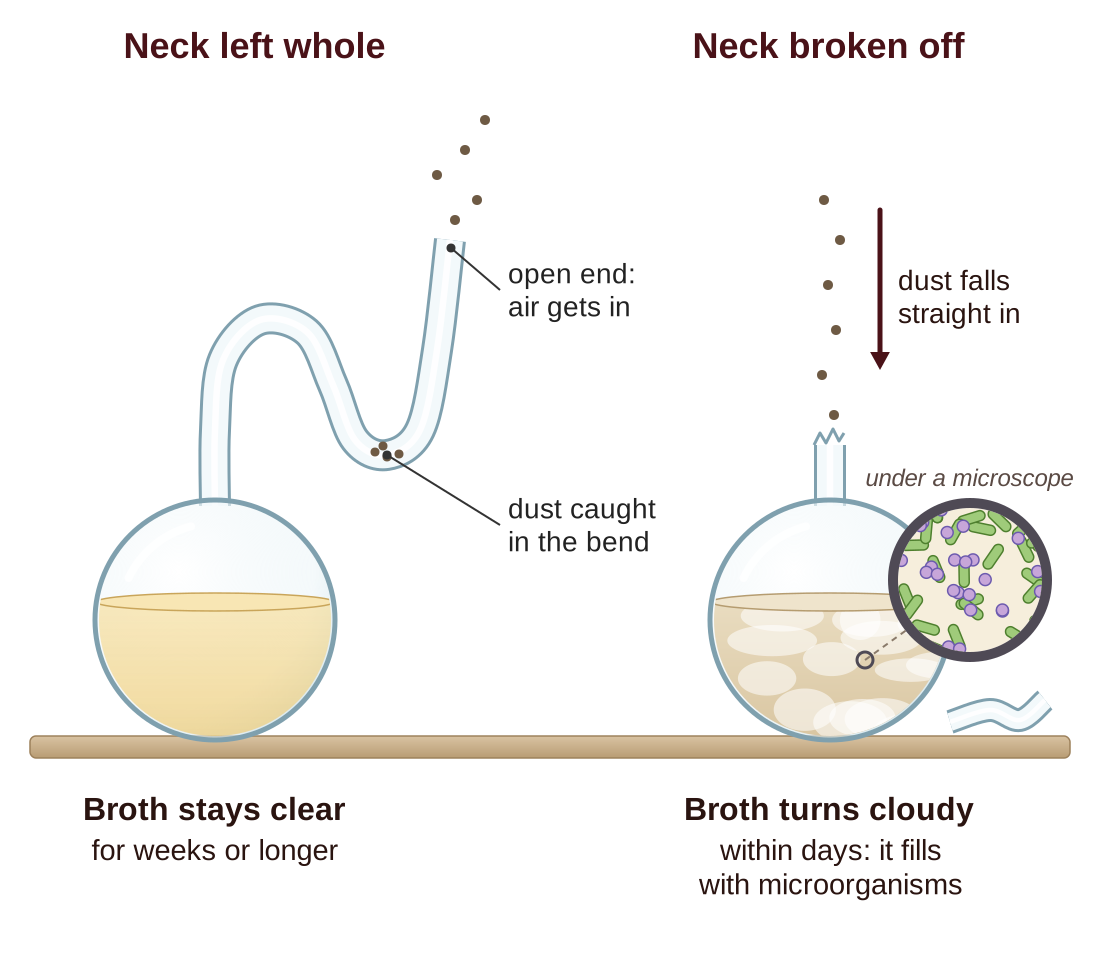
Name the parts of Pasteur’s experiment.
Independent variable (what he changed): whether dust from the air could reach the broth. The whole swan neck kept the dust out; the broken neck, or tipping the flask, let it in.
Dependent variable (what he observed): whether the broth turned cloudy, which showed that microorganisms were growing in it.
Constants: the same broth, boiled the same way, in the same kind of flask. Most important, air could reach the broth in every flask. That answered the people who said life needed air to form.
Result and conclusion: microorganisms grew only when dust could reach the broth. They came from living microorganisms carried in the dust, not from the broth itself.
Redi (1668) showed that maggots come from flies, not from meat. Pasteur (about 1859 to 1862) showed that microorganisms in broth come from other microorganisms carried in dust, not from the broth. Both experiments support the idea that living things, and cells, come only from other living things.
Think it through. Why was it important that air could reach the broth in Pasteur’s swan-neck flasks?
Show a model answer
Because believers in spontaneous generation said life could not form in sealed containers only because the air had been shut out. In Pasteur’s flasks, air could get in, and still nothing grew. The only thing kept out was the dust. So the difference had to be the dust, and the microorganisms it carried, not the air.
The modern cell theory, and why its history matters
The modern cell theory
Put together, the work described in this guide gives us the three parts of cell theory, as it is taught today:
- All living things are made of one or more cells. (Schleiden for plants, Schwann for animals; Leeuwenhoek for single-celled life.)
- The cell is the basic unit of life. It is the smallest thing that carries out all the jobs of being alive. (Schwann, building on Schleiden.)
- All cells come from cells that already existed. (Remak’s observations, made famous by Virchow; supported by Redi and Pasteur, who showed that living things do not form from non-living material.)
Since then, scientists have added more to what we know about cells. For example, we now know that cells pass their DNA, their instructions, on to new cells when they divide. But the three parts above are the core of cell theory, and they are what the GED expects you to know.
Why this history is on the GED
The GED Science test does not mainly ask you to remember who did what in which year. It asks you to understand how science works. The history of cell theory is a good example of several things the test cares about.
- Better tools bring new evidence. Cells could not be seen until there were lenses good enough. The big discoveries of the 1830s came soon after microscopes were improved.
- Evidence changes what scientists accept. Schleiden and Schwann thought new cells could form from fluid. When Remak observed cells dividing, that idea had to give way. For centuries people believed in spontaneous generation; Redi’s and Pasteur’s experiments showed it was wrong.
- A theory is built from many people’s observations. No single person discovered cell theory. A spectacle maker, a scientist in London, a cloth merchant in Delft, a Scottish botanist, two Germans, a doctor studying embryos, a doctor studying disease, an Italian doctor, and a French chemist each added a piece.
- Fair tests settle questions. Redi and Pasteur each changed one thing, kept the rest the same, and observed the result. That is the same method the GED asks you to recognize in its questions about experiments.
Scientific ideas change when new evidence comes in, and new evidence often comes from better tools. A theory such as cell theory is built from the observations of many people over a long time.
Beverly Biology, "Cell History": www.youtube.com/watch?v=eD8FrhqZzL0. A short video on the same story, from Hooke to Virchow.
Practice: putting the events in order
Choose an answer, then press Check. The explanation opens either way.
Which list puts these three events in the right order, earliest first?
Hooke named cells in 1665, Brown named the nucleus in 1831, and Virchow wrote "all cells come from cells" in 1855. If you put Brown first, remember that the nucleus is a part inside the cell: someone had to see cells before anyone could name a part inside them.
Which happened first?
Leeuwenhoek, in the 1670s. Schwann was 1839, Remak the 1840s and early 1850s, and Pasteur about 1859 to 1862. If you chose Schwann, you may have been thinking of the first two parts of cell theory, which came before the third; but Leeuwenhoek came long before both.
Schleiden and Schwann did their work a year apart. Which is the right order?
Schleiden said plants are made of cells in 1838, and Schwann said animals are made of cells in 1839. The last choice has the right order of names but swaps plants and animals. One way to remember: Schleiden was the botanist, the plant scientist.
Which of these happened last?
Virchow, in 1855. The first compound microscopes came around the 1590s and early 1600s, Hooke’s book in 1665, and Redi’s jars in 1668. Redi is easy to place too late, because his question about spontaneous generation was finally settled by Pasteur, in the 1860s; but Redi himself worked in the 1660s, only three years after Hooke.
Put these in order, earliest first: Pasteur’s flasks; Leeuwenhoek’s animalcules; Redi’s jars.
Redi in 1668, Leeuwenhoek in the 1670s, and Pasteur about 1859 to 1862. Redi and Leeuwenhoek are close together, which is why the last choice is tempting; Redi’s results came out in 1668, and Leeuwenhoek’s first letters about tiny living things came in the mid-1670s.
The terms in this guide
Cell the smallest living part of a living thing.
Cell theory the three statements that all living things are made of cells, the cell is the basic unit of life, and all cells come from cells that already existed.
Theory in science, a well-tested explanation that ties together many observations; not a guess.
Lens a curved piece of clear glass that bends light and can make things look bigger.
Magnify to make something look bigger than it is.
Microscope a tool for looking at things too small to see with the eye alone.
Compound microscope a microscope with two or more lenses, one making the picture bigger and the next making it bigger again.
Single-lens microscope a microscope with one small lens, like the ones Leeuwenhoek made.
Micrographia Robert Hooke’s 1665 book of drawings of small things seen through a microscope.
Cell wall the stiff layer outside the membrane of a plant cell; what Hooke saw in cork.
Animalcules Leeuwenhoek’s word, meaning "little animals," for the tiny living things he saw.
Microorganism a living thing too small to see without a microscope.
Bacteria single-celled living things with no nucleus.
Nucleus the round body inside many cells that holds the DNA; named by Robert Brown in 1831.
Botanist a scientist who studies plants.
Tissue a group of similar cells that work together, such as muscle or skin.
Embryo an animal or plant at the earliest stage of its development.
Cell division one cell splitting into two cells.
Omnis cellula e cellula Latin for "every cell from a cell"; the phrase Virchow made famous in 1855.
Spontaneous generation the old, disproved idea that living things can form on their own from non-living material.
Fair test an experiment that changes only one thing and keeps everything else the same.
Independent variable the one thing changed on purpose in an experiment.
Dependent variable the thing measured or observed to see the result.
Constants the things kept the same in an experiment.
Control group the group left alone, so there is something to compare against.
Broth a soup made by boiling meat or other food in water.
Flask a glass container with a round body and a narrow neck.
Pasteurization heating a drink such as milk to kill harmful microorganisms; named after Louis Pasteur.
14 questions on this guide
Check yourself
Choose an answer, then press Check. The explanation opens either way.
Read the passage.
In 1665 Robert Hooke looked at a thin slice of cork under his microscope. He saw that it was made of many small, empty boxes packed together in rows. He called them cells.
What was Hooke actually seeing?The walls of dead plant cells. Cork is bark from a dead part of the tree, so its cells have lost their living contents and only the walls are left. The tempting answer is "living cells," because we now know cells are alive; but Hooke’s cells were empty, and the nucleus was not named until 1831.
Which statement best describes the microscopes Antonie van Leeuwenhoek used?
Leeuwenhoek made his own microscopes, each with one tiny, carefully made lens. The tempting mistake is "compound microscopes," because Hooke used one; but Leeuwenhoek’s single lenses were sharper and stronger than the compound microscopes of his time.
Use the list.
1590s–1600s: first compound microscopes
1665: Hooke names cells
1831: Brown names the nucleus
1839: Schwann: animals are made of cells
Which event in the list happened before Hooke named cells?The first compound microscopes, around the 1590s and early 1600s. Hooke needed one to see the cork. "None of them" is tempting if you think of Hooke as the very beginning of the story; but the tool came first.
Matthias Schleiden concluded that plants are made of cells, and Theodor Schwann concluded that animals are made of cells. Together, their work most directly supported which part of cell theory?
Plants and animals together cover most of the living things people could study then, so their work supported the statement that all living things are made of cells. "Cells come from cells" is a true part of cell theory, which makes it tempting, but it came later, from Remak and Virchow. Schleiden and Schwann actually thought cells could form from non-living fluid.
About 150 years passed between Leeuwenhoek’s work and the discoveries of the 1830s. What was the main reason?
The compound microscopes most scientists used gave blurry pictures with colored edges, and Leeuwenhoek’s better lenses were hard to make and kept secret. When lenses improved in the early 1800s, discoveries followed. "Lost interest" may sound possible, but the story shows that the limit was the tool, not people’s interest.
Read the passage.
Redi put meat into several jars. He left some open and covered others with fine cloth that let air in but kept flies out. Maggots appeared on the meat in the open jars only.
What was the independent variable in Redi’s experiment?The independent variable is the one thing changed on purpose: whether flies could reach the meat. "Whether maggots appeared" is the most tempting wrong answer, but that is what Redi observed as the result, which makes it the dependent variable.
Why did Pasteur bend the necks of his flasks into an S-shape instead of sealing them shut?
Some people said life could not form in a sealed flask only because the air was shut out. The open, curved neck let air in, while dust settled in the bend. If you chose "cool down faster," notice that the shape of the neck had nothing to do with temperature; it was about what could reach the broth.
Use the table.
All three flasks held the same boiled broth. Which conclusion do the results support?Flask Neck Broth after 2 weeks 1 whole S-shaped neck clear 2 neck broken off cloudy 3 whole neck, flask tipped so broth touched the bend cloudy Air reached the broth in all three flasks, but only the two flasks where dust could reach the broth turned cloudy. So the cause was in the dust: microorganisms carried on it. "When air reaches it" is tempting, but Flask 1 had air and stayed clear.
Which statement about the third part of cell theory, "all cells come from cells," is accurate?
Remak watched new cells form by division in the 1840s and early 1850s, and Virchow made the idea famous in 1855. Schwann is tempting because he is part of the story, but he believed new cells could form from fluid, which is the opposite idea.
What did Robert Brown add to the study of cells in 1831?
Brown, a Scottish botanist, named the nucleus after seeing it in orchid cells. "He named the cell" is the likely mix-up: that was Hooke, in 1665, more than 150 years earlier.
Which lesson about science does the history of cell theory show most clearly?
Over and over in this story, ideas changed because of new evidence, often from better tools: spontaneous generation and the idea that cells form from fluid both gave way. "One famous scientist" is tempting because names like Hooke and Virchow are famous, but the theory was built by many people.
For centuries, many people believed that mold on old bread formed from the bread itself. What is this idea called?
Spontaneous generation is the idea that living things form on their own from non-living material. Cell division is tempting because it is about new cells, but it means one cell splitting into two, which is the opposite of life forming from non-living material.
Read the passage.
Leeuwenhoek scraped material from between his teeth, mixed it with water, and looked at it through one of his microscopes. He saw many tiny moving things and called them animalcules.
What do scientists today call the tiny things he saw?Bacteria: single-celled living things with no nucleus. "Nuclei" may be tempting because they are also tiny, but a nucleus is a part inside a cell, not a whole living thing that moves on its own.
In Redi’s experiment, the covered jars let air in through fine cloth. Why did that matter?
Some people said life needed air to form. Because the cloth let air in, air was a constant: the only difference between the jars was whether flies could reach the meat. "Made the meat rot more slowly" is tempting, but the passage in this guide says the meat rotted just the same in both kinds of jar.