What this guide is for
Chemistry is about what things are made of and how they change. This guide starts at the beginning. It explains what matter and energy are, then the building blocks of all matter: elements, atoms, molecules, and compounds. Then it goes inside the atom, to the three particles it is made of, and shows you how to count them, including how to work out the number of neutrons. From there it explains how an atom arranges its electrons, how to read the periodic table, how to read a chemical formula, and the two main ways atoms join together: by sharing electrons and by handing them over.
Part of this guide moves. In Part 7 you can add electrons to an atom one at a time and watch its shells fill, and Parts 11 and 12 show a water molecule and a crystal of table salt forming, step by step, with a voice that reads each step aloud. You can turn the voice off and read instead.
This guide gives you a little more than the GED test strictly asks for, where the extra makes the main ideas easier to understand. Boxes marked Going further hold extra material you can skip. The next guide, Chemistry 2, takes up mixtures and solutions, solids, liquids, and gases, physical and chemical changes, chemical reactions and how to balance their equations, the energy that reactions give off or take in, and acids and bases.
Goes with: the Chemistry reading · Science Practices
In this guide:
- Matter and energy
- The building blocks: elements, atoms, molecules, compounds
- Inside the atom: protons, neutrons, and electrons
- Counting particles: atomic number, mass number, and neutrons
- Isotopes and ions
- What holds the nucleus together
- Electrons live in shells
- Full shells and valence electrons
- The periodic table
- Chemical symbols and formulas
- Covalent bonds: sharing electrons
- Ionic bonds: handing electrons over
- Which kind of bond? A rule of thumb
- Check yourself
Matter and energy
Everything around you, the air, the water, your chair, your own body, is made of matter. In science, matter means anything that has mass and takes up space.
Mass is the amount of matter in something. It is measured in grams and kilograms. Volume is the amount of space something takes up. It is measured in liters and milliliters, or in cubic centimeters. A brick has mass and volume. So does the air in a balloon: air is thin, but it is still matter, which is why a balloon stays puffed up when you blow air into it.
Weight is how hard gravity pulls on a mass. An astronaut on the Moon weighs about one-sixth of what she weighs on Earth, because the Moon’s gravity is weaker. But her mass, the amount of matter in her body, has not changed at all.
Some things that are real are not matter. Light, heat, and sound have no mass and take up no space. They are forms of energy.
Energy is the ability to do work or to cause a change: to move something, heat it, light it up, or change it into something else. Energy comes in several forms:
- Chemical energy, stored in the bonds that hold atoms together. Food, gasoline, wood, and batteries all hold chemical energy.
- Heat (thermal energy), the energy of moving particles. The faster the particles of a substance move, the hotter it is.
- Light and other radiant energy, such as the energy that reaches us from the Sun.
- Motion (kinetic energy), the energy of anything that moves.
- Electrical energy, carried by moving electric charges.
Energy can change from one form to another. When you eat, your body turns the chemical energy in food into motion and heat. A car engine turns the chemical energy in gasoline into motion and heat. But energy is never made out of nothing and never destroyed. It only changes form. Scientists call this the law of conservation of energy. (The Physics guides look at energy more closely.)
Chemistry is the study of matter: what it is made of, how it is put together, how it changes, and the energy that goes in or comes out when it changes. Burning wood, rusting iron, baking bread, and digesting lunch are all chemistry.
Matter is anything that has mass and takes up space. Energy is the ability to do work or cause a change. Chemistry studies what matter is made of, how it changes, and the energy involved.
The building blocks: elements, atoms, molecules, compounds
All matter is built from a fairly small number of basic substances called elements. An element is a pure substance that cannot be broken down into anything simpler by ordinary chemical means, such as heating it or mixing it with other chemicals. Gold, oxygen, carbon, iron, and hydrogen are elements.
Scientists know of 118 elements. About 90 of them occur in nature; the rest have been made in laboratories, and most of those last only a moment. A handful of elements make up most of the living world. About 96 percent of the mass of your body is just four elements: oxygen, carbon, hydrogen, and nitrogen.
Atoms
If you could cut a piece of gold in half, and then in half again, over and over, you would finally reach a piece that could not be cut any smaller and still be gold. That smallest piece is an atom. An atom is the smallest piece of an element that is still that element. Atoms are far too small to see. A single grain of table salt holds about a billion billion of them.
Each element has its own kind of atom. All the atoms of gold are alike in one important way (Part 4 explains which way), and they are different from the atoms of every other element.
Molecules and compounds
Atoms can join together. The connection that holds two atoms together is called a chemical bond. When two or more atoms are bonded together into a unit, that unit is called a molecule. The oxygen you breathe is made of molecules of two oxygen atoms bonded together. A water molecule is two hydrogen atoms bonded to one oxygen atom.
A compound is a substance made of two or more different elements bonded together, always in the same proportion. Water is a compound: every bit of pure water, anywhere, has exactly two hydrogen atoms for each oxygen atom. Carbon dioxide, table salt, and sugar are compounds too.
So a molecule of oxygen gas is a molecule, but it is not a compound, because both of its atoms are the same element. A water molecule is both a molecule and a compound.
| Substance | Element? | Molecule? | Compound? |
|---|---|---|---|
| Gold, Au | Yes | No: separate atoms | No |
| Oxygen gas, O2 | Yes | Yes: 2 oxygen atoms | No: only one element |
| Water, H2O | No | Yes | Yes: hydrogen and oxygen |
| Carbon dioxide, CO2 | No | Yes | Yes: carbon and oxygen |
| Table salt, NaCl | No | No: a crystal of ions (Part 12) | Yes: sodium and chlorine |
A compound is something new
When elements combine into a compound, the result can be completely unlike the elements that made it. Sodium is a soft, silvery metal that bursts into flame in water. Chlorine is a poisonous yellow-green gas. Bonded together, they make sodium chloride: ordinary table salt, which you sprinkle on your food. Hydrogen and oxygen are both gases, and hydrogen burns easily; together they make water, which puts fires out.
An element is a pure substance that cannot be broken down into anything simpler. An atom is the smallest piece of an element. A molecule is two or more atoms bonded together. A compound is two or more different elements bonded together in a fixed proportion, and it has its own new properties.
Practice: element, molecule, or compound?
Choose an answer, then press Check. The explanation opens either way.
Helium gas is made of single helium atoms that do not bond to anything. Helium is
Helium is an element. Its atoms stay single, so it is not made of molecules, and since it has only one kind of atom, it cannot be a compound.
Methane, CH4, is one carbon atom bonded to four hydrogen atoms. Methane is
Methane is made of two different elements, carbon and hydrogen, bonded in a fixed proportion, so it is a compound. Each unit of it is also a molecule.
Nitrogen gas, N2, is made of two nitrogen atoms bonded together. Which is true?
Two atoms bonded together make a molecule. But both atoms are nitrogen, one element, so it is not a compound.
Rust is iron bonded to oxygen. Rust is
Iron and oxygen are bonded together, so rust is a compound, with properties of its own: it is a reddish, crumbly powder, nothing like shiny iron or the oxygen gas in the air.
Inside the atom: protons, neutrons, and electrons
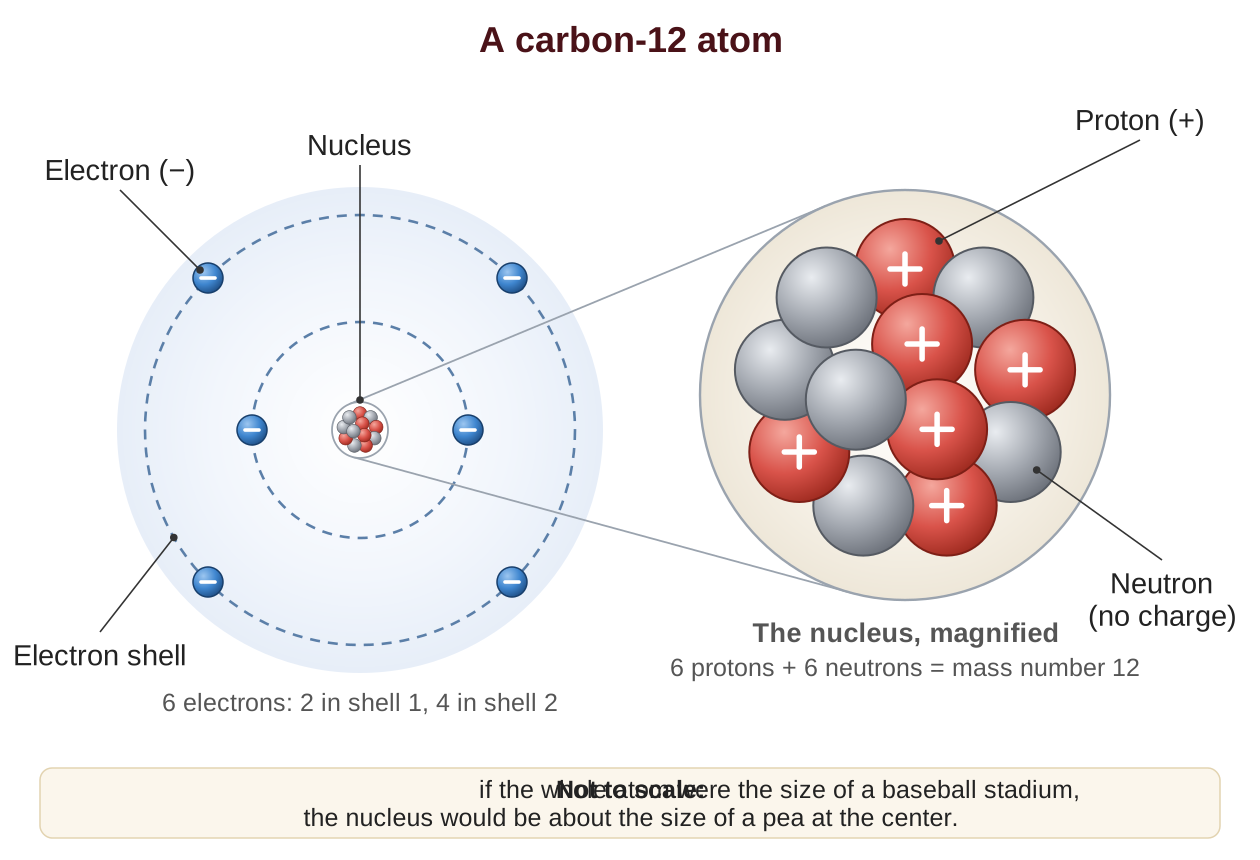
For a long time, people thought atoms were the smallest things there are. Around 1900, scientists found that atoms are made of even smaller particles. There are three of them, called subatomic particles (sub means under or below):
- Protons, which carry a positive electric charge.
- Neutrons, which carry no charge. They are neutral, which is where the name comes from.
- Electrons, which carry a negative charge.
The protons and neutrons are packed together in the center of the atom, in a tiny, heavy core called the nucleus. The electrons move around the nucleus, far outside it.
Charge
Electric charge comes in two kinds, positive and negative. The rule is simple: opposite charges attract and like charges repel (push each other away). The negative electrons are attracted to the positive protons in the nucleus. That attraction is what keeps the electrons around the atom.
A proton’s charge is written +1 and an electron’s is written −1. They are exactly equal in size and opposite in sign. An ordinary atom has the same number of electrons as protons, so the charges cancel, and the atom as a whole has no charge. Scientists say the atom is neutral.
Mass
Atoms are so light that grams are far too big a unit for them. Scientists use the atomic mass unit (amu) instead. A proton has a mass of about 1 amu. A neutron is just slightly heavier, also about 1 amu. An electron is much, much lighter: it would take about 1,836 electrons to match the mass of one proton. For counting purposes, an electron’s mass is treated as zero.
| Particle | Charge | Mass | Where it is |
|---|---|---|---|
| Proton | +1 (positive) | about 1 amu | in the nucleus |
| Neutron | 0 (no charge) | about 1 amu | in the nucleus |
| Electron | −1 (negative) | about 1/1,836 amu (almost nothing) | outside the nucleus, in shells |
So almost all of an atom’s mass is in its nucleus. Yet the nucleus is unbelievably small compared with the whole atom. If an atom were blown up to the size of a baseball stadium, the nucleus would be about the size of a pea at the center, and the electrons would be moving around somewhere out in the seats. Nearly all of an atom is empty space.
An atom has a nucleus of protons (+1, about 1 amu) and neutrons (no charge, about 1 amu), with electrons (−1, almost no mass) moving around it. Almost all the mass is in the nucleus. A neutral atom has as many electrons as protons.
Going further: are protons and neutrons made of anything smaller?
Yes. Each proton and each neutron is made of three smaller particles called quarks, held together very tightly. As far as scientists can tell, electrons are not made of anything smaller. The GED test does not ask about quarks.
Counting particles: atomic number, mass number, and neutrons
Three numbers describe an atom. Once you know two of them, you can work out the third.
The atomic number
The atomic number is the number of protons in the atom’s nucleus. This number is what makes an element that element. Every atom with 6 protons is a carbon atom. Every atom with 8 protons is oxygen. Every atom with 79 protons is gold. If an atom gained or lost a proton, it would become a different element.
In a neutral atom, the number of electrons equals the number of protons. So the atomic number also tells you the number of electrons in a neutral atom.
The mass number
The mass number is the number of protons plus neutrons in the nucleus. Protons and neutrons each have a mass of about 1, and electrons have almost none, so the mass number is very close to the mass of the whole atom in atomic mass units.
Scientists show the mass number by writing it after the name of the element, with a dash. Carbon-12 is a carbon atom with a mass number of 12. Uranium-238 is a uranium atom with a mass number of 238. Another way to write this puts the mass number above and to the left of the symbol, sometimes with the atomic number below it: 12C, or 126C.
Working out the number of neutrons
Since the mass number counts protons and neutrons together, you can find the neutrons by taking away the protons:
Number of neutrons = mass number − atomic number
How many protons, neutrons, and electrons are in an atom of sodium-23? (Sodium’s atomic number is 11.)
Protons: the atomic number is 11, so there are 11 protons.
Neutrons: the mass number is 23. 23 − 11 = 12 neutrons.
Electrons: a neutral atom has as many electrons as protons, so 11 electrons.
| Atom | Atomic number (protons) | Mass number | Neutrons | Electrons (neutral atom) |
|---|---|---|---|---|
| Carbon-12 | 6 | 12 | 12 − 6 = 6 | 6 |
| Oxygen-16 | 8 | 16 | 16 − 8 = 8 | 8 |
| Sodium-23 | 11 | 23 | 23 − 11 = 12 | 11 |
| Chlorine-35 | 17 | 35 | 35 − 17 = 18 | 17 |
| Iron-56 | 26 | 56 | 56 − 26 = 30 | 26 |
| Uranium-238 | 92 | 238 | 238 − 92 = 146 | 92 |
Reading one box of the periodic table
The periodic table (Part 9) lists every element in a box like this one:
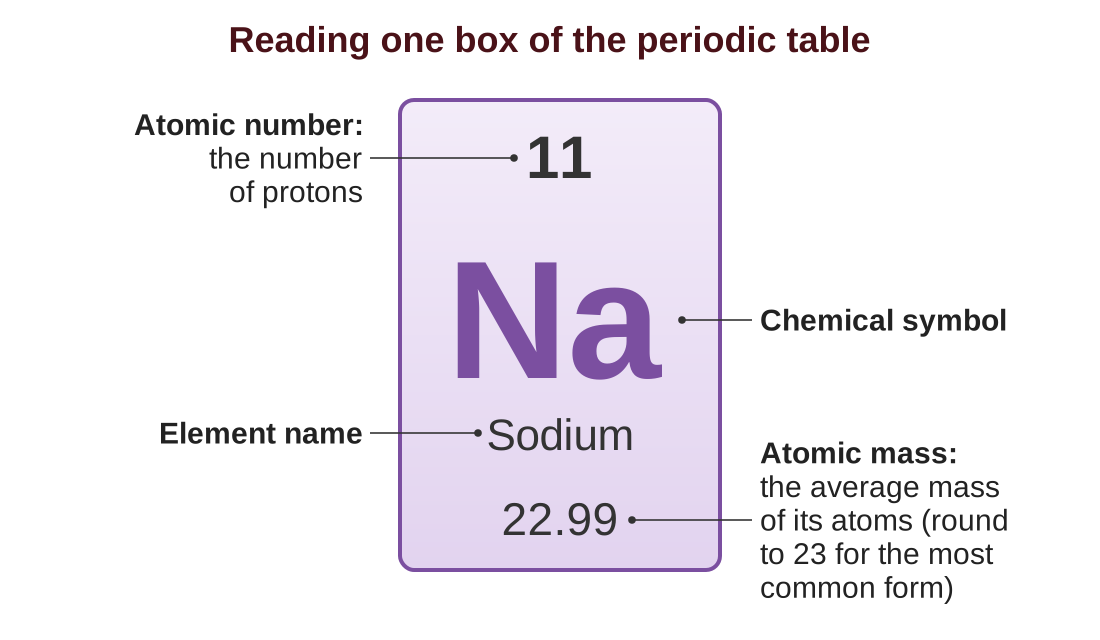
The whole number at the top is the atomic number, 11 for sodium. The decimal number at the bottom, 22.99, is the atomic mass. It is a decimal and not a whole number because it is an average: the atoms of an element do not all have the same number of neutrons (Part 5 explains this), and the atomic mass averages them, counting the common kinds more heavily than the rare ones.
To find the mass number of an element’s most common atom, round the atomic mass to the nearest whole number. Sodium’s 22.99 rounds to 23, so the most common sodium atom is sodium-23, with 23 − 11 = 12 neutrons. This shortcut works for most of the elements you will meet. A few are exceptions, but a test question will give you the numbers it expects you to use.
You do not need to memorize the periodic table. When a question shows part of the periodic table, or a box like the one above, it is asking you to read numbers off it and use them: the atomic number for protons and electrons, and mass number minus atomic number for neutrons.
Practice: counting particles
Choose an answer, then press Check. The explanation opens either way.
An atom of potassium-39 has an atomic number of 19. How many neutrons does it have?
39 − 19 = 20 neutrons. (19 is the number of protons, 39 is protons and neutrons together, and 58 comes from adding instead of taking away.)
An atom has 13 protons and 14 neutrons. What is its mass number?
Mass number = protons + neutrons = 13 + 14 = 27. This is aluminum-27, since 13 protons makes it aluminum.
A neutral atom of calcium has 20 protons. How many electrons does it have?
A neutral atom has as many electrons as protons: 20. Neutrons have no charge, so they do not affect the count of electrons.
A periodic table box shows atomic number 17 and atomic mass 35.45. How many neutrons are in the most common atom of this element?
Round 35.45 to 35 for the mass number of the most common atom. 35 − 17 = 18 neutrons. (This element is chlorine.)
Which number tells you which element an atom is?
The number of protons, the atomic number, decides the element. Atoms of one element can have different numbers of neutrons, and so different mass numbers.
Isotopes and ions
Isotopes: same element, different neutrons
All atoms of an element have the same number of protons. But they do not all have the same number of neutrons. Atoms of the same element with different numbers of neutrons are called isotopes of that element.
Carbon is a good example. Every carbon atom has 6 protons. Most carbon atoms (about 99 in every 100) have 6 neutrons: carbon-12. About 1 in 100 has 7 neutrons: carbon-13. A very few have 8 neutrons: carbon-14.
| Isotope | Protons | Neutrons | Mass number |
|---|---|---|---|
| Carbon-12 | 6 | 6 | 12 |
| Carbon-13 | 6 | 7 | 13 |
| Carbon-14 | 6 | 8 | 14 |
Isotopes of an element behave the same way in chemical reactions, because chemical behavior depends on the electrons, and the isotopes all have the same number of electrons. What differs is the mass, and sometimes how stable the nucleus is. Carbon-14 is radioactive: its nucleus slowly breaks down, at a steady, known rate. Living things take in carbon, including a little carbon-14, as long as they live. After they die, the carbon-14 in them slowly disappears. By measuring how much is left, scientists can tell how long ago a bone, a piece of wood, or a scrap of cloth was part of a living thing. This is called carbon dating, and it works for things up to about 50,000 years old.
Ions: atoms with a charge
Protons stay locked in the nucleus during chemical reactions. But electrons, out at the edge of the atom, can be gained or lost. When an atom gains or loses electrons, its protons and electrons no longer balance, and the atom has an electric charge. A charged atom is called an ion.
- An atom that loses electrons has more protons than electrons, so it becomes a positive ion.
- An atom that gains electrons has more electrons than protons, so it becomes a negative ion.
Charge of an ion = number of protons − number of electrons
Sodium has 11 protons and 11 electrons. When it loses 1 electron, it has 11 protons and 10 electrons: 11 − 10 = +1. This sodium ion is written Na+. Chlorine has 17 protons and 17 electrons. When it gains 1 electron, it has 17 protons and 18 electrons: 17 − 18 = −1. This chloride ion is written Cl−. The charge is written small and raised, after the symbol. An atom that loses or gains two electrons gets a charge of 2+ or 2−: a magnesium ion is Mg2+ and an oxide ion is O2−.
What changes, and what you get
| If an atom has a different number of | you get | Example |
|---|---|---|
| protons | a different element | 6 protons is carbon; 7 protons is nitrogen |
| neutrons | an isotope of the same element | carbon-12 and carbon-14 |
| electrons | an ion of the same element | Na and Na+ |
Practice: isotopes and ions
Choose an answer, then press Check. The explanation opens either way.
An atom has 12 protons and 10 electrons. What is its charge?
12 − 10 = +2. It has lost two electrons, so it is a positive ion. (12 protons makes it magnesium, so this is Mg2+.)
Oxygen-16 and oxygen-18 are isotopes of oxygen. How are their atoms different?
Isotopes of one element have the same number of protons (8, for oxygen) and differ only in neutrons: 16 − 8 = 8 neutrons, and 18 − 8 = 10 neutrons.
A fluorine atom (9 protons) gains one electron. What does it become?
9 protons and 10 electrons: 9 − 10 = −1. It is still fluorine, because it still has 9 protons. Gaining an electron never changes the element.
What holds the nucleus together
Here is a puzzle. Every proton carries a positive charge, and like charges push each other away. Packed together in a nucleus, protons push on each other very hard. So why doesn’t every nucleus fly apart?
What holds a nucleus together is a different force, called the strong nuclear force: a powerful pull that works only over the tiny distances inside a nucleus. Protons and neutrons both feel this pull. A neutron adds to the pull without adding any push, because it has no charge. So neutrons help hold the protons together, the way extra glue helps hold a stack of magnets that are trying to fly apart.
This explains why the most common kind of hydrogen has no neutron at all. Its nucleus is a single proton. With only one proton, there is no other proton pushing it away, so there is nothing to hold together. Helium, with 2 protons, has 2 neutrons. Bigger atoms need more and more neutrons for each proton: iron has 26 protons and 30 neutrons, and uranium has 92 protons and 146 neutrons. In the very largest atoms, even the extra neutrons are not quite enough, and the nucleus slowly breaks apart. That is why uranium is radioactive.
Neutrons do not change how an atom bonds. Bonding depends on the electrons, and a neutral atom has as many electrons as protons. That is why the drawings in the rest of this guide show the nucleus as one colored circle with its number of protons, and leave the neutrons out.
Protons repel each other. Neutrons, with no charge, add to the strong nuclear force that holds the nucleus together. Hydrogen, with a single proton, needs no neutron.
Electrons live in shells
The electrons in an atom are not scattered just anywhere. They are arranged in layers around the nucleus, called shells or energy levels. Scientists number the shells starting from the inside: shell 1 is closest to the nucleus, then shell 2, then shell 3, and so on.
Two things increase as you go outward. The shells get farther from the nucleus, and the electrons in them have more energy. An electron in an outer shell is held less tightly than one close to the center, the way a magnet holds a paper clip more weakly the farther away the clip is.
An electron is always in one shell or another. It cannot sit in the space between two shells. One way to picture this is a building: a person can stand on the first floor or the second floor, but not halfway between them. That is why the shells are also called energy levels.
How many electrons each shell holds
Each shell has room for only so many electrons. For the first 20 elements, the ones you will meet most on the GED test, the rule is:
| Shell | 1 | 2 | 3 | 4 |
|---|---|---|---|---|
| Holds up to | 2 | 8 | 8 | starts filling after shell 3 has 8 |
The shells fill from the inside out. An atom puts its first 2 electrons in shell 1. When shell 1 is full, the next electrons go into shell 2, up to 8. When shell 2 is full, the next ones go into shell 3. Sodium, with 11 electrons, has 2 in shell 1, 8 in shell 2, and 1 in shell 3. Scientists write this as 2, 8, 1.
Shell 1 holds up to 2 electrons. Shell 2 holds up to 8. For the first 20 elements, shell 3 also fills to 8, and then a fourth shell begins.
Watch an atom fill up
Add electrons one at a time, from hydrogen (1 electron) to calcium (20). Watch each shell fill, and watch the outer ring turn gold when it is full. Press Play to go through all twenty with the narration, or add one electron at a time yourself.
Going further: why the third shell is “really” 18, and where light comes from
The third shell can hold 18
The rule of 2, 8, 8 works for the first 20 elements. But the third shell can actually hold up to 18 electrons. There is a pattern: shell n can hold up to 2 × n × n electrons. Shell 1 holds 2 × 1 × 1 = 2. Shell 2 holds 2 × 2 × 2 = 8. Shell 3 holds 2 × 3 × 3 = 18.
So why does argon, at 2, 8, 8, count as full? Each shell is divided into smaller parts called sublevels, named s, p, d, and f. The first 8 places in shell 3 (its s and p sublevels) fill first. The other 10 places (its d sublevel) are higher in energy, so they fill only later, after the fourth shell has started. That happens in the short middle columns of the periodic table, in metals like iron and copper. For bonding, what matters is the outer shell, and for the elements in the tall columns, the outer shell is full at 8.
Electrons that jump, and the light they give off
An electron can move from one shell to another, but only by gaining or losing the exact amount of energy that separates the two shells. If an electron takes in energy, from heat, light, or electricity, it jumps up to a higher shell. When it falls back down, it gives off that same amount of energy, often as a flash of light.
Each element’s shells are spaced differently, so each element gives off its own colors. That is why neon signs glow red-orange, why sodium streetlights glow yellow-orange, and why fireworks makers use strontium for red, barium for green, and copper for blue. Scientists use these colors to tell what the stars are made of.
Full shells and valence electrons
A full outer shell means stable
Look at three elements in the builder above: helium (2), neon (2, 8), and argon (2, 8, 8). Each one has a full outer shell. These three are called noble gases, and they almost never react with anything. They do not need to gain, lose, or share electrons, because their outer shell is already complete. Scientists call an atom like this stable.
Every other atom has an outer shell that is not full. Atoms react with each other in ways that leave them with a full outer shell: 8 electrons in most cases, or 2 for the smallest atoms, hydrogen and helium, whose only shell is shell 1. This is sometimes called the rule of eight, or the octet rule (octet means a group of eight).
An atom is stable when its outer shell is full: 8 electrons, or 2 if shell 1 is its only shell. Atoms gain, lose, or share electrons to get there.
Valence electrons: the ones that matter for bonding
The electrons in an atom’s outer shell are called its valence electrons. They are the farthest from the nucleus and the most loosely held, so they are the electrons that take part when atoms bond. The inner electrons stay out of it.
Sodium (2, 8, 1) has 1 valence electron. Chlorine (2, 8, 7) has 7. Oxygen (2, 6) has 6. Carbon (2, 4) has 4.
The number of valence electrons tells you what an atom is likely to do:
- 1, 2, or 3 valence electrons (most of these are metals): it is easier to give away a few electrons than to find 5 or more. Sodium gives up its one.
- 5, 6, or 7 valence electrons (nonmetals): it is easier to take or share a few more than to give away so many. Chlorine takes one.
- 4 valence electrons (carbon and silicon): halfway there, so it tends to share. Carbon shares its 4, which is why it can build the long chains in sugar, fat, and DNA.
- A full outer shell (noble gases): nothing to do. It stays alone.
Notice what happens to the ions from Part 5. When sodium (2, 8, 1) loses its one valence electron, it is left with 2, 8: a full outer shell, like neon. When chlorine (2, 8, 7) gains one, it has 2, 8, 8: a full outer shell, like argon. Atoms form the ions that give them full outer shells.
The periodic table
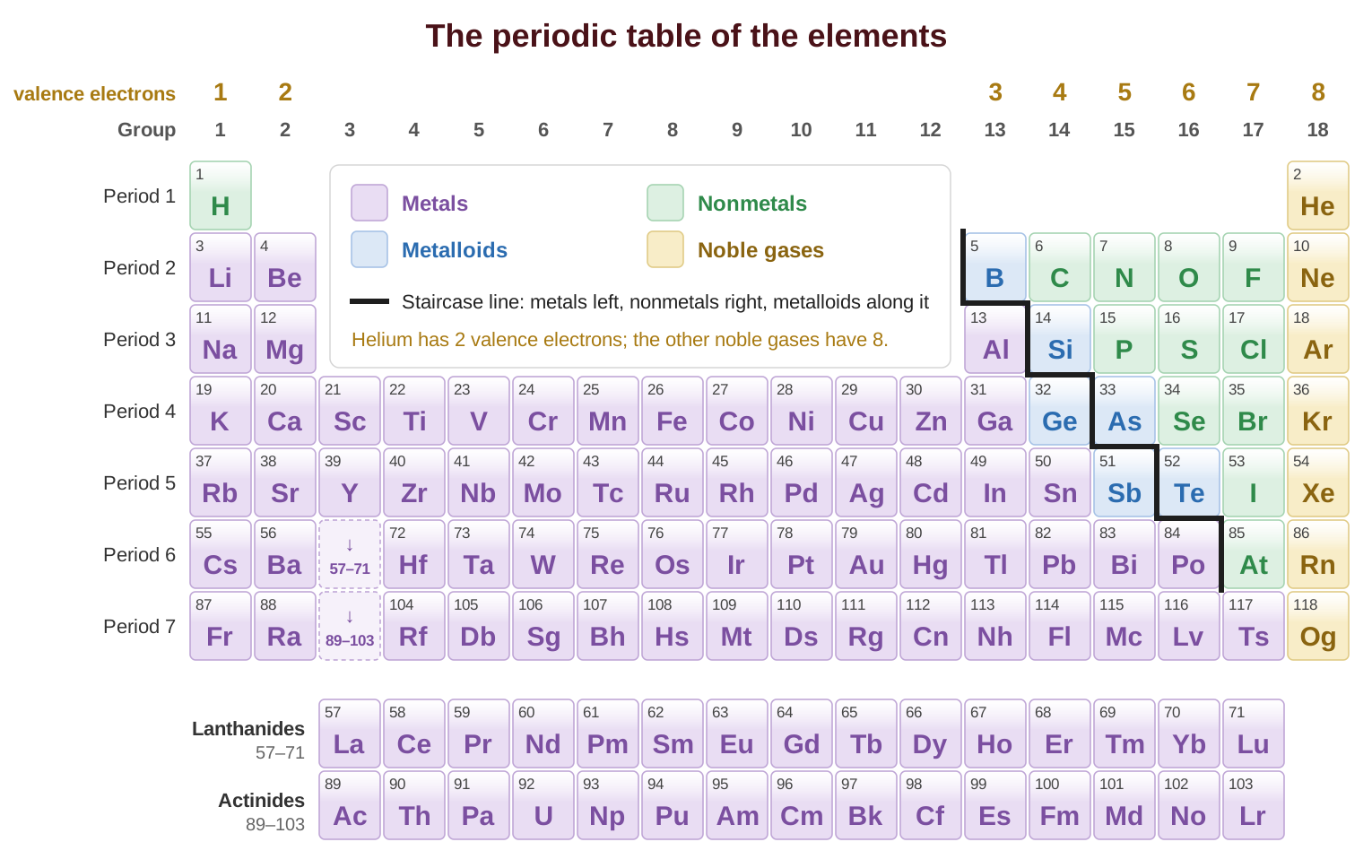
The periodic table arranges all 118 elements in order of their atomic numbers, in rows and columns. It was first worked out in 1869 by a Russian chemist, Dmitri Mendeleev. He arranged the elements known in his day so that elements with similar properties fell in the same column, and where the pattern called for an element no one had found yet, he left a gap. He even predicted what the missing elements would be like. When gallium and germanium were discovered in the years that followed, they matched his predictions closely.
Rows and columns
The rows are called periods. Every element in a row has the same number of electron shells: the elements in period 2 have 2 shells, and the elements in period 3 have 3. The columns are called groups or families. The elements in a column have the same number of valence electrons, and that is why they behave alike.
For the tall columns, you can read the number of valence electrons right off the table:
| Group (column) | 1 | 2 | 13 | 14 | 15 | 16 | 17 | 18 |
|---|---|---|---|---|---|---|---|---|
| Valence electrons | 1 | 2 | 3 | 4 | 5 | 6 | 7 | 8 (full) |
For groups 13 to 18, take away 10 from the group number. Some tables number these columns 1A to 8A instead; then the number in front of the A is the number of valence electrons. Helium is the one exception in group 18: its only shell is shell 1, so it is full with 2. The short columns in the middle of the table, groups 3 to 12, follow a more complicated pattern, and the GED test does not ask about them.
Families that behave alike
- Group 1 (lithium, sodium, potassium): 1 valence electron each. All are soft metals that react strongly with water, and the reaction gets stronger going down the column. (Hydrogen sits at the top of group 1 because it has 1 valence electron, but it is a gas and a nonmetal, not a metal.)
- Group 2 (beryllium, magnesium, calcium): 2 valence electrons each. Also reactive metals, but less so than group 1.
- Group 17 (fluorine, chlorine, bromine, iodine): 7 valence electrons each. All grab one more electron easily, and all pair up with group 1 metals to make salts like sodium chloride.
- Group 18 (helium, neon, argon): full outer shells. None of them reacts in everyday conditions.
Metals, nonmetals, and metalloids
A heavy staircase line runs down the right side of the table. The elements to its left are metals, and the elements to its right are nonmetals. The elements that sit along the line are metalloids.
| Kind | Where | What they are like | Examples |
|---|---|---|---|
| Metals | left of the staircase (most elements) | Shiny; good conductors of heat and electricity; can be bent or hammered into shape without breaking. Tend to give away electrons. | iron, copper, aluminum, sodium, calcium |
| Nonmetals | right of the staircase, plus hydrogen | Dull; poor conductors; many are gases, and the solids break easily. Tend to take or share electrons. | oxygen, carbon, nitrogen, chlorine, sulfur |
| Metalloids | along the staircase | Partly like metals and partly like nonmetals. Some conduct electricity only under certain conditions, which makes them useful in electronics. | silicon (in computer chips), boron |
| Noble gases | the last column | Nonmetals with full outer shells; almost never react. | helium, neon, argon |
Patterns across a row
Going from left to right across a row, each element has one more proton and one more valence electron than the one before. The elements on the left are metals that give electrons away easily. The elements on the right are nonmetals that pull electrons in. The row ends with a noble gas, whose outer shell is full. Then the next row starts a new shell, and the pattern repeats. That repeating pattern is why the table is called periodic.
Elements in the same column (group) have the same number of valence electrons, so they behave alike. Elements in the same row (period) have the same number of shells. Metals are on the left, nonmetals on the right.
When a question shows part of the periodic table, use the column to find the number of valence electrons, and use the staircase or the colors to tell metals from nonmetals.
Chemical symbols and formulas
Chemical symbols
Each element has a chemical symbol of one or two letters. The first letter is always a capital; the second, if there is one, is always small. Most symbols come from the English name: H for hydrogen, O for oxygen, C for carbon, Ca for calcium, Cl for chlorine. A few come from the old Latin names: Na for sodium (natrium), K for potassium (kalium), Fe for iron (ferrum), Au for gold (aurum), Ag for silver (argentum), and Pb for lead (plumbum).
Co is cobalt, a single element. CO is carbon monoxide, a compound of carbon and oxygen. A capital letter always starts a new element.
Chemical formulas
A chemical formula shows which elements are in a substance and how many atoms of each. The small number written low after a symbol is called a subscript. It tells how many atoms of the element just before it. When there is no subscript, there is one atom.
| Formula | Name | Atoms of each element | Total atoms |
|---|---|---|---|
| H2O | water | 2 hydrogen, 1 oxygen | 3 |
| CO2 | carbon dioxide | 1 carbon, 2 oxygen | 3 |
| O2 | oxygen gas | 2 oxygen | 2 |
| CH4 | methane (natural gas) | 1 carbon, 4 hydrogen | 5 |
| NaCl | table salt | 1 sodium, 1 chlorine | 2 |
| C6H12O6 | glucose (a sugar) | 6 carbon, 12 hydrogen, 6 oxygen | 24 |
Parentheses and big numbers in front
Sometimes a group of atoms is put in parentheses with a subscript after it. The subscript then multiplies everything inside. Calcium hydroxide, Ca(OH)2, has 1 calcium, 2 oxygen, and 2 hydrogen atoms.
A large number written in front of a formula is called a coefficient. It tells how many molecules there are. 2H2O means two water molecules: 2 × 2 = 4 hydrogen atoms and 2 × 1 = 2 oxygen atoms. You will use coefficients when you balance chemical equations in Chemistry 2.
How many atoms of each element are in 3CO2?
The coefficient 3 means three molecules of CO2. Each has 1 carbon and 2 oxygen.
Carbon: 3 × 1 = 3. Oxygen: 3 × 2 = 6. Total: 9 atoms.
Practice: reading formulas
Choose an answer, then press Check. The explanation opens either way.
How many hydrogen atoms are in one molecule of ammonia, NH3?
The subscript 3 belongs to the H just before it: 3 hydrogen atoms. The N has no subscript, so there is 1 nitrogen atom.
How many atoms in all are in one molecule of glucose, C6H12O6?
6 + 12 + 6 = 24 atoms. (3 counts the elements, not the atoms; 72 comes from multiplying instead of adding.)
How many oxygen atoms are in 2H2O?
Each water molecule has 1 oxygen atom, and the coefficient 2 means two molecules: 2 × 1 = 2 oxygen atoms. (There are 4 hydrogen atoms.)
Which formula is a compound containing cobalt?
Co, with a small o, is cobalt. CoCl2 is cobalt chloride. CO and CO2 start with a capital C followed by a capital O: carbon and oxygen.
Covalent bonds: sharing electrons
Atoms bond in ways that leave them with full outer shells. There are two main ways to do it, and which one happens depends on what kind of atoms meet.
- When two nonmetals meet, neither one gives up electrons easily, so they share. A shared pair of electrons is a covalent bond. This part is about covalent bonds.
- When a metal meets a nonmetal, the metal hands over its few valence electrons and the nonmetal takes them. The atoms become ions with opposite charges, and the charges attract. That attraction is an ionic bond. Part 12 is about ionic bonds.
Sharing: the covalent bond
In a covalent bond, two atoms each put one electron into a pair, and both atoms count that pair as their own. The shared pair sits between the two nuclei, and both nuclei pull on it. That shared pull is what holds the atoms together. (Co- means together, as in co-workers; the atoms hold their valence electrons together.)
Water is the classic example. Oxygen has 6 valence electrons and needs 2 more. Each hydrogen has 1 and needs 1 more to fill shell 1. Oxygen shares one pair with each hydrogen. Then oxygen counts 8 in its outer shell, and each hydrogen counts 2. Everyone is full.
Sharing electrons: water, H2O
More than one shared pair
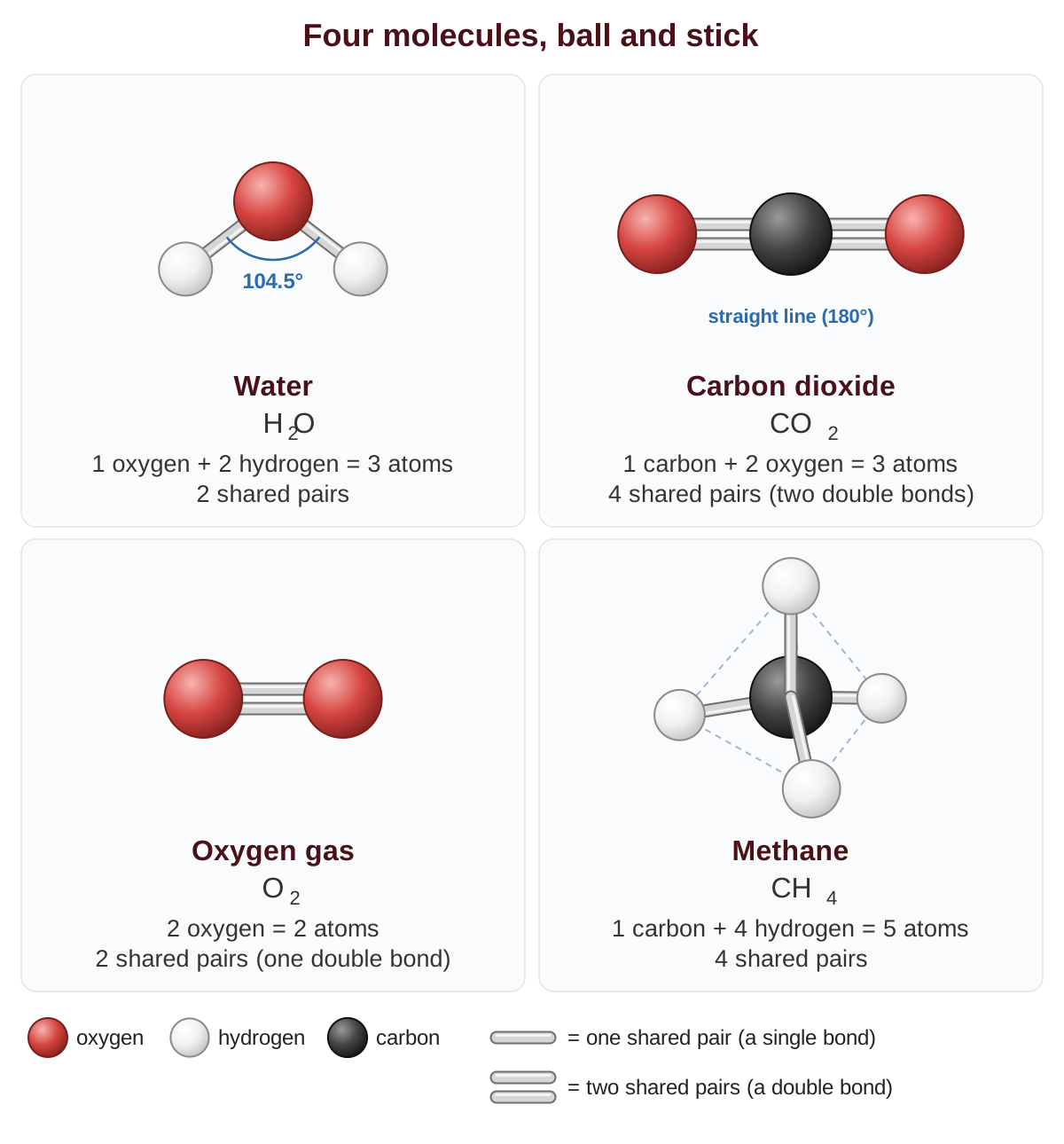
Sometimes two atoms share more than one pair. In oxygen gas, O2, each oxygen atom has 6 valence electrons and needs 2 more. The two atoms share two pairs, four electrons in all. Two shared pairs make a double bond.
In carbon dioxide, CO2, carbon has 4 valence electrons and needs 4 more. Each oxygen needs 2. Carbon shares two pairs with each oxygen: two double bonds. Carbon now counts 8, and so does each oxygen.
In methane, CH4, carbon shares one pair with each of four hydrogen atoms: four single bonds. Look back at the drawing of four molecules in Part 10 to see all of these.
Carbon’s 4 valence electrons let it form four bonds at once, with hydrogen, oxygen, nitrogen, and above all other carbon atoms. That is how carbon builds the long chains and rings in sugar (C6H12O6), fat, protein, and DNA, the molecules of life. All of their bonds are covalent.
Substances held together by covalent bonds are made of separate molecules. Many of them are gases or liquids at room temperature (oxygen, carbon dioxide, water), or solids that melt fairly easily (sugar, wax).
In a covalent bond, two nonmetal atoms share a pair of electrons, and both count it toward a full outer shell. Two shared pairs make a double bond.
Going further: unequal sharing and triple bonds
Atoms do not always share equally. Oxygen pulls on shared electrons harder than hydrogen does, so in a water molecule the shared electrons spend more time near the oxygen. That makes the oxygen end of the molecule slightly negative and the hydrogen ends slightly positive. A molecule with a slightly negative end and a slightly positive end is called polar. Water’s polarity explains many of its unusual properties, including why so many things dissolve in it. Chemistry 2 comes back to this.
Two atoms can even share three pairs, a triple bond. The nitrogen gas that makes up most of the air, N2, is held together by a triple bond, which is very hard to break. That is why nitrogen gas hardly reacts with anything.
Ionic bonds: handing electrons over
When a metal meets a nonmetal, they do not share. The metal has only 1, 2, or 3 valence electrons, held loosely, and the nonmetal pulls on electrons strongly. So the metal hands over its valence electrons, and the nonmetal takes them.
Sodium and chlorine show how this works. Sodium (2, 8, 1) gives its one valence electron to chlorine (2, 8, 7). Now sodium is 2, 8, with a full outer shell, and chlorine is 2, 8, 8, also full. But the trade has left them charged. Sodium has 11 protons and only 10 electrons: it is a positive ion, Na+. Chlorine has 17 protons and 18 electrons: it is a negative ion, Cl−.
Opposite charges attract. The pull between the positive sodium ion and the negative chloride ion is called electrostatic attraction, and it is what holds them together. This attraction between oppositely charged ions is an ionic bond.
Handing over an electron: table salt, NaCl
Ionic compounds form crystals
An ionic compound is not made of separate molecules. A grain of salt is a huge, orderly stack of sodium ions and chloride ions, one after another, in every direction. Each sodium ion is surrounded by six chloride ions, and each chloride ion by six sodium ions. A regular, repeating arrangement like this is called a crystal. That is why salt grains, seen under a magnifying glass, are little cubes.
The formula NaCl does not describe one molecule. It describes the ratio of ions in the crystal: one sodium ion for each chloride ion.
Ionic compounds share some properties. They are hard but break easily, and they melt only at high temperatures (table salt melts at 801°C, about 1,474°F). Many dissolve in water, and when they do, the ions come apart and move freely, so the solution conducts electricity. That is why salt water conducts electricity and pure water hardly does.
Other ionic compounds
- Magnesium oxide, MgO. Magnesium (2 valence electrons) gives both of them to oxygen (6 valence electrons, needs 2). The ions are Mg2+ and O2−. Magnesium oxide is the bright white powder left when magnesium metal burns, as it does in some flares and fireworks.
- Calcium chloride, CaCl2. Calcium has 2 valence electrons to give away, but each chlorine atom takes only one. So it takes two chlorine atoms to take both: one Ca2+ ion for every two Cl− ions. That is what the subscript 2 says. Calcium chloride is spread on icy sidewalks.
- Calcium carbonate, CaCO3, the material of chalk, limestone, seashells, and eggshells, and an ingredient in some antacid tablets. Here the calcium ion, Ca2+, is bonded to a group of atoms, the carbonate group, CO3. Inside the carbonate group, the carbon and oxygen atoms share electrons: their bonds are covalent. The group as a whole carries a charge of 2−, and it is held to the calcium ion by an ionic bond. So one compound can contain both kinds of bond.
- Sodium bicarbonate, NaHCO3, baking soda. In the same way, a sodium ion, Na+, is held by an ionic bond to the bicarbonate group, HCO3−, whose own atoms are joined by covalent bonds.
In an ionic bond, a metal hands its valence electrons over to a nonmetal. The metal becomes a positive ion, the nonmetal a negative ion, and the electrostatic attraction between the opposite charges holds them together.
Which kind of bond? A rule of thumb
You can usually tell which kind of bond two elements will form just by finding them on the periodic table.
Metal + nonmetal → ionic bond (electrons handed over).
Nonmetal + nonmetal → covalent bond (electrons shared).
Remember that hydrogen counts as a nonmetal, even though it sits at the top of group 1.
| Compound | Elements | Kinds | Bond |
|---|---|---|---|
| NaCl, table salt | sodium + chlorine | metal + nonmetal | ionic |
| H2O, water | hydrogen + oxygen | nonmetal + nonmetal | covalent |
| CO2, carbon dioxide | carbon + oxygen | nonmetal + nonmetal | covalent |
| MgO, magnesium oxide | magnesium + oxygen | metal + nonmetal | ionic |
| CH4, methane | carbon + hydrogen | nonmetal + nonmetal | covalent |
| KCl, potassium chloride (salt substitute) | potassium + chlorine | metal + nonmetal | ionic |
| NH3, ammonia | nitrogen + hydrogen | nonmetal + nonmetal | covalent |
Like most rules of thumb, this one has exceptions, but the GED test sticks to clear cases like the ones above.
Going further: when metal meets metal
In a piece of pure metal, or a mix of metals such as brass or steel, the atoms neither trade electrons nor share them in pairs. Each atom lets its valence electrons go, and those electrons drift freely through the whole piece of metal, shared by all the atoms at once. This is called metallic bonding. Those free-moving electrons are why metals carry electricity so well: an electric current is a flow of electrons, and in a metal, the electrons are already free to flow.
Practice: ionic or covalent?
Choose an answer, then press Check. The explanation opens either way.
Lithium fluoride, LiF (lithium is a metal in group 1; fluorine is a nonmetal in group 17)
Metal + nonmetal: lithium hands its one valence electron to fluorine, giving Li+ and F−.
Hydrogen chloride, HCl
Hydrogen and chlorine are both nonmetals, so they share a pair of electrons.
Calcium oxide, CaO (lime)
Calcium is a metal in group 2 and oxygen is a nonmetal, so calcium hands its 2 valence electrons to oxygen: Ca2+ and O2−.
Carbon tetrachloride, CCl4
Carbon and chlorine are both nonmetals. Carbon shares one pair with each of the four chlorine atoms.
The terms in this guide
Matter anything that has mass and takes up space.
Mass the amount of matter in something, measured in grams or kilograms.
Weight how hard gravity pulls on a mass. It changes with gravity; mass does not.
Volume the amount of space something takes up.
Energy the ability to do work or to cause a change.
Chemical energy energy stored in the bonds that hold atoms together.
Law of conservation of energy energy can change form, but it is never created or destroyed.
Element a pure substance that cannot be broken down into anything simpler by chemical means. There are 118.
Atom the smallest piece of an element that is still that element.
Chemical bond the connection that holds two atoms together.
Molecule two or more atoms bonded together into a unit.
Compound a substance made of two or more different elements bonded together in a fixed proportion.
Subatomic particle one of the particles atoms are made of: protons, neutrons, and electrons.
Proton a particle in the nucleus with a charge of +1 and a mass of about 1 amu.
Neutron a particle in the nucleus with no charge and a mass of about 1 amu.
Electron a particle outside the nucleus with a charge of −1 and almost no mass.
Nucleus (of an atom) the tiny, heavy center of an atom, holding its protons and neutrons.
Atomic mass unit (amu) the unit for the mass of atoms and their particles; a proton is about 1 amu.
Neutral having no overall electric charge.
Atomic number the number of protons in an atom. It decides which element the atom is.
Mass number the number of protons plus neutrons in an atom.
Atomic mass the average mass of an element’s atoms, shown as a decimal on the periodic table.
Isotopes atoms of the same element with different numbers of neutrons.
Radioactive having a nucleus that breaks down over time, giving off particles and energy.
Ion an atom (or group of atoms) with an electric charge, because it has gained or lost electrons.
Strong nuclear force the powerful pull, working only over very short distances, that holds protons and neutrons together in the nucleus.
Electron shell (energy level) one of the layers in which electrons are arranged around the nucleus.
Valence electrons the electrons in an atom’s outer shell; they take part in bonding.
Stable not likely to react; for an atom, having a full outer shell.
Noble gases the elements in the last column of the periodic table, with full outer shells; they almost never react.
Periodic table the chart of all the elements in order of atomic number, arranged so that elements in a column behave alike.
Period a row of the periodic table; its elements have the same number of shells.
Group (family) a column of the periodic table; its elements have the same number of valence electrons.
Metal an element that is shiny, conducts heat and electricity, and tends to give away electrons.
Nonmetal an element that is usually dull and a poor conductor, and tends to take or share electrons.
Metalloid an element with some properties of metals and some of nonmetals, such as silicon.
Chemical symbol the one- or two-letter abbreviation for an element, such as C for carbon or Na for sodium.
Chemical formula symbols and numbers that show which elements are in a substance and how many atoms of each.
Subscript the small, low number after a symbol in a formula; it tells how many atoms of that element.
Coefficient a large number in front of a formula; it tells how many molecules or units there are.
Covalent bond a bond in which two atoms share a pair of electrons; usually between nonmetals.
Double bond a covalent bond made of two shared pairs of electrons.
Ionic bond the attraction between a positive ion and a negative ion, formed when a metal hands electrons to a nonmetal.
Electrostatic attraction the pull between opposite electric charges.
Crystal a solid whose particles are arranged in a regular, repeating pattern.
15 questions on this guide
Check yourself
Choose an answer, then press Check. The explanation opens either way.
Which of these is not matter?
Light has no mass and takes up no space, so it is not matter; it is a form of energy. Air is matter even though you cannot see it: it has mass and fills space.
An astronaut travels from Earth to the Moon. What happens to her mass?
Mass is the amount of matter in her body, and that does not change. Her weight drops to about one-sixth, because the Moon’s gravity is weaker.
Which particle has a negative charge and almost no mass?
The electron carries a charge of −1, and its mass is about 1/1,836 of a proton’s. Protons and neutrons each have a mass of about 1 amu.
Where is almost all of an atom’s mass?
Protons and neutrons, which are in the nucleus, each have a mass of about 1 amu. Electrons have almost no mass. So nearly all the mass is in the tiny nucleus.
Iron-56 has an atomic number of 26. How many neutrons does an atom of iron-56 have?
Neutrons = mass number − atomic number = 56 − 26 = 30.
A periodic table box shows: 15, P, Phosphorus, 30.97. How many protons, neutrons, and electrons does a neutral atom of its most common form have?
The atomic number, 15, gives the protons, and a neutral atom has the same number of electrons. Round 30.97 to 31 for the mass number: 31 − 15 = 16 neutrons.
Chlorine-35 and chlorine-37 are both chlorine. What is different about them?
They are isotopes: same number of protons (17), and so the same element and the same bonding, but 18 and 20 neutrons.
An atom of sulfur has 16 protons. It gains 2 electrons. Which is true?
16 protons − 18 electrons = −2. Gaining electrons makes a negative ion; it is still sulfur, because the protons have not changed. Electrons add almost nothing to the mass.
Why does the most common form of hydrogen have no neutron?
Neutrons add to the strong nuclear force that holds protons together against their repulsion. With a single proton, there is nothing pushing apart, so no neutron is needed.
Magnesium has 12 electrons. How are they arranged in shells?
Shell 1 fills first, with 2. Shell 2 holds up to 8. The remaining 2 go into shell 3: 2, 8, 2. So magnesium has 2 valence electrons.
Why do elements in the same group (column) of the periodic table behave alike?
Elements in a column have the same number of valence electrons, and the valence electrons decide how an atom bonds. Elements in the same row have the same number of shells.
Nitrogen is in group 15. How many valence electrons does it have, and what does it tend to do?
For groups 13 to 18, take away 10: 15 − 10 = 5. With 5 valence electrons, nitrogen needs 3 more to reach 8, so it takes or shares electrons, like other nonmetals.
How many atoms of oxygen are in one unit of calcium carbonate, CaCO3?
The subscript 3 belongs to the O just before it: 3 oxygen atoms. Ca and C have no subscripts, so there is 1 of each, for 5 atoms in all.
In table salt, NaCl, what holds the sodium and chlorine together?
Sodium hands its valence electron to chlorine. Sodium becomes Na+, chlorine becomes Cl−, and the electrostatic attraction between the opposite charges is the ionic bond.
Which pair of elements is most likely to form a covalent bond?
Sulfur and oxygen are both nonmetals, so they share electrons. Each of the other pairs is a metal with a nonmetal, which forms an ionic bond.