What this guide is for
This guide follows Chemistry 1. That guide explained what matter is made of: atoms, the particles inside them, and how atoms bond into molecules and compounds. This guide is about what matter does. It covers how substances mix and how mixtures can be separated; solutions, and how much of something will dissolve; solids, liquids, and gases, and how one turns into another; density, and why things float or sink; the difference between a physical change and a chemical change; chemical reactions, and how to read and balance their equations; the energy that reactions give off or take in, and what makes them go faster; and finally acids, bases, and the pH scale.
Several of these topics come with a graph or diagram, and the GED test likes to ask questions about graphs and diagrams like them. Part 11 has an equation balancer you can work with your own hands: you change the numbers in an equation and watch the atoms on each side add up.
If some of the words from Chemistry 1, such as atom, molecule, compound, or chemical formula, feel unfamiliar, go back and read those parts first. Boxes marked Going further hold extra material you can skip.
Goes with: Chemistry 1: Matter, Atoms, and Bonds · the Chemistry reading
In this guide:
- Pure substances and mixtures
- Separating a mixture
- Solutions
- Concentration and solubility
- Solids, liquids, and gases
- Changes of state
- The heating curve: where the heat goes
- Density, floating, and sinking
- Physical and chemical changes
- Chemical equations and the conservation of mass
- Balancing an equation
- The limiting reactant: what runs out first
- Reactions in living things and in daily life
- Energy in reactions
- How fast reactions go: rates, catalysts, and enzymes
- Acids, bases, and pH
- Check yourself
Pure substances and mixtures
In Chemistry 1 you met elements (gold, oxygen) and compounds (water, table salt). Both are pure substances. A pure substance is made of only one kind of thing, and its makeup is always the same. Every sample of pure water, anywhere in the world, is two hydrogen atoms for every oxygen atom.
Most of the things around you are not pure substances. They are mixtures. A mixture is two or more substances mixed together but not chemically bonded. Each substance in a mixture keeps its own properties, and the amounts can vary. Salt water is a mixture: the salt is still salt and the water is still water, and you can make it saltier or less salty just by adding more of one or the other.
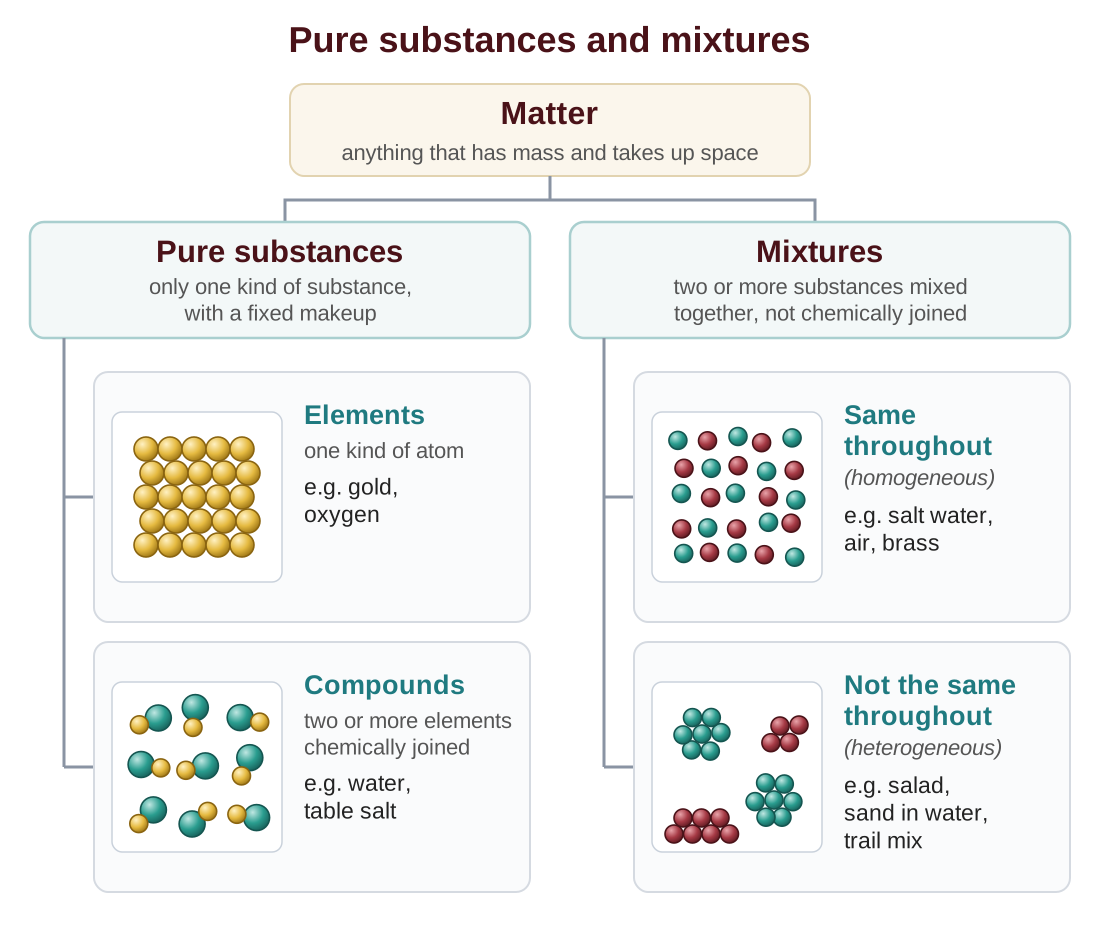
Two kinds of mixture
Some mixtures are the same throughout. Stir sugar into water until it disappears, and every sip tastes equally sweet. You cannot see the separate parts, even with a magnifying glass. Scientists call this kind of mixture homogeneous (from Greek words meaning “same kind”). Air is one: it is about 78 percent nitrogen and 21 percent oxygen, with small amounts of other gases, evenly mixed. Brass, a metal made of copper and zinc melted together, is another.
Other mixtures are not the same throughout. In a salad, a bowl of trail mix, or sand stirred into water, you can see the different parts, and one spoonful is not exactly like the next. This kind of mixture is called heterogeneous (“different kinds”).
| Pure substance | Mixture | |
|---|---|---|
| Made of | one element or one compound | two or more substances |
| Makeup | always the same | can vary: more of one, less of another |
| Parts bonded? | in a compound, yes | no; each part keeps its own properties |
| Separated by | only a chemical reaction (for a compound) | physical means: filtering, evaporating, and so on (Part 2) |
| Examples | gold, oxygen, water, table salt, sugar | salt water, air, brass, salad, soil, blood |
A pure substance (an element or a compound) has one fixed makeup. A mixture is two or more substances mixed but not bonded; each keeps its own properties. A mixture can be the same throughout (homogeneous) or not (heterogeneous).
Separating a mixture
Because the parts of a mixture are not bonded, you can separate them with physical methods: ways that do not change what the substances are. Each method takes advantage of some difference between the parts: their size, whether they dissolve, whether a magnet attracts them, or the temperature at which they boil.
- Sorting by hand or sifting. If the pieces are big enough, you can pick them out, as you might pick raisins out of trail mix, or shake them through a sieve that lets small pieces fall through and holds big ones back.
- Filtering. Pour a mixture of sand and water through filter paper (or a coffee filter). The water passes through the tiny holes; the sand stays behind. Filtering separates a solid that has not dissolved from a liquid. It cannot separate salt from salt water, because the dissolved salt passes right through the filter with the water.
- Evaporating. To get dissolved salt back out of salt water, let the water evaporate, or heat it to speed things up. The water goes off into the air as a gas, and the salt is left behind. Sea salt is made this way, in shallow ponds of seawater left in the sun.
- Using a magnet. A magnet pulls iron out of a mixture and leaves everything else. Recycling plants use huge magnets to pull steel cans out of the mixed trash.
- Distilling. To separate two liquids, or to get pure water back from salt water, heat the mixture. The part with the lower boiling point turns to a gas first. The gas is led away through a cooled tube, where it turns back into a liquid and drips into a separate container. This is distillation. It is how fresh water is made from seawater in some dry countries, and how crude oil is separated into gasoline, diesel fuel, and other products.
A compound is different. You cannot filter the hydrogen out of water or pick the sodium out of salt, because the atoms are bonded. Taking a compound apart takes a chemical reaction. For example, an electric current passed through water breaks it into hydrogen gas and oxygen gas.
The parts of a mixture can be separated by physical means, using a difference between them: filtering, evaporating, a magnet, or distilling. The elements in a compound can be separated only by a chemical reaction.
Practice: separating mixtures
Choose an answer, then press Check. The explanation opens either way.
Which method would separate sand from water?
Sand does not dissolve, so the grains are caught by a filter while the water passes through.
A student filters salt water. What comes through the filter?
Dissolved salt is broken up into particles far too small for a filter to catch. To get the salt back, evaporate the water.
Which method takes advantage of a difference in boiling points?
In distillation, the liquid with the lower boiling point turns to gas first, and is cooled and collected separately.
Solutions
When you stir sugar into tea and it disappears, you have made a solution. A solution is a mixture that is the same throughout (homogeneous), in which one substance is spread evenly through another, broken up into particles as small as single molecules or ions. The particles are so small that they never settle to the bottom and cannot be filtered out.
- The solute is the substance that dissolves: the sugar.
- The solvent is the substance it dissolves in: the water in the tea. Usually the solvent is the substance there is more of.
- To dissolve is to break up and spread evenly through a solvent.
A simple way to keep the words straight: the solvent does the dissolving; the solute is what gets dissolved.
People often say that sugar “melts” in tea. It does not. Melting is a solid turning into a liquid because it has been heated, as when ice becomes water. Sugar in tea is not turning into liquid sugar; its molecules are being pulled apart and spread out among the water molecules. That is dissolving.
Water: the common solvent
More things dissolve in water than in any other common liquid, so water is sometimes called the universal solvent. The reason lies in its molecules. As Chemistry 1 explained, oxygen pulls on the shared electrons in a water molecule harder than hydrogen does, so the oxygen end of the molecule is slightly negative and the hydrogen ends are slightly positive. Those charged ends tug on the charged particles of other substances. When salt goes into water, the water molecules crowd around each sodium ion and each chloride ion and pull them away from the crystal, one by one.
That is why water matters so much to living things. Blood, sap, and the fluid inside every cell are water solutions, carrying sugar, salts, and oxygen wherever they are needed.
Not every solution is a liquid
Air is a solution of gases, with nitrogen as the solvent and oxygen and the other gases as solutes. Brass is a solid solution of zinc in copper. Soda is a solution with a gas, carbon dioxide, dissolved in a liquid. Any mixture that is the same throughout is a solution.
A solution is a mixture that is the same throughout. The solute dissolves in the solvent. Water dissolves more substances than any other common liquid.
Concentration and solubility
Concentration: how much is dissolved
The concentration of a solution is how much solute there is in a certain amount of solution. A glass of water with one spoonful of sugar in it has a low concentration of sugar; with five spoonfuls, a high concentration. A solution with only a little solute is dilute. A solution with a lot of solute is concentrated. In everyday speech people say “weak” and “strong,” as in weak tea or strong coffee.
Concentration is often written as an amount of solute per amount of solution: for example, grams per liter (g/L). Seawater has about 35 grams of salt in every liter. To dilute a solution, add more solvent: the same amount of solute is spread through more liquid, so the concentration goes down. That is what you do when you add water to orange juice concentrate.
Two glasses of salt water: Glass A has 10 grams of salt in 200 mL of water. Glass B has 10 grams of salt in 500 mL. Which is more concentrated?
Both have the same amount of salt, but in Glass A it is spread through less water. So Glass A is more concentrated.
To check with numbers: Glass A has 10 ÷ 200 = 0.05 gram of salt in each milliliter. Glass B has 10 ÷ 500 = 0.02 gram in each milliliter. 0.05 is more than 0.02.
Solubility: how much can dissolve
Keep adding sugar to a glass of water and stirring, and eventually no more will dissolve. The extra sugar just sinks to the bottom. The solubility of a substance is the most of it that can dissolve in a certain amount of solvent at a certain temperature. It is often given as the number of grams that will dissolve in 100 grams of water.
A solution that holds all the solute it can is saturated. A solution that could still dissolve more is unsaturated.
Temperature changes solubility
For most solids, more dissolves in hot water than in cold. That is why sugar dissolves easily in hot tea but sits at the bottom of iced tea. The graph below shows how the solubility of two compounds changes with the temperature of the water.
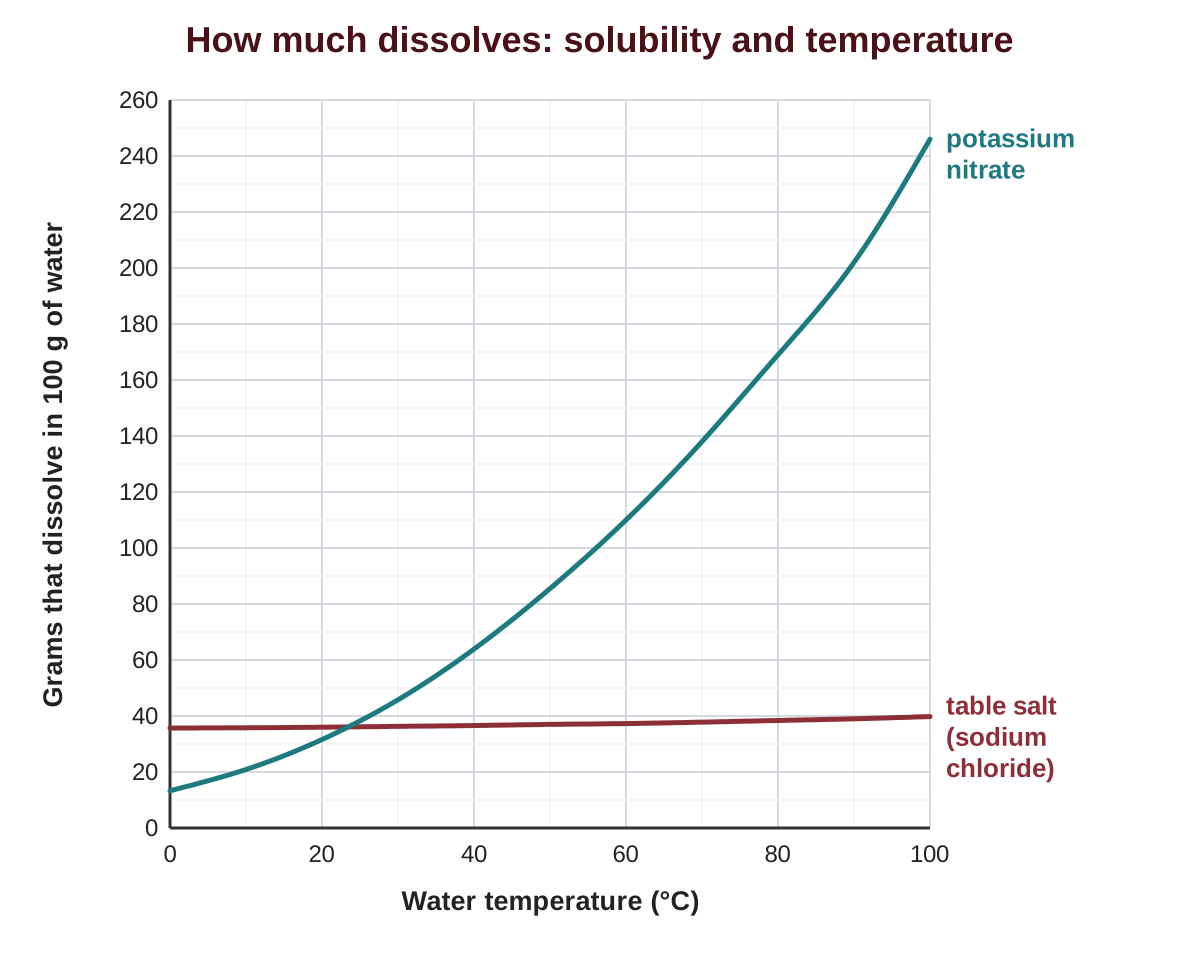
To read a value from the graph, find the temperature on the bottom axis, go straight up to the line, then straight across to the axis on the left. At 40°C, the potassium nitrate line is at about 64, so about 64 grams of potassium nitrate will dissolve in 100 grams of water at 40°C. Table salt behaves very differently. Its line is almost flat: about 36 grams dissolve at 0°C and only about 40 grams at 100°C. Heating the water hardly helps.
At 60°C, a student stirs 80 grams of potassium nitrate into 100 grams of water. Is the solution saturated?
Read the graph at 60°C: the potassium nitrate line is at about 110 grams. That is the most that can dissolve.
80 grams is less than 110 grams, so all of it dissolves and there is room for about 30 grams more. The solution is unsaturated.
Gases behave the opposite way: less gas dissolves in warm water than in cold. A warm soda goes flat faster than a cold one, because the carbon dioxide escapes. In warm summer water, fish can run short of oxygen, because warm water holds less of it.
Concentration is how much solute is in a certain amount of solution. Solubility is the most that can dissolve. Most solids dissolve better in hot water; gases dissolve better in cold water.
Going further: more than saturated
If you dissolve as much sugar as you can in very hot water and then let it cool slowly and undisturbed, the water can end up holding more sugar than it normally could at the lower temperature. This is a supersaturated solution. It is unstable: drop in a grain of sugar or a string, and the extra sugar comes out of solution as crystals. That is how rock candy is made, and why old honey sometimes turns grainy.
Practice: reading the solubility graph
Choose an answer, then press Check. The explanation opens either way.
About how many grams of potassium nitrate dissolve in 100 g of water at 20°C?
At 20°C the potassium nitrate line is at about 32 grams (the real value is 31.6).
At about what temperature does the same amount of potassium nitrate and table salt dissolve?
The two lines cross at about 23°C, where about 36 grams of each will dissolve.
A saturated solution of potassium nitrate at 80°C is cooled to 20°C. What happens?
At 80°C about 169 grams were dissolved. At 20°C only about 32 grams can stay dissolved, so about 137 grams come back out as solid.
Which statement does the graph support?
The potassium nitrate line rises steeply. The table salt line is nearly flat. And above about 23°C, potassium nitrate is the more soluble one.
Solids, liquids, and gases
Matter on Earth is usually found in one of three states: solid, liquid, or gas. Water is the familiar example: ice, liquid water, and steam (or water vapor) are the same substance, H2O, in three states. The difference between them is not in the molecules themselves but in how the molecules are arranged and how fast they move.
All particles of matter are always moving. The more energy they have, the faster they move. Temperature is a measure of how fast, on average, the particles of a substance are moving.
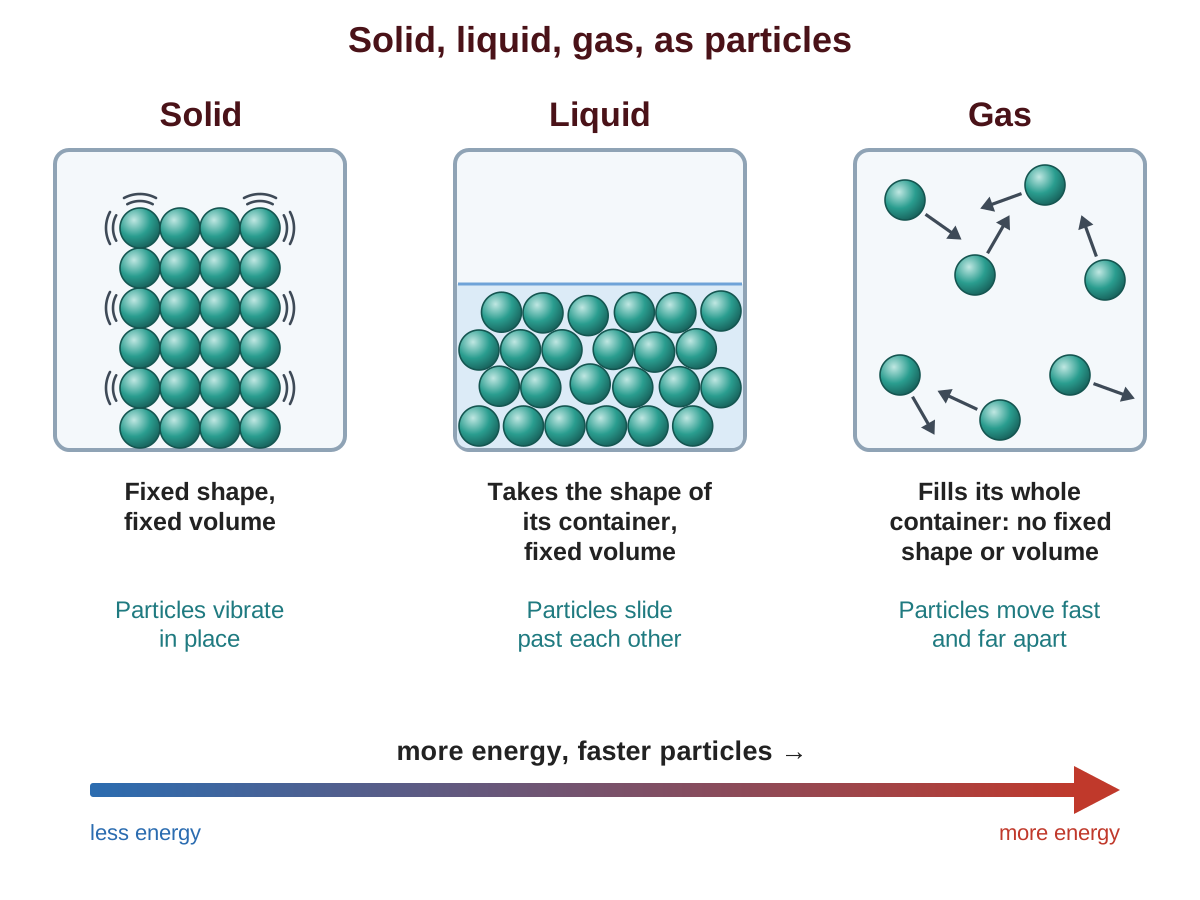
- Solid. The particles are packed tightly together, held in place by their pull on each other. They cannot move around; they only vibrate in place. So a solid keeps its own shape and its own volume. A brick is a brick wherever you put it.
- Liquid. The particles are still close together, but they have enough energy to slide past one another. So a liquid has a fixed volume, but it flows and takes the shape of whatever container it is in. A liter of milk is a liter whether it is in a carton or a pitcher.
- Gas. The particles have so much energy that they break away from each other and fly around, far apart, until they hit something. So a gas has no fixed shape and no fixed volume: it spreads out to fill any container, and it can be squeezed into a smaller space, which is how air is pumped into a tire.
Watch a gas spread out
The particles of a gas never stop moving, and they move in every direction. So a gas that is crowded into one place does not stay there. In the box below, a divider holds 60 gas particles in one quarter of the space: a high concentration, as Part 4 used the word. Remove the divider and watch what happens. The bars under the box count how many particles are in each quarter.
No one pushes the particles to the right. Each one just keeps moving in a straight line until it hits a wall or another particle. But while all of them are crowded on the left, far more particles happen to move from left to right than from right to left, because there are far more on the left to begin with. So the gas spreads from where it is crowded toward where it is not, until it is spread evenly. Then particles still move, but as many cross one way as the other.
This spreading of particles from a high concentration to a low concentration is called diffusion. It is why the smell of cooking reaches you in the next room, and why a few drops of food coloring slowly color a whole glass of still water. It also moves oxygen into your blood and into your cells, as the life science guide Cells explains.
Notice, too, what happens to the density. The same 60 particles, with the same mass, end up spread through 4 times the space, so the gas is only one-fourth as dense as it was. A gas has no fixed volume, so its density changes with the space it is given (Part 8).
| Solid | Liquid | Gas | |
|---|---|---|---|
| Shape | keeps its own | takes the container’s | fills the container |
| Volume | fixed | fixed | spreads to fill any space |
| Particles | packed tight, vibrating in place | close, sliding past each other | far apart, moving fast |
| Energy of particles | least | more | most |
In a solid, particles are packed tightly and vibrate in place. In a liquid, they are close but slide past each other. In a gas, they are far apart and move fast. The more energy the particles have, the more freely they move.
Going further: a fourth state
At extremely high temperatures, as inside the Sun or in a lightning bolt, atoms are torn apart: electrons are knocked loose from their nuclei. This electrically charged gas is called plasma, and it is sometimes called the fourth state of matter. Most of the visible matter in the universe, in the stars, is plasma. Neon signs and the old plasma TVs also make it.
Changes of state
Add enough energy to a substance, usually as heat, and its particles move faster, until they can break free of the arrangement they were in. Take energy away, and they slow down and settle into a closer arrangement. Each of these changes has a name.
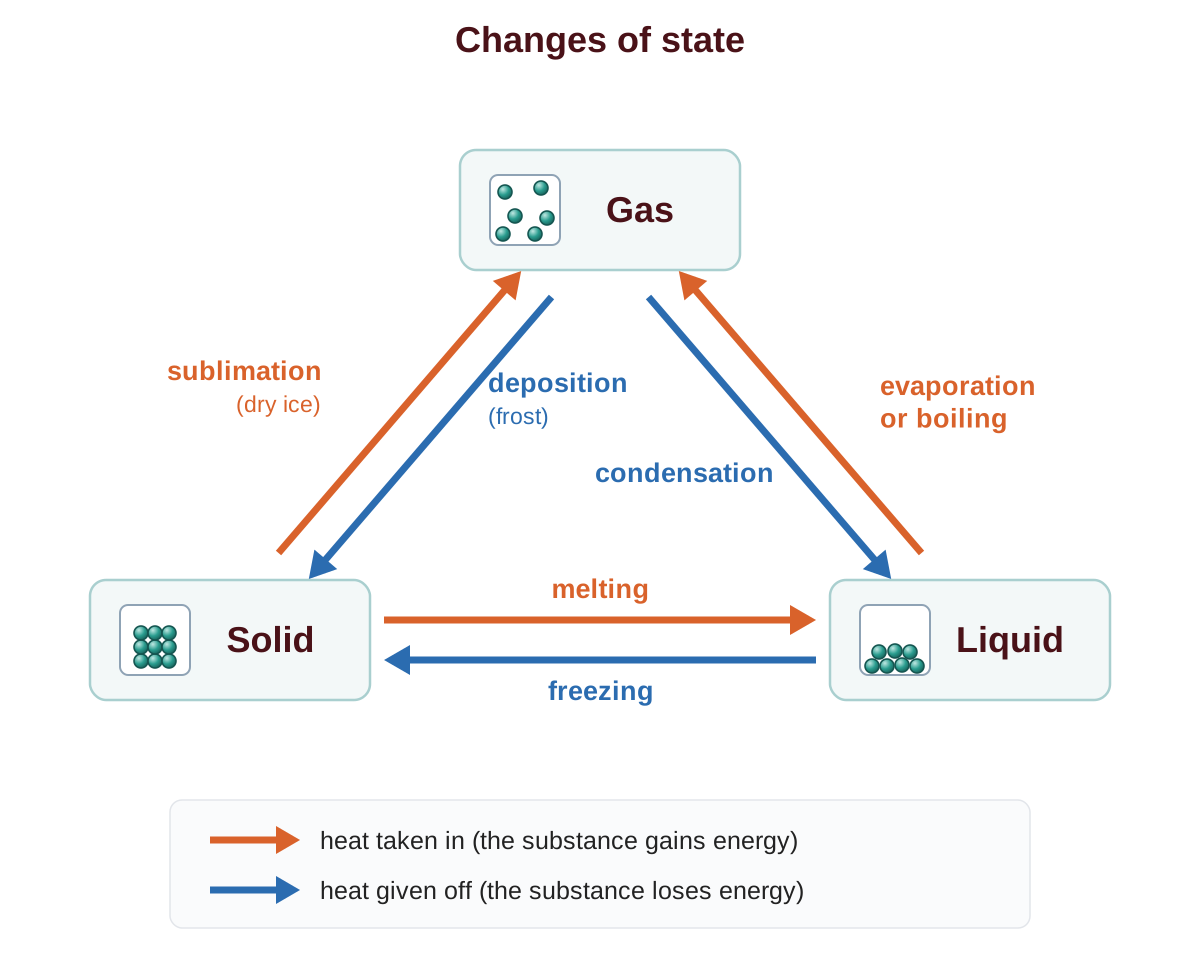
| Change | From | To | Heat is | Everyday example |
|---|---|---|---|---|
| Melting | solid | liquid | taken in | ice cream melting on a hot day |
| Freezing | liquid | solid | given off | water turning to ice in the freezer |
| Evaporation, boiling | liquid | gas | taken in | a puddle drying up; a pot of water boiling |
| Condensation | gas | liquid | given off | drops forming on a cold glass; fog on a bathroom mirror |
| Sublimation | solid | gas | taken in | dry ice (frozen carbon dioxide) turning straight into gas |
| Deposition | gas | solid | given off | frost forming on a window on a cold night |
Evaporation and boiling
Both turn a liquid into a gas, but they are not quite the same. Evaporation happens only at the surface of a liquid, and it happens at any temperature: a puddle dries up even on a cool day, as the fastest-moving molecules at the surface escape into the air. Boiling happens throughout the liquid, at one particular temperature, the boiling point. Bubbles of gas form inside the liquid and rise. Evaporation also cools whatever it leaves behind, because the molecules that escape take energy with them. That is why sweating cools you off.
Melting points and boiling points
Every pure substance melts and boils at its own temperatures. Water melts (and freezes) at 0°C, which is 32°F, and boils at 100°C, which is 212°F, at sea level. These temperatures help identify a substance: iron melts at about 1,538°C, and table salt at 801°C. (On a high mountain, where the air pressure is lower, water boils at a lower temperature. In Denver, about a mile up, it boils at about 95°C.)
Melting, evaporation and boiling, and sublimation take in heat. Freezing, condensation, and deposition give heat off. A change of state changes how the particles are arranged, not what the substance is.
The heating curve: where the heat goes
Here is something that surprises many people. Put a pot of ice on a stove, and keep the heat steady. Measure the temperature every minute. The temperature climbs until the ice starts to melt, and then it stops climbing. It stays at 0°C until every bit of ice has melted, even though the stove is still pouring heat in. Then it climbs again until the water boils, and stops again, at 100°C, until all the water has boiled away. A graph of this is called a heating curve.
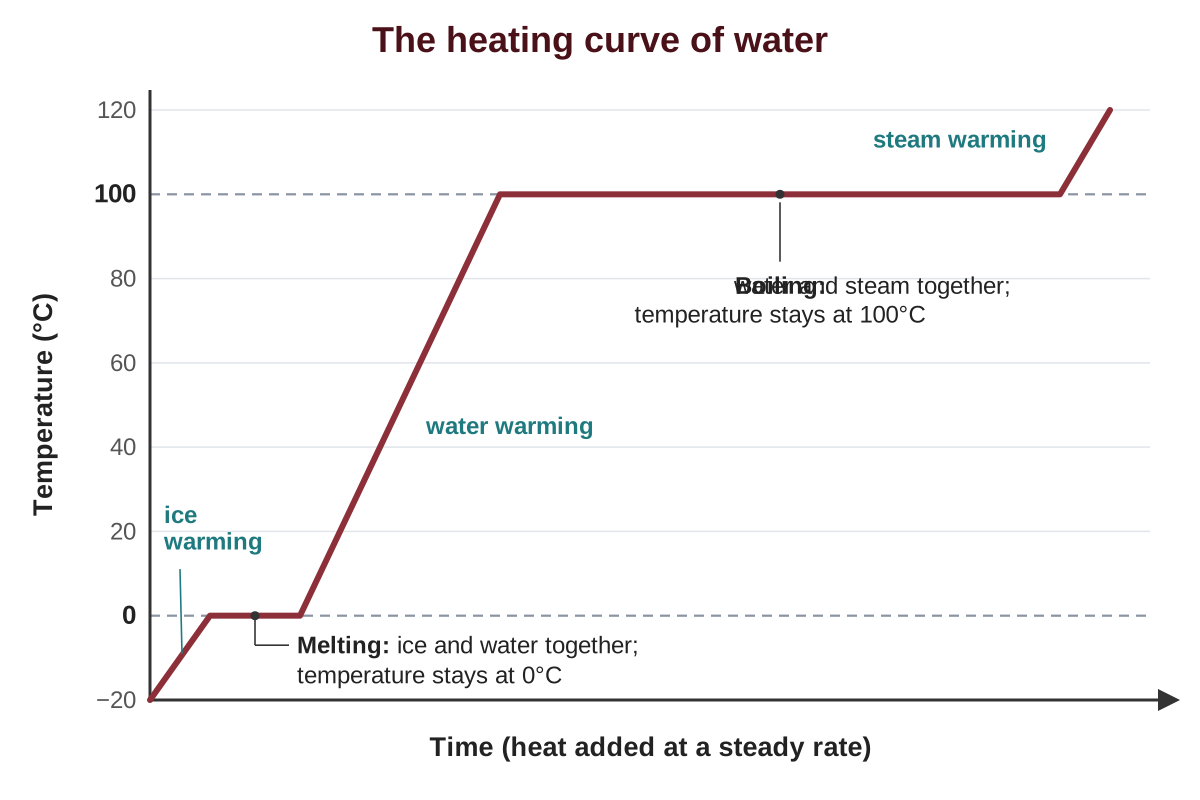
Where does the heat go?
While the line is rising, the heat is making the particles move faster, so the temperature goes up. While the line is flat, the heat is doing a different job: it is breaking the particles free of each other. During melting, the energy loosens the molecules from the rigid arrangement of ice so they can slide past each other. During boiling, it separates them completely so they can fly off as a gas. None of that energy goes into making the particles move faster, so the temperature does not change.
Notice that the boiling stretch is much longer than the melting stretch. Pulling molecules completely apart from each other takes far more energy than just loosening them: about seven times as much, for water.
Run the graph backward and you have a cooling curve. As steam cools, the temperature drops, then holds steady at 100°C while the steam condenses, giving off heat, then drops again, then holds at 0°C while the water freezes.
During a change of state, the temperature stays the same, even while heat is added, because the energy goes into separating the particles rather than speeding them up.
Practice: the heating curve
Choose an answer, then press Check. The explanation opens either way.
On the heating curve of water, what is happening during the flat part at 0°C?
At 0°C, ice and liquid water are together. The heat is melting the ice, so the temperature does not rise until all of it has melted.
Why does the temperature stay at 100°C while water boils, even though the stove is still on?
The energy goes into breaking the molecules free of each other. Once all the water is steam, the temperature of the steam rises above 100°C.
Density, floating, and sinking
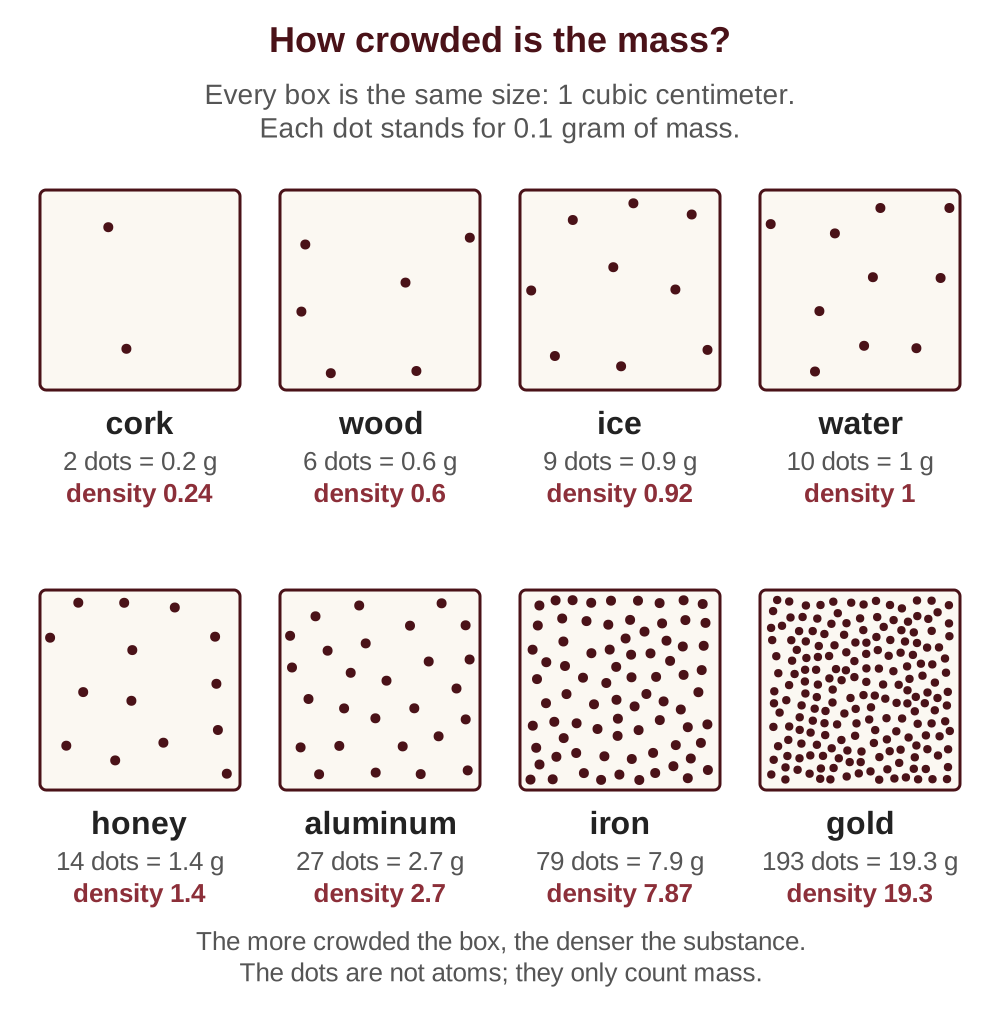
Which is heavier, a kilogram of feathers or a kilogram of iron? Neither: they both have a mass of one kilogram. But the iron would fit in your hand, and the feathers would fill a large bag. Iron packs much more mass into the same space. That is what density measures: how much mass is packed into a certain volume.
One way to picture it is the way a map shows how crowded a city is, with dots for people. In the picture below, every box is the same size, and each dot stands for the same small amount of mass. The more crowded a box is with dots, the denser the substance.
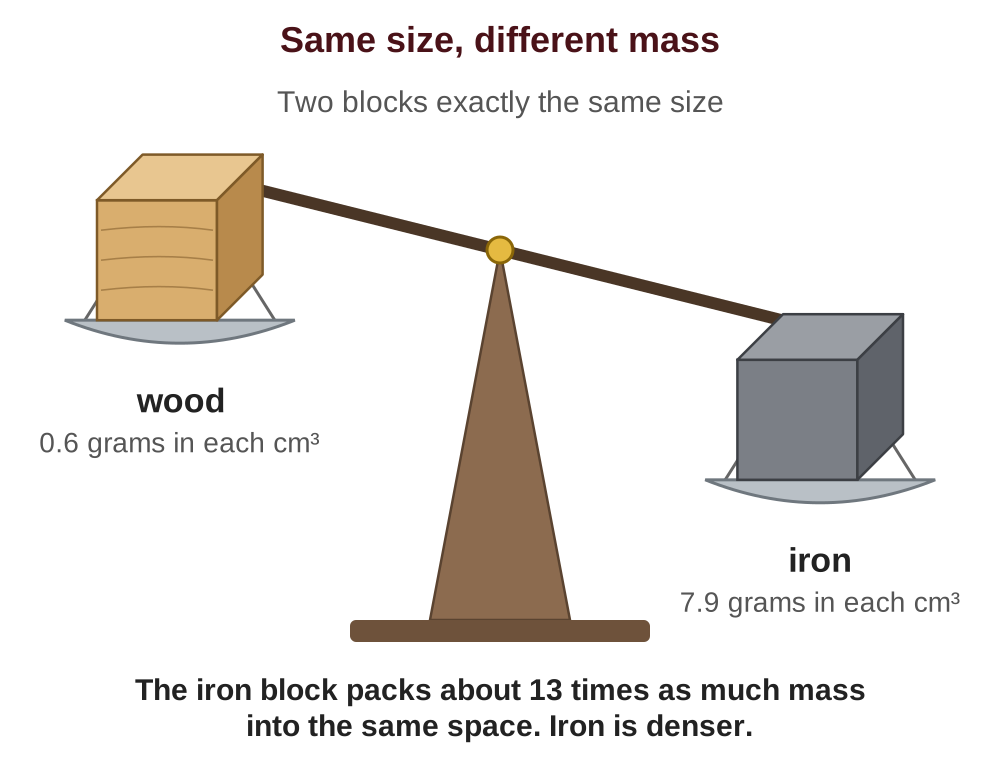
The same idea can be seen on a balance. Two blocks of exactly the same size do not have the same mass if they are made of different substances:
Density = mass ÷ volume
Mass is usually measured in grams, and volume in cubic centimeters (cm³) or milliliters (mL), which are the same size. So density is given in grams per cubic centimeter (g/cm³) or grams per milliliter (g/mL). Pure water has a density of 1 g/mL: each milliliter of water has a mass of 1 gram.
A block of wood has a mass of 30 grams and a volume of 50 cm³. What is its density?
Density = mass ÷ volume = 30 g ÷ 50 cm³ = 0.6 g/cm³.
A small rock has a mass of 63 grams. You put water in a measuring cylinder up to 50 mL, then drop the rock in. The water rises to 58 mL. What is the rock’s density?
The rock pushed aside its own volume of water. So its volume is 58 mL − 50 mL = 8 mL.
Density = 63 g ÷ 8 mL = about 7.9 g/mL. That is close to the density of iron, so the rock may contain a lot of iron.
Density is a property of a substance. It does not depend on how much of the substance you have. A gold ring and a gold bar have the same density, because if you have twice the gold, you have twice the mass and twice the volume. So density can help identify a substance. (This is true of solids and liquids at a given temperature. A gas is different, as you will see below.)
| Substance | Density (g/cm³) |
|---|---|
| Air | about 0.0012 |
| Cork | about 0.24 |
| Vegetable oil | about 0.92 |
| Ice | 0.92 |
| Water | 1.00 |
| Honey | about 1.4 |
| Aluminum | 2.70 |
| Iron | 7.87 |
| Lead | 11.3 |
| Gold | 19.3 |
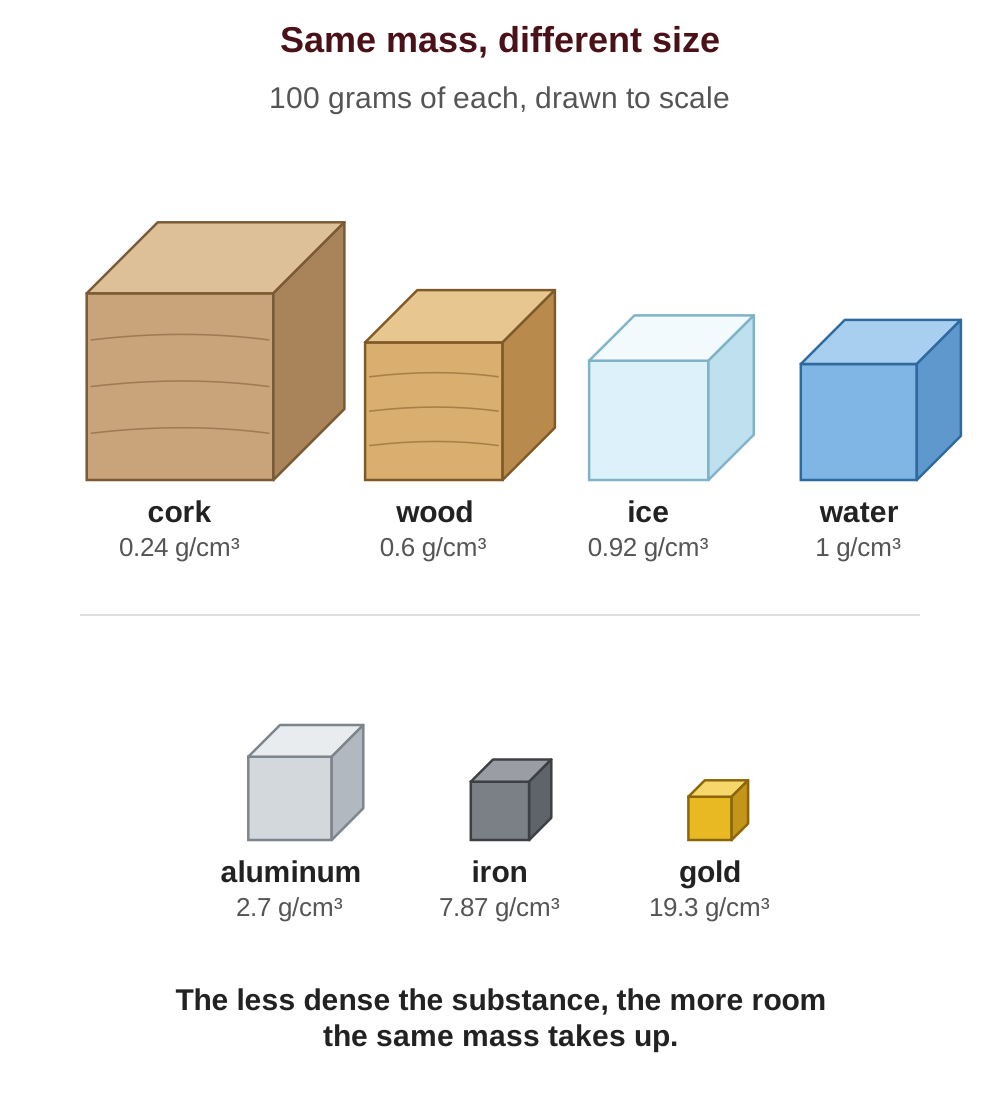
The picture below turns the table around. Instead of blocks of the same size, it shows the same mass of each substance, 100 grams, with each block drawn to scale. The less dense the substance, the bigger the block it takes to make 100 grams.
Floating and sinking
An object floats in a liquid if it is less dense than the liquid, and sinks if it is more dense. Wood (0.6) and cork (0.24) float in water (1.00); iron (7.87) sinks. Oil floats on water, which is why an oil spill spreads across the top of the sea. Liquids that do not mix settle in layers, with the densest at the bottom. Gases work the same way: a balloon filled with helium, which is much less dense than air, floats up.
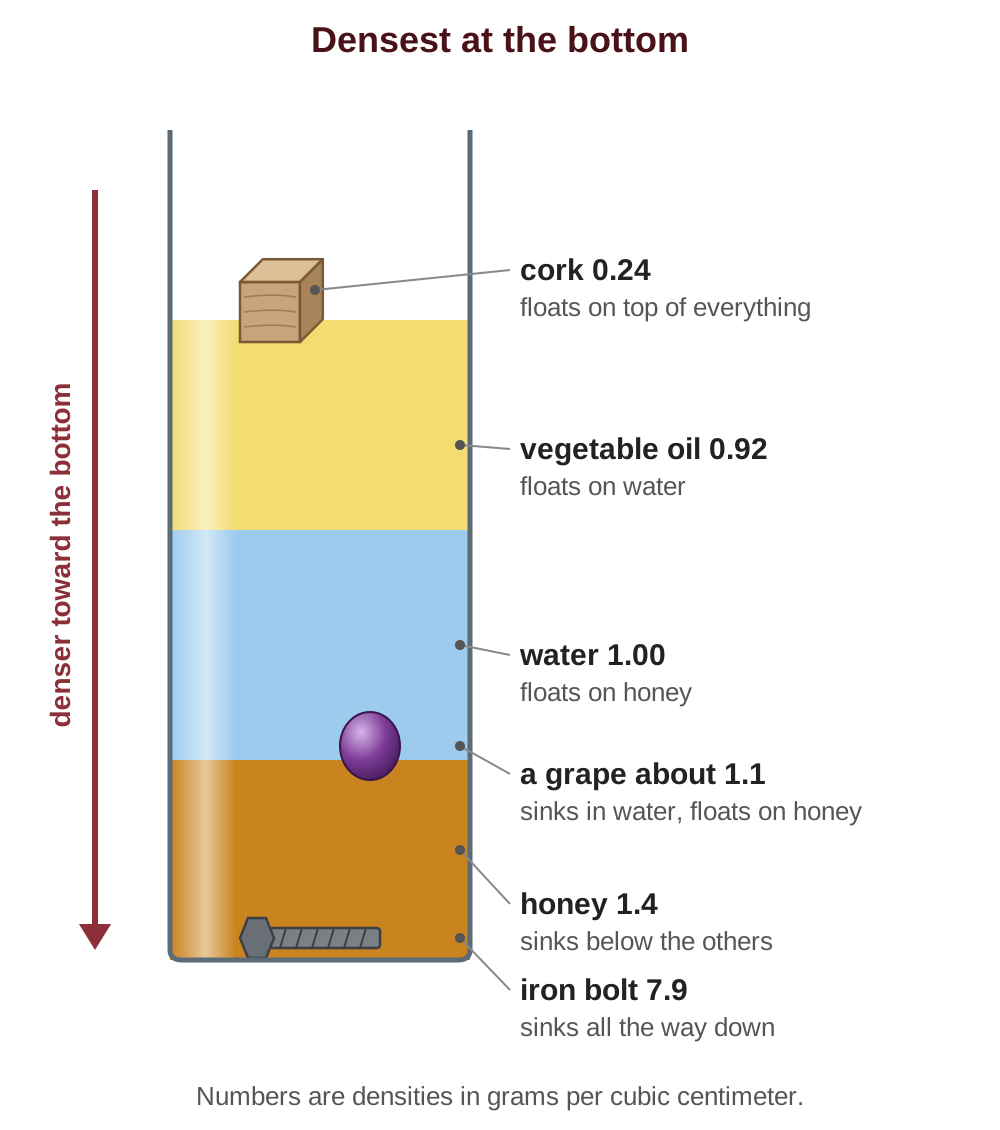
A steel ship floats even though steel is far denser than water, because a ship is mostly hollow. Its steel plus all the air inside it make up a large volume with an overall density less than water’s.
A gas can change its density
Squeeze a brick or a glass of water as hard as you like, and its volume hardly changes. A gas is different. Its particles are far apart, with empty space between them, so a gas can be squeezed into a smaller space or allowed to spread into a bigger one. The mass stays the same, but the volume changes, so the density changes too.
The cylinder below holds a gas, closed off by a plunger that can slide in and out. The gas is drawn as 60 dots, and each dot stands for 0.1 gram of air, so the cylinder holds 6 grams of air. (Each real dot’s worth of air would hold billions of billions of molecules.) Gases are so light that their volume is measured in liters (L) rather than cubic centimeters, and their density in grams per liter (g/L). One liter is 1,000 cubic centimeters, a little more than a quart.
Things to try:
- Press Squeeze until the volume is 2.5 liters, half of where it started. The mass is still 6 grams, so the density doubles, from 1.2 to 2.4 grams per liter. A bicycle pump and a scuba diver’s air tank work this way: they pack a lot of air into a small space.
- Press Let it expand. The same 6 grams spread out through more space, and the density goes down.
- Press Start over, then Heat it. The particles move faster and strike the plunger harder and more often, and they push it out. The volume grows, so the density drops below that of the room air around it, 1.2 grams per liter.
That last result is how a hot-air balloon flies. A burner heats the air inside the balloon. The warm air expands, and some of it spills out of the opening at the bottom, so the air left inside is less dense than the cooler air outside. Like a cork in water, the less dense balloon floats upward. Warm air rising over a stove or a radiator is the same thing on a small scale.
A gas can be squeezed or allowed to expand. The same mass in a smaller volume is denser; the same mass in a larger volume is less dense. Heating a gas makes it expand and become less dense, so warm air rises.
Why ice floats
In almost every substance, the solid is denser than the liquid, because the particles are packed more tightly. Water is a famous exception. When water freezes, its molecules lock into an open, six-sided pattern that takes up more room than the liquid did. Water expands by about 9 percent when it freezes. That is why ice (0.92) floats on water, and why a full bottle of water left in the freezer can crack.
This matters for life on Earth. When a lake freezes in winter, the ice forms on top and floats there, and it shields the water below from the cold air. Fish and plants survive the winter in the liquid water underneath. If ice sank, lakes would freeze from the bottom up.
Practice: density
Choose an answer, then press Check. The explanation opens either way.
A piece of metal has a mass of 54 grams and a volume of 20 cm³. What is its density?
54 ÷ 20 = 2.7 g/cm³. (0.37 comes from dividing the wrong way; 1,080 from multiplying.) By the table, this metal is probably aluminum.
An object has a density of 1.3 g/cm³. In water, it will
1.3 is more than water’s 1.00, so the object is denser than water and sinks.
A large piece of gold is cut in half. What happens to the density of each half?
Each half has half the mass and half the volume, so mass divided by volume is unchanged: 19.3 g/cm³. Density does not depend on the amount.
Physical and chemical changes
Properties
A property is a feature that describes a substance. Chemists sort properties into two kinds.
Physical properties are ones you can observe or measure without changing what the substance is: color, smell, hardness, whether it is a solid, liquid, or gas at room temperature, melting point, boiling point, density, and how well it dissolves in water.
Chemical properties describe how a substance can change into other substances: whether it burns, whether it rusts, how it reacts with acids or with oxygen. You can only observe a chemical property by letting the substance change. To find out whether paper burns, you have to burn some, and then it is not paper anymore.
Physical changes
In a physical change, a substance changes in form or appearance, but it is still the same substance. No new substance is made. Its molecules are the same before and after.
- Changes of state: ice melting, water boiling, steam condensing. Melted ice is still H2O.
- Changes of shape or size: cutting paper, crushing a can, grinding coffee beans, breaking glass.
- Dissolving: sugar dissolving in tea. The sugar molecules are still sugar; let the water evaporate and you get sugar back.
- Mixing and separating mixtures: stirring sand into water, then filtering it out again.
Many physical changes are easy to reverse: you can freeze the melted water again. (Not all are. You cannot un-break a glass, but the pieces are still glass.)
Chemical changes
In a chemical change, also called a chemical reaction, atoms are rearranged: bonds break, new bonds form, and new substances are made, with properties different from the substances you started with. When wood burns, the wood and the oxygen in the air become carbon dioxide, water vapor, and ash. When iron rusts, iron and oxygen become iron oxide, a crumbly reddish-brown solid.
You cannot see atoms rearranging, but there are signs that a chemical change has happened:
- A new color that is not just from mixing colors: an apple slice turning brown, a copper roof turning green, bread browning in a toaster.
- Bubbles of gas, when nothing is being boiled: baking soda fizzing in vinegar, an antacid tablet fizzing in water.
- Light or heat given off, or heat taken in: a candle flame, fireworks, a log fire.
- A solid forming when two liquids are mixed. This solid is called a precipitate. Milk curdling when lemon juice is added is an example.
- A new smell: food rotting or burning.
- Hard or impossible to reverse: you cannot un-cook an egg or un-burn a match.
One sign alone is not proof. Boiling water makes bubbles, and a light bulb gives off light, but both are physical changes. Ask the real question: has a new substance been made?
| Change | Physical or chemical? | Why |
|---|---|---|
| Ice melting | physical | still water, in a different state |
| Sugar dissolving in water | physical | still sugar; you can get it back by evaporating the water |
| Paper being torn | physical | still paper, in smaller pieces |
| Paper burning | chemical | becomes ash, smoke, and gases; heat and light given off |
| Iron rusting | chemical | iron and oxygen become a new substance, iron oxide |
| An egg cooking | chemical | the proteins change permanently; the egg cannot be un-cooked |
| Baking soda fizzing in vinegar | chemical | a new gas, carbon dioxide, is made |
| Water boiling | physical | the bubbles are water vapor, still H2O |
A physical change alters the form of a substance but makes nothing new. A chemical change makes new substances. Signs of a chemical change include a new color, gas bubbles, light or heat, a solid forming from liquids, and a new smell.
A question may describe what happens in an experiment and ask whether it was a physical or a chemical change. Look in the passage for evidence that a new substance was made, and be careful with bubbles and heat: boiling and melting have them too.
Practice: physical or chemical?
Choose an answer, then press Check. The explanation opens either way.
Milk left out for a week turns sour and lumpy and smells bad.
New substances are made: a new smell and a solid forming are both signs of a chemical change.
Butter melts in a hot pan.
Melting is a change of state. It is still butter, and it will harden again when cooled.
A match is struck and burns.
Light and heat are given off, and the match head and wood become ash and gases. The change cannot be reversed.
Salt is stirred into water until it disappears.
Dissolving is a physical change. Evaporate the water and the salt is still there.
Chemical equations and the conservation of mass
Chemists describe a reaction with a chemical equation. It uses chemical formulas to show what you start with and what you end with. Here is the equation for burning methane, the main gas in natural gas, which is what burns on a gas stove:
CH4 + 2O2 → CO2 + 2H2O
- The substances on the left, the ones you start with, are the reactants: methane and oxygen.
- The substances on the right, the ones that are made, are the products: carbon dioxide and water.
- The arrow means “react to make” or “yield.” Read the equation as: one molecule of methane and two molecules of oxygen react to make one molecule of carbon dioxide and two molecules of water.
- The plus signs mean “and.”
Sometimes an equation adds a small note in parentheses after each formula to show its state: (s) for solid, (l) for liquid, (g) for gas, and (aq) for dissolved in water. (Aq is short for aqueous, from the Latin word for water.)
Conservation of mass
In the 1770s, the French chemist Antoine Lavoisier weighed substances very carefully before and after reactions, in sealed containers so that no gas could get in or out. He found that the total mass never changed. This is the law of conservation of mass: in a chemical reaction, matter is neither created nor destroyed. The total mass of the products equals the total mass of the reactants.
Atoms explain why. A chemical reaction only rearranges atoms: it breaks some bonds and makes others. Every atom present at the start is still there at the end, just joined to different partners. No atom appears from nowhere, and none disappears. So in a correct equation, every kind of atom must be counted the same on both sides. Count the atoms in the methane equation:
| Atoms of | Left side (reactants) | Right side (products) |
|---|---|---|
| Carbon | CH4: 1 | CO2: 1 |
| Hydrogen | CH4: 4 | 2H2O: 2 × 2 = 4 |
| Oxygen | 2O2: 2 × 2 = 4 | CO2: 2, plus 2H2O: 2, total 4 |
One carbon, four hydrogen, and four oxygen on each side. An equation with the same count of every atom on both sides is called balanced.
A log that burns leaves only a small pile of ash. Did mass disappear? No. Most of the log combined with oxygen from the air and became carbon dioxide and water vapor, which floated away as gases. If you could catch all the gases and weigh them with the ash, the total would equal the mass of the log plus the oxygen it used. When a reaction seems to gain or lose mass, look for a gas going out or coming in.
Coefficients and subscripts: two different numbers
A chemical equation has two kinds of numbers, and they mean very different things.
- A subscript is the small number low after a symbol, inside a formula. It is part of what the substance is. H2O is water. H2O2, with one more subscript, is hydrogen peroxide, a different substance entirely: a bleach and disinfectant. Change a subscript and you have changed the substance.
- A coefficient is the large number in front of a formula. It tells how many molecules of that substance there are. 2H2O is two molecules of water. A coefficient multiplies every atom in the formula after it. Change a coefficient and you have changed only the amount.
In a reaction, atoms are rearranged but never created or destroyed, so mass is conserved. A balanced equation has the same number of each kind of atom on both sides. To balance an equation, change only the coefficients, never the subscripts.
Balancing an equation
Balancing an equation means choosing the coefficients so that every kind of atom is counted the same on both sides. You do it by careful counting, adjusting one number at a time. Here is the method, worked through for the reaction that makes water from hydrogen gas and oxygen gas.
Balance: H2 + O2 → H2O
Step 1. Count each kind of atom on each side. Left: 2 hydrogen, 2 oxygen. Right: 2 hydrogen, 1 oxygen. The oxygen does not match.
Step 2. Change a coefficient to fix one kind of atom. There are 2 oxygen atoms on the left, so we need 2 on the right. We cannot change H2O to H2O2 (that would be a different substance), so we put a 2 in front: 2H2O. Now the right side has 2 oxygen and 2 × 2 = 4 hydrogen.
Step 3. Count again. Left: 2 hydrogen, 2 oxygen. Right: 4 hydrogen, 2 oxygen. Now the hydrogen does not match.
Step 4. Fix that one. Put a 2 in front of H2 on the left: 2H2 gives 4 hydrogen.
Step 5. Count one last time. Left: 4 hydrogen, 2 oxygen. Right: 4 hydrogen, 2 oxygen. Balanced:
2H2 + O2 → 2H2O. (A coefficient of 1 is not written.)
Fixing one kind of atom often upsets another, so you go back and forth. That is normal. Keep counting until everything matches, and use the smallest whole numbers that work.
Try it: the equation balancer
Choose a reaction. Press + and − to change the coefficient in front of each formula. The pictures show the molecules, one for each count, and the table counts every kind of atom on each side. When every row says “same,” the equation is balanced.
The GED test may ask you to tell whether an equation is balanced, or to choose the missing coefficient. Make a quick count of each kind of atom on each side, as in the table above. Remember to multiply by the coefficient.
Practice: balanced or not?
Choose an answer, then press Check. The explanation opens either way.
Is this equation balanced? 2Na + Cl2 → 2NaCl
Left: 2 sodium, 2 chlorine. Right: 2 × NaCl = 2 sodium, 2 chlorine. Balanced.
Is this equation balanced? N2 + H2 → 2NH3
Nitrogen: 2 on each side. Hydrogen: 2 on the left, but 2 × 3 = 6 on the right. It needs 3H2 on the left.
What coefficient belongs in the blank? 2Mg + O2 → __MgO
The left has 2 magnesium and 2 oxygen. Each MgO has one of each, so it takes 2MgO.
A student balances H2 + O2 → H2O by writing H2 + O2 → H2O2. What is wrong?
The atoms do match, but the equation no longer describes making water. Only coefficients may be changed when balancing.
The limiting reactant: what runs out first
Suppose you are making cheese sandwiches. Each one takes 2 slices of bread and 1 slice of cheese. You have 10 slices of bread and 3 slices of cheese. How many sandwiches can you make?
The bread is enough for 5 sandwiches, but the cheese is enough for only 3. So you make 3 sandwiches, and you have 4 slices of bread left over. The cheese decided how many you could make, because it ran out first.
Chemical reactions work the same way. The reactants combine in fixed proportions, given by the coefficients of the balanced equation. The reactant that runs out first is called the limiting reactant, because it limits how much product can be made. Whatever is left over of the other reactants is called the excess.
The equation for making water is 2H2 + O2 → 2H2O. A container holds 6 molecules of hydrogen and 2 molecules of oxygen. Which runs out first, and how much water is made?
The equation says each oxygen molecule needs 2 hydrogen molecules. The 2 oxygen molecules need 2 × 2 = 4 hydrogen molecules, and there are 6, so there is enough hydrogen.
So the oxygen runs out first: it is the limiting reactant. Each oxygen molecule makes 2 water molecules, so 2 oxygen molecules make 4 water molecules. 6 − 4 = 2 hydrogen molecules are left over.
This is why a gas burner turns yellow and smoky when it gets too little air: with oxygen as the limiting reactant, some of the fuel cannot burn completely. It is also why a fire goes out when you smother it: you have cut off the oxygen.
The limiting reactant is the one that runs out first. It decides how much product is made. The other reactants are left over.
Practice: what runs out first?
Choose an answer, then press Check. The explanation opens either way.
A bicycle needs 1 frame and 2 wheels. A shop has 8 frames and 12 wheels. How many bicycles can it build?
12 wheels are enough for 12 ÷ 2 = 6 bicycles. The 8 frames would allow 8. The wheels run out first, so 6 bicycles, with 2 frames left over.
2H2 + O2 → 2H2O. You start with 4 molecules of hydrogen and 5 molecules of oxygen. Which is the limiting reactant?
4 hydrogen molecules need only 2 oxygen molecules. There are 5, so oxygen is in excess and hydrogen runs out first. 4 water molecules are made, and 3 oxygen molecules are left.
Reactions in living things and in daily life
Chemical reactions are going on all around you and inside you. A few of them come up again and again on the GED test.
Photosynthesis
Green plants, algae, and some bacteria use the energy of sunlight to turn carbon dioxide and water into sugar (glucose) and oxygen:
6CO2 + 6H2O + light energy → C6H12O6 + 6O2
The energy of the light is stored in the bonds of the sugar. Nearly all the food on Earth, and nearly all the oxygen in the air, comes from this reaction.
Cellular respiration
Your cells, and the cells of almost every living thing, release the energy stored in sugar by combining it with oxygen. This is the same equation run the other way:
C6H12O6 + 6O2 → 6CO2 + 6H2O + energy
That is why you breathe in oxygen and breathe out carbon dioxide. (The life science guide Photosynthesis and Cellular Respiration follows both reactions in detail.) Reaction 6 in the balancer above is respiration: 6 carbon, 12 hydrogen, and 18 oxygen atoms on each side. Photosynthesis has the same atoms, on opposite sides.
Burning (combustion)
Combustion is a fast reaction with oxygen that gives off heat and light. When a fuel made of carbon and hydrogen burns completely, the products are carbon dioxide and water. The methane equation in Part 10 is one example; burning gasoline, wood, or candle wax is another. Respiration is a slow, controlled cousin of burning: the same kind of fuel, the same products, but the energy is released in small steps that a cell can use, instead of all at once as fire.
Rusting
Iron combines slowly with oxygen, when water is present, to make iron oxide, or rust: 4Fe + 3O2 → 2Fe2O3. Paint, oil, and a coating of zinc (on “galvanized” steel) protect iron by keeping air and water away from it.
Baking soda and vinegar
Baking soda (sodium bicarbonate) reacts with vinegar (a weak acid) to make carbon dioxide gas, water, and a dissolved salt. The fizzing is the carbon dioxide. The same reaction, between baking soda and an acid in the batter such as buttermilk, makes the bubbles that puff up pancakes and quick breads.
Photosynthesis stores the energy of sunlight in sugar. Respiration releases it. Combustion is fast burning with oxygen, making carbon dioxide and water from fuels. Rusting is a slow reaction of iron with oxygen.
Energy in reactions
Every chemical reaction involves energy. Breaking a chemical bond takes energy; forming a new bond gives off energy. Whether a reaction gives off energy or takes it in overall depends on which is bigger: the energy given off by the new bonds, or the energy taken to break the old ones.
- An exothermic reaction gives off energy, usually as heat, sometimes as light. (Exo means out, and thermic means heat: heat goes out.) The surroundings get warmer. Burning, respiration, and rusting are exothermic. The hand warmers sold in winter contain iron powder that rusts very quickly when you open the packet and let air in, and the heat it gives off warms your hands.
- An endothermic reaction takes in energy. (Endo means in.) The energy must come from somewhere: from heat in the surroundings, which then get colder, or from light or electricity. Photosynthesis is endothermic: it takes in the energy of sunlight. Cooking an egg and baking a cake are endothermic too: they only happen while heat keeps flowing in. Instant cold packs, used for sports injuries, get cold because the chemical inside takes in heat as it dissolves in water. (Strictly, dissolving is a physical change, not a reaction, but it takes in heat in the same way.)
Energy diagrams
An energy diagram shows how much energy is stored in the chemicals as a reaction goes on, from start (left) to finish (right).
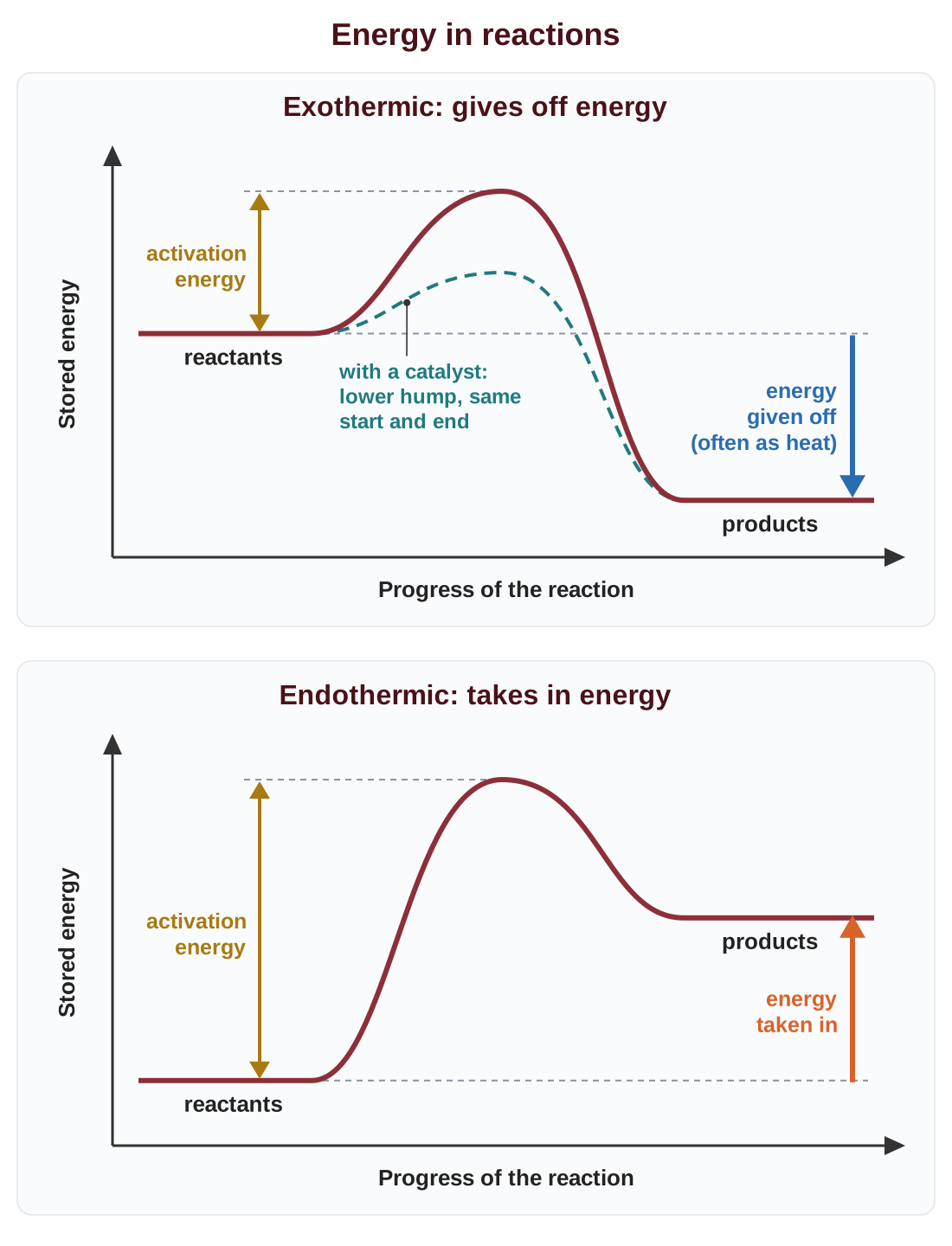
In the exothermic diagram, the products end lower than the reactants. The difference is the energy given off. In the endothermic diagram, the products end higher. The difference is the energy taken in.
The hump: activation energy
Both diagrams have a hump in the middle. Even a reaction that will give off a lot of energy needs a push to get started, because some old bonds have to start breaking before new ones can form. This starting push is called the activation energy. A match will not light until you strike it; the friction supplies the activation energy. Wood does not burst into flame on its own in the air, even though burning gives off plenty of energy, until a flame or spark gives it enough to start. After that, the heat from the burning keeps supplying the push.
Exothermic reactions give off energy (the products end lower). Endothermic reactions take in energy (the products end higher). Every reaction needs some activation energy to get started.
Practice: exothermic or endothermic?
Choose an answer, then press Check. The explanation opens either way.
A campfire burning
Burning gives off heat and light, so it is exothermic.
Photosynthesis in a leaf
Photosynthesis takes in the energy of sunlight and stores it in sugar, so it is endothermic.
On an energy diagram, the products end higher than the reactants. The reaction
The products hold more energy than the reactants, so energy had to be taken in: endothermic.
How fast reactions go: rates, catalysts, and enzymes
Some reactions, like an explosion, are over in a split second. Others, like rusting, take years. For a reaction to happen, particles of the reactants have to collide, and hit hard enough to supply the activation energy. Anything that makes those collisions more frequent or more forceful speeds a reaction up.
- Higher temperature. Particles move faster, so they collide more often and harder. Food spoils more slowly in a refrigerator, because the reactions that spoil it slow down in the cold. Cooking on high heat is faster than on low.
- Higher concentration. More particles crowded into the same space means more collisions. A fire burns more fiercely in pure oxygen than in air, which is only about one-fifth oxygen.
- More surface area. A reaction with a solid happens only at its surface, where the particles can be reached. Break the solid into smaller pieces and you expose much more surface. Granulated sugar dissolves faster than a sugar cube; small sticks catch fire faster than a log. Fine flour dust floating in the air can even burn so fast that it explodes, which is a real danger in flour mills and grain elevators.
- Stirring or shaking. Stirring keeps bringing fresh reactant particles together.
Catalysts
A catalyst is a substance that speeds up a reaction without being used up itself. It works by giving the reaction an easier path, one with a lower activation energy. Look back at the dashed line in the exothermic energy diagram above: with a catalyst, the hump is lower, but the reactants and the products are the same, and the energy given off is the same. Because the catalyst is not used up, a small amount can be used over and over.
The catalytic converter on a car’s exhaust pipe contains the metals platinum, palladium, and rhodium. They speed up reactions that turn poisonous exhaust gases, such as carbon monoxide, into less harmful ones, such as carbon dioxide.
Enzymes: the body’s catalysts
Living things depend on catalysts called enzymes. An enzyme is a protein that speeds up one particular reaction in a living thing. Without enzymes, the reactions of life would be far too slow at body temperature to keep anything alive. Amylase, an enzyme in your saliva, starts breaking the starch in bread down into sugar while you chew. (Chew a piece of plain bread for a minute or two, and it begins to taste sweet.) Other enzymes in your stomach and intestines break down proteins and fats.
Each enzyme works on one particular substance, the way a key fits one lock. And each works best in a narrow range of temperature and pH (Part 16). A very high fever is dangerous partly because heat can change the shape of enzymes so they stop working.
Reactions go faster with higher temperature, higher concentration, more surface area, and stirring. A catalyst speeds a reaction by lowering its activation energy, and is not used up. Enzymes are the catalysts in living things.
Acids, bases, and pH
Lemon juice and vinegar taste sour. Soap feels slippery. The sourness comes from acids; the slipperiness comes from bases. Acids and bases are two important families of compounds, and they are opposites.
| Acids | Bases | |
|---|---|---|
| Taste (never taste lab chemicals!) | sour | bitter |
| Feel | strong ones burn the skin | slippery; strong ones also burn |
| Litmus paper (a test strip) | turn blue litmus red | turn red litmus blue |
| pH | below 7 | above 7 |
| Examples | lemon juice, vinegar, soda, stomach acid, battery acid | baking soda, soap, ammonia, bleach, drain cleaner |
Acids and bases are everywhere. Your stomach makes hydrochloric acid to help digest food. Car batteries contain sulfuric acid. Ammonia and many cleaning products are bases, and so are the lye in drain cleaner and the lime gardeners spread on soil.
Bases that dissolve in water are also called alkaline. Strong acids and strong bases can both burn skin and eyes, which is why drain cleaner and battery acid carry warning labels.
The pH scale
Chemists measure how acidic or basic a solution is on the pH scale, which runs from 0 to 14.
- pH 7 is neutral: neither acidic nor basic. Pure water has a pH of 7.
- Below 7 is acidic. The lower the number, the stronger the acid.
- Above 7 is basic (alkaline). The higher the number, the stronger the base.
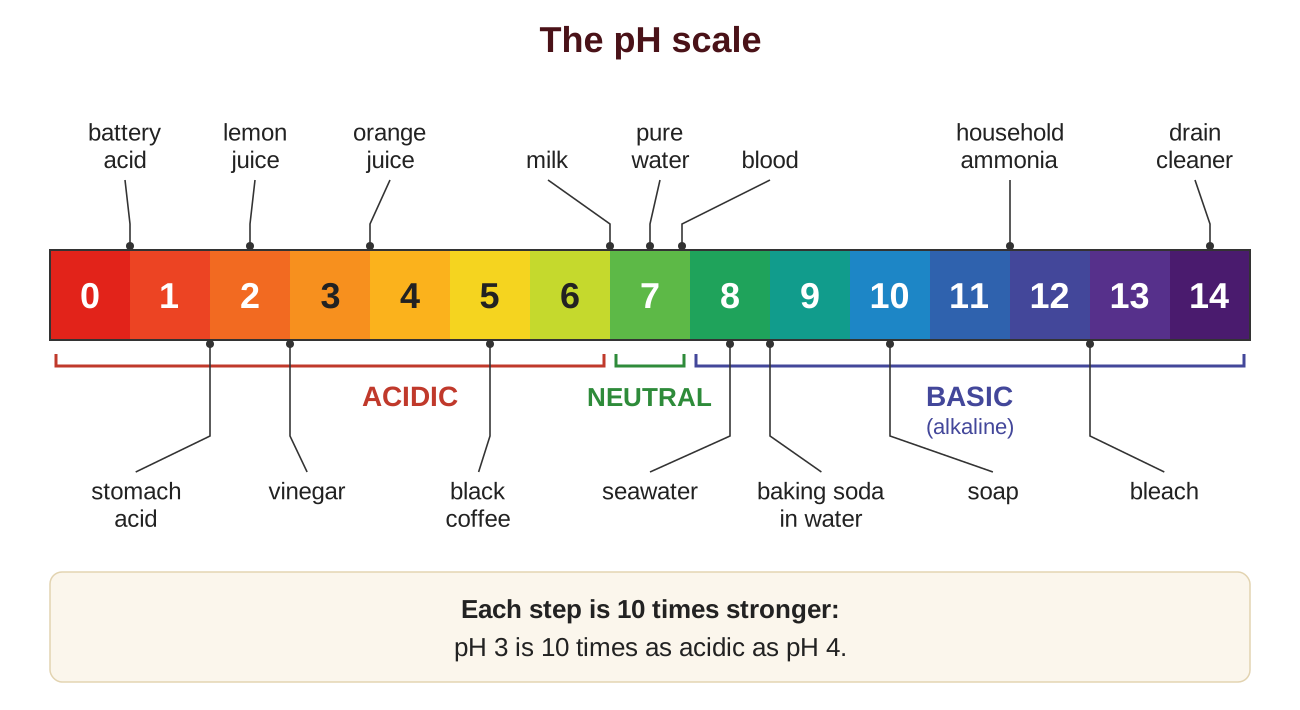
Each step on the pH scale is ten times stronger than the one next to it. A solution with pH 3 is 10 times as acidic as one with pH 4, and 10 × 10 = 100 times as acidic as one with pH 5. So the difference between lemon juice (pH 2) and black coffee (pH 5) is not small: lemon juice is 10 × 10 × 10 = 1,000 times as acidic.
The pH of the body is kept within narrow limits. Blood stays between about 7.35 and 7.45, slightly basic. If it moves much outside that range, enzymes stop working properly, and a person becomes seriously ill.
Neutralization
When an acid and a base are mixed, they cancel each other out. This reaction is called neutralization, and it makes water and a salt. (In chemistry, a salt is any ionic compound made this way; table salt is just one of them.) Hydrochloric acid and sodium hydroxide, a strong base, make water and ordinary table salt:
HCl + NaOH → NaCl + H2O
Antacid tablets work by neutralization. Many contain calcium carbonate, the compound from Chemistry 1, which acts as a base. When too much stomach acid causes heartburn, the antacid neutralizes some of it:
CaCO3 + 2HCl → CaCl2 + H2O + CO2
The carbon dioxide is why antacids can make you burp. Farmers use the same idea when they spread lime, a base, on soil that has become too acidic for their crops.
Acids have a pH below 7; bases have a pH above 7; 7 is neutral. Each step on the pH scale is ten times stronger. An acid and a base neutralize each other, making water and a salt.
Going further: what makes an acid an acid?
When an acid dissolves in water, it releases hydrogen ions, H+: hydrogen atoms that have lost their one electron. The more hydrogen ions in the solution, the more acidic it is, and the lower its pH. A base does the opposite: it releases hydroxide ions, OH−, or takes up hydrogen ions. In neutralization, the H+ from the acid and the OH− from the base join to make H2O, water. When the pH scale says one solution is ten times as acidic as another, it means the first has ten times as many hydrogen ions in the same amount of water.
You can make your own pH indicator. Boil chopped red cabbage in water and strain it. The purple liquid turns pink or red in acids (add vinegar) and green or yellow in bases (add baking soda).
Practice: acids, bases, and pH
Choose an answer, then press Check. The explanation opens either way.
A solution has a pH of 9. It is
Above 7 is basic (alkaline).
How many times as acidic is a solution with pH 2 as a solution with pH 4?
Two steps down the scale: 10 × 10 = 100 times as acidic.
What are the products when an acid neutralizes a base?
Neutralization makes water and a salt, such as HCl + NaOH → NaCl + H2O.
The terms in this guide
Pure substance a single element or compound, with a makeup that is always the same.
Mixture two or more substances mixed together but not chemically bonded; each keeps its own properties.
Homogeneous mixture a mixture that is the same throughout, such as salt water or air.
Heterogeneous mixture a mixture that is not the same throughout, such as salad or sand in water.
Filtering separating an undissolved solid from a liquid by pouring it through a material with tiny holes.
Evaporation a liquid turning into a gas at its surface; it happens at any temperature.
Distillation separating liquids by boiling off the one with the lower boiling point and cooling the gas back into a liquid.
Solution a mixture that is the same throughout, with one substance dissolved in another.
Solute the substance that dissolves.
Solvent the substance that does the dissolving, usually the one there is more of.
Dissolve to break up and spread evenly through a solvent.
Concentration how much solute is in a certain amount of solution; more generally, how crowded the particles of something are in a space.
Diffusion the spreading of particles from where they are crowded (high concentration) to where they are fewer (low concentration).
Dilute having little solute (as an action: to add solvent, which lowers the concentration).
Concentrated having a lot of solute.
Solubility the most of a substance that can dissolve in a certain amount of solvent at a certain temperature.
Saturated holding all the solute it can at that temperature.
Unsaturated able to dissolve more solute.
States of matter solid, liquid, and gas (and, at extreme temperatures, plasma).
Melting a solid turning into a liquid.
Freezing a liquid turning into a solid.
Boiling a liquid turning into a gas throughout, at its boiling point.
Condensation a gas turning into a liquid.
Sublimation a solid turning directly into a gas, like dry ice.
Deposition a gas turning directly into a solid, like frost.
Melting point, boiling point the temperatures at which a substance melts and boils. For water, 0°C and 100°C.
Heating curve a graph of temperature against time as a substance is heated; its flat parts are the changes of state.
Density mass divided by volume; how much mass is packed into a certain space.
Physical property a feature you can observe or measure without changing the substance, such as color or density.
Chemical property how a substance can change into other substances, such as whether it burns.
Physical change a change in form or appearance that makes no new substance.
Chemical change (chemical reaction) a change in which atoms are rearranged and new substances are made.
Precipitate a solid that forms when two liquids are mixed.
Chemical equation a description of a reaction in chemical formulas, with reactants on the left and products on the right.
Reactants the substances you start with in a reaction.
Products the substances made in a reaction.
Law of conservation of mass in a chemical reaction, matter is neither created nor destroyed; the mass of the products equals the mass of the reactants.
Balanced equation an equation with the same number of each kind of atom on both sides.
Coefficient the large number in front of a formula; it tells how many molecules there are.
Subscript the small number low in a formula; it tells how many atoms of that element are in one molecule.
Limiting reactant the reactant that runs out first, and so limits how much product is made.
Photosynthesis the reaction in which plants use light energy to make sugar and oxygen from carbon dioxide and water.
Cellular respiration the reaction in which cells release energy from sugar using oxygen, giving off carbon dioxide and water.
Combustion burning: a fast reaction with oxygen that gives off heat and light.
Exothermic giving off energy, usually as heat.
Endothermic taking in energy.
Activation energy the energy needed to get a reaction started.
Energy diagram a graph of the energy stored in the chemicals as a reaction goes from start to finish.
Catalyst a substance that speeds up a reaction by lowering its activation energy, without being used up.
Enzyme a protein that acts as a catalyst in a living thing.
Acid a compound that tastes sour, turns blue litmus red, and has a pH below 7.
Base (alkali) a compound that tastes bitter, feels slippery, turns red litmus blue, and has a pH above 7.
pH scale a scale from 0 to 14 that measures how acidic or basic a solution is; 7 is neutral, and each step is ten times stronger.
Neutral neither acidic nor basic; pH 7.
Neutralization the reaction of an acid with a base, making water and a salt.
17 questions on this guide
Check yourself
Choose an answer, then press Check. The explanation opens either way.
Which of these is a mixture?
Air is several gases, mostly nitrogen and oxygen, mixed but not bonded. Table salt and water are compounds; oxygen is an element.
A cook wants the salt back from a pot of salt water. Which method works?
Dissolved salt passes through a filter. Evaporating the water leaves the salt behind.
In a glass of lemonade, the sugar is the
The sugar is what gets dissolved, so it is the solute. The water does the dissolving, so it is the solvent.
Using the solubility graph, about how many grams of potassium nitrate will dissolve in 100 g of water at 60°C?
At 60°C the potassium nitrate line is at about 110 grams. (37 is table salt at 60°C; 64 is potassium nitrate at 40°C; 169 is at 80°C.)
Why does a cold soda keep its fizz longer than a warm one?
Gases dissolve better in cold liquids. In a warm soda, the carbon dioxide comes out of solution and escapes.
In which state are the particles close together but able to slide past one another?
That describes a liquid, which flows and takes the shape of its container but keeps its volume.
Frost forms on a car window on a cold night, as water vapor in the air turns directly into ice. This change is called
Gas straight to solid is deposition. (Sublimation is the reverse: solid straight to gas, like dry ice.)
While a pot of water is boiling, its temperature stays at 100°C even though the burner is still on. Where is the heat going?
The energy frees the molecules from each other so they can become a gas. The molecules themselves stay H2O; boiling is a physical change.
A stone has a mass of 45 g. It raises the water in a measuring cylinder from 30 mL to 45 mL. What is its density?
Volume = 45 − 30 = 15 mL. Density = 45 g ÷ 15 mL = 3 g/mL.
Why does ice float on water?
Water molecules lock into an open pattern when they freeze, so ice takes up more room and is less dense (0.92 g/cm³) than liquid water (1.00).
Which is a sign that a chemical change has happened?
A solid forming from two liquids, a precipitate, is a sign of a new substance. The others are physical changes; boiling makes bubbles, but they are still water.
A sealed jar holds 50 grams of reactants. A reaction takes place inside the sealed jar. What is the mass of the jar’s contents afterward?
By the law of conservation of mass, atoms are only rearranged, and in a sealed jar nothing can get in or out. The mass stays 50 grams.
In the equation 3O2 → 2O3, how many oxygen atoms are on each side?
Left: 3 × 2 = 6. Right: 2 × 3 = 6. The equation is balanced. (O3 is ozone.)
An energy diagram shows the products at a lower energy than the reactants. Which is true?
Products lower than reactants means energy was given off: exothermic. Every reaction still has an activation energy hump.
Chalk (calcium carbonate) fizzes in vinegar. Which change would make the reaction go fastest?
Powder has much more surface area, so more particles can be reached by the acid at once. Cooling and diluting would slow the reaction down.
What does a catalyst do?
A catalyst gives the reaction an easier path with a lower hump. The starting and ending substances, and the energy given off, stay the same.
Stomach acid has a pH of about 2. Milk has a pH of about 6. How many times as acidic is stomach acid as milk?
Four steps on the pH scale: 10 × 10 × 10 × 10 = 10,000 times as acidic.